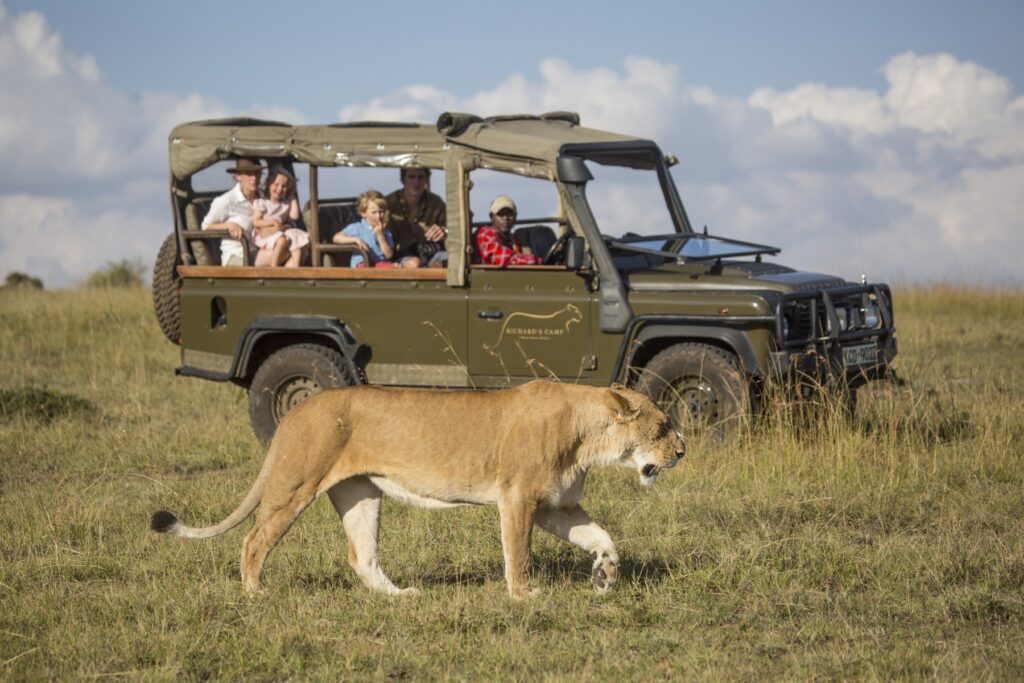
Big Five Game Drives in Tanzania: The Ultimate Safari Guide
A Big Five game drive is a guided wildlife excursion in an open 4×4 safari vehicle, specifically aimed at spotting the five most iconic and historically most dangerous large mammals in Africa: the lion, leopard, African elephant, African buffalo, and black or white rhinoceros. The term ‘Big Five’ was coined by big-game hunters in the 19th century to describe the five animals that were considered the most difficult and dangerous to hunt on foot. Today it defines the pinnacle ambition of every safari traveler. Tanzania is one of the best countries on Earth to complete a Big Five sighting on a single safari, with its combination of the Serengeti National Park, Ngorongoro Crater, Tarangire National Park, Lake Manyara National Park, and Ruaha National Park covering habitat for all five species. Completing the Big Five is not guaranteed on any one game drive, but a well-planned 5–7-day private Tanzania safari with experienced guides dramatically increases the odds. Most of our clients complete the Big Five within 3–4 days of guided game drives.
Big Five Game Drives in Tanzania Quick Facts
| The Big Five | Lion, Leopard, African Elephant, African Buffalo, Black/White Rhinoceros |
| Best Destination | Serengeti, Ngorongoro Crater, Tarangire, Lake Manyara, Ruaha, Nyerere |
| Game Drive Types | Morning drive (dawn–10am), afternoon drive (3pm–dusk), night drive (select parks) |
| Vehicle Type | Custom 4WD Toyota Land Cruiser with pop-up roof; max 6 guests, private |
| Best Season | June–October (dry season): peak wildlife concentration at waterholes |
| Average Duration | Morning drives: 3–4 hrs. Full-day drives: 8–10 hrs. Sundowner: 2–3 hrs |
| Success Rate | 4–5 of Big Five typically seen within 5–7 days; Ngorongoro has highest density |
| Rhino Situation | Black rhino: rare; best seen in Ngorongoro Crater (~30 individuals). White rhino: not in TZ wild |
| Park Fees (2025) | Serengeti: $70/pp/day. Ngorongoro: $100/pp/day. Tarangire: $53.10/pp/day |
| ATOL Protected | Yes, all bookings with Luxury Safaris Tanzania are ATOL-protected |
| Expert Guides | KINAPA-licensed & TANAPA-registered; 12+ years, 10,000+ happy travelers |
| Languages | English, Swahili; French, German, Italian guides available on request |
Why Tanzania Is the World’s Premier Big Five Safari Destination
There is a specific quality of silence that settles over an open safari vehicle when a leopard drops from an acacia branch twenty metres ahead. The engine cuts. Nobody speaks. And for a moment, the entirety of the natural world, the burnished Serengeti light, the tick of cooling metal, the leopard’s amber gaze, exists only for you. That is what a private Big Five game drive in Tanzania delivers, over and over, in ways no photograph fully captures.
Tanzania’s unmatched wildlife density is the result of geography, conservation, and sheer ecological scale. Covering 945,087 km² of some of Africa’s most protected wilderness, the country is home to roughly 4 million large mammals, more than any other nation on the continent. Its national parks and game reserves span habitats from open savannah to dense riverine forest, from ancient volcanic craters to sweeping semi-arid bushlands, providing ideal territory for all five species. And crucially, unlike Kenya or South Africa, Tanzania’s parks remain vast, wild, and outside peak season remarkably uncrowded.
At Luxury Safaris Tanzania, our KINAPA-licensed expert guides have spent more than 12 years tracking the Big Five across Tanzania’s finest wilderness areas. With over 10,000 happy travelers guided and full ATOL protection on every booking, we know exactly where each species ranges, when to find them, and how to position your vehicle for the most rewarding encounter. This guide covers everything you need to know: what the Big Five are, where to find them, which Tanzania safari parks offer the best sightings, and how to design the ideal game drive itinerary.
|
→ Design Your Private Big Five Safari: Talk to Our Experts Today |
Meet the Big Five: Africa’s Most Iconic Wildlife
Understanding each species, its behavior, habitat, and where it concentrates in Tanzania transforms a game drive from a tick-list exercise into a genuine wildlife encounter. Here is what our guides know about each of the Big Five, drawn from thousands of hours in the field.
1. The African Lion (Panthera leo): King of the Savannah
Tanzania is home to approximately 40% of Africa’s remaining wild lion population, an estimated 14,000–16,000 individuals, making it one of the most important lion strongholds on Earth. Lions are the only truly social big cats, living in prides of 4–40 individuals with a complex hierarchy of females, cubs, and dominant males. Our guides track lions primarily by sound (their 114-decibel roar carries up to 8 km at dawn) and by reading the behavior of prey animals, particularly Thomson’s gazelles and wildebeest that freeze and stare in the direction of a hidden predator.
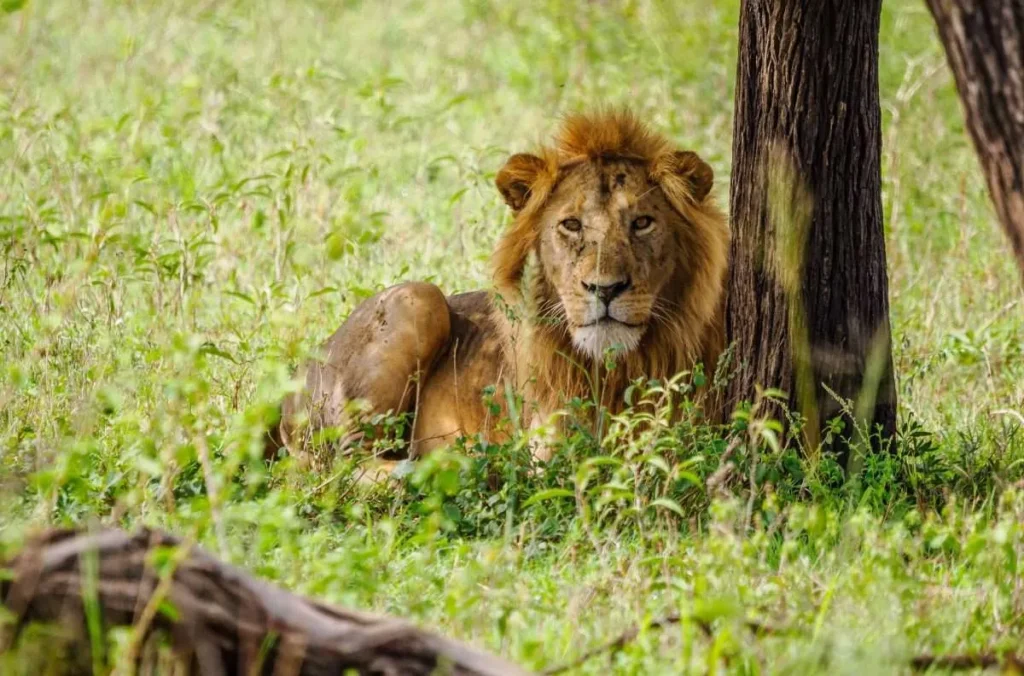
Prime locations: Lions are most reliably found in the central and northern Serengeti National Park, particularly around the Seronera River, where prey is year-round. The Ngorongoro Crater holds one of Africa’s most genetically distinct lion populations: approximately 60–70 individuals in one of the world’s most spectacular natural arenas. Ruaha National Park supports the largest lion population in East Africa, with prides regularly numbering 20+ animals in the remote south.
Expert tip: Early morning (6–8am) is the best time to find lions active and hunting. By mid-morning they typically seek shade under acacia trees or in long grass, making them harder to spot. If you see vultures spiraling on a thermal, follow them; there is often a kill underneath, with lions or leopards feeding nearby.
2. The African Leopard (Panthera pardus): Master of Concealment
The leopard is the most elusive of the Big Five and, for many of our clients, the most coveted sighting. Leopards are solitary, nocturnal, and very well camouflaged, and they can be found in almost every habitat across Tanzania, from the riverine forest of Lake Manyara National Park to the kopje-studded plains of the Serengeti. However, seeing one requires patience, knowledge of their territory, and experienced eyes scanning every tree branch and shadow.

Tanzania’s leopard population is estimated at 1,000–2,000+ individuals, concentrated in areas of mixed woodland and rocky outcrops. The Seronera Valley in the central Serengeti is East Africa’s premier leopard-viewing location: resident animals here are habituated to vehicles and frequently lounge in sausage trees (Kigelia africana) with their kills draped elegantly from the branches, an image that defines the African safari experience. Tarangire National Park also has excellent leopard density in its acacia woodlands, particularly along the Tarangire River.
Expert tip: Leopards are most active at dawn and dusk. When you find a leopard in a tree at first light, stay with it, as leopards frequently descend to feed, move to a nearby waterhole, or engage with other wildlife as the light improves for photography. Patience yields the most extraordinary photographic opportunities of any Big Five species.
3. The African Elephant (Loxodonta africana): The Great One
Tanzania’s African elephant population of approximately 60,000 individuals is one of Africa’s largest, and encountering a herd in the wild is among the most emotionally arresting experiences any game drive can deliver. Elephants are highly intelligent, deeply social, and capable of communicating across kilometers through infrasound vibrations below the range of human hearing. A scene that stays with travelers for the rest of their lives is a matriarch-led herd crossing a seasonal river, with calves stumbling through the shallows while adults use their trunks to test currents.
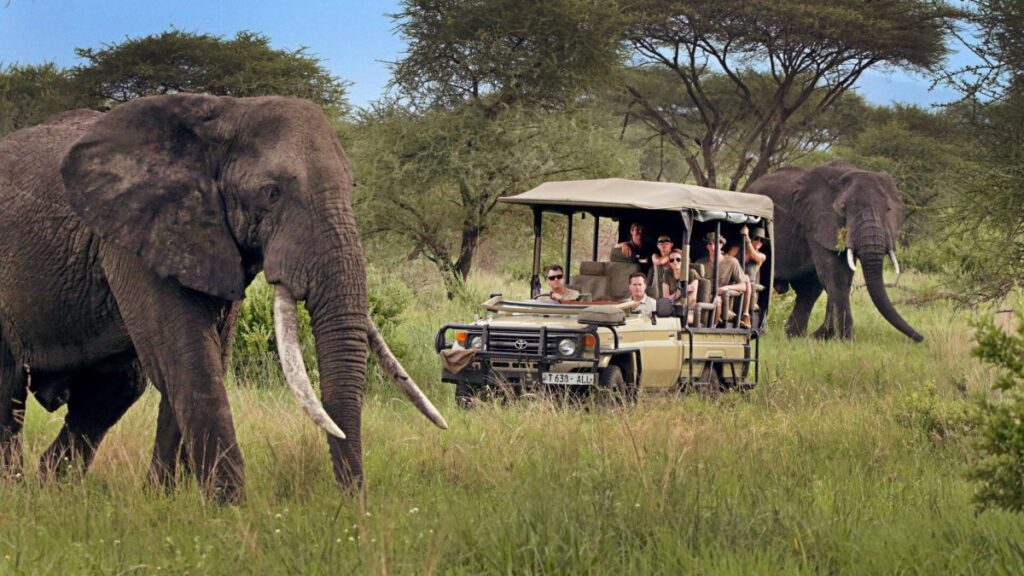
The undisputed elephant capital of Tanzania is Tarangire National Park, where herds of 200–300 individuals congregate around the Tarangire River during the dry season (June–October), creating the highest elephant densities anywhere in East Africa. The Serengeti also supports large elephant populations in its western and northern sectors. For a different but equally remarkable encounter, Nyerere National Park (formerly Selous) offers boat safaris on the Rufiji River, where elephant families wade and swim across channels in what is genuinely one of Africa’s most extraordinary wildlife spectacles.
Expert tip: Approach elephant herds slowly from downwind, as they have an extremely acute sense of smell. If a matriarch spreads her ears and raises her trunk, your guide will know it is time to create respectful distance. Never approach elephants with young calves from directly in front; it triggers defensive mock charges. Our guides read elephant body language instinctively after years in the field.
4. The African Buffalo (Syncerus caffer): The Most Dangerous Grazer
Despite its misleadingly calm appearance, professional hunters widely regard the African buffalo as the most dangerous of the Big Five. Old dagga boys, solitary old males ousted from the herd, are notoriously unpredictable. Buffalo are also the Big Five member most likely to be seen in very large numbers on any Tanzania game drive: herds of 1,000–2,000 individuals are not uncommon in the Serengeti during the wet season, moving like a slow dark river across the plains.
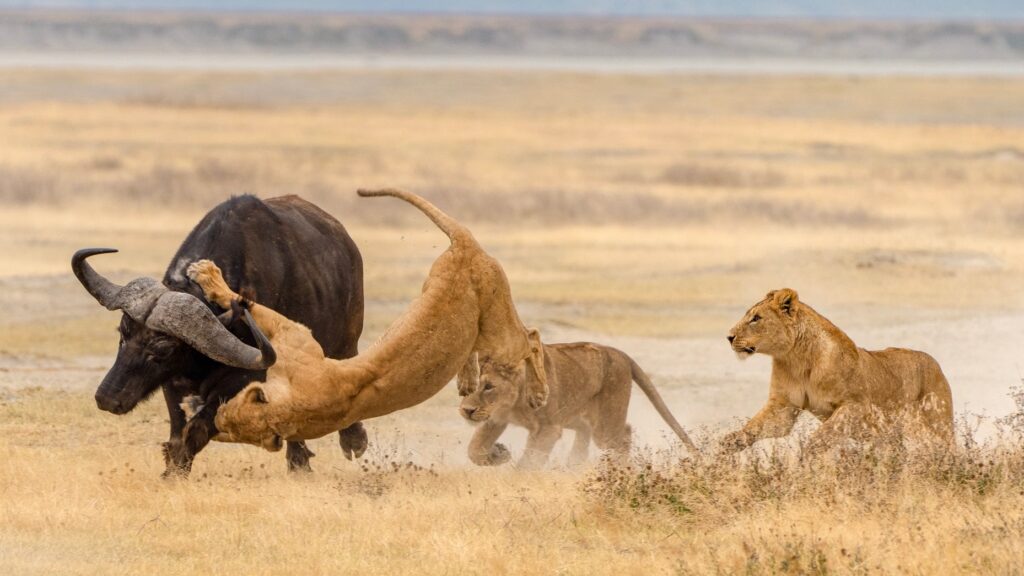
You can find buffalo across virtually all of Tanzania’s major parks. The Ngorongoro Crater is home to a resident herd of approximately 4,000 individuals, making it one of the world’s most photographed buffalo concentrations. In the Serengeti, buffalo herds are a key draw for lion prides, and their presence often signals dramatic predator-prey interactions. Ruaha National Park and Nyerere National Park in southern Tanzania both harbor substantial populations in remote, uncrowded settings.
Expert tip: Buffalo are most active in the early morning and late afternoon, moving between grazing grounds and water sources. Their dark bodies absorb heat quickly, so by mid-morning they typically seek shade or wallow in muddy pools. If you see tickbirds (red-billed oxpeckers) clustering on a dark shape in the long grass, you have found a resting buffalo.
5. The Black Rhinoceros (Diceros bicornis): The Rarest Prize
The black rhinoceros is the rarest and most sought-after of the Big Five and the one where Tanzania’s conservation record matters most. Poached to the brink of extinction in the late 20th century, Tanzania’s black rhino population has slowly recovered through intensive protection efforts. The Ngorongoro Crater is now the single best place in East Africa to see wild black rhinos: approximately 25–35 individuals roam the crater floor in a naturally enclosed, intensively monitored sanctuary. Sightings are not guaranteed, but our guides know the most productive areas on the crater floor and spend time positioning strategically, particularly near Lerai Forest and Mandusi Swamp.
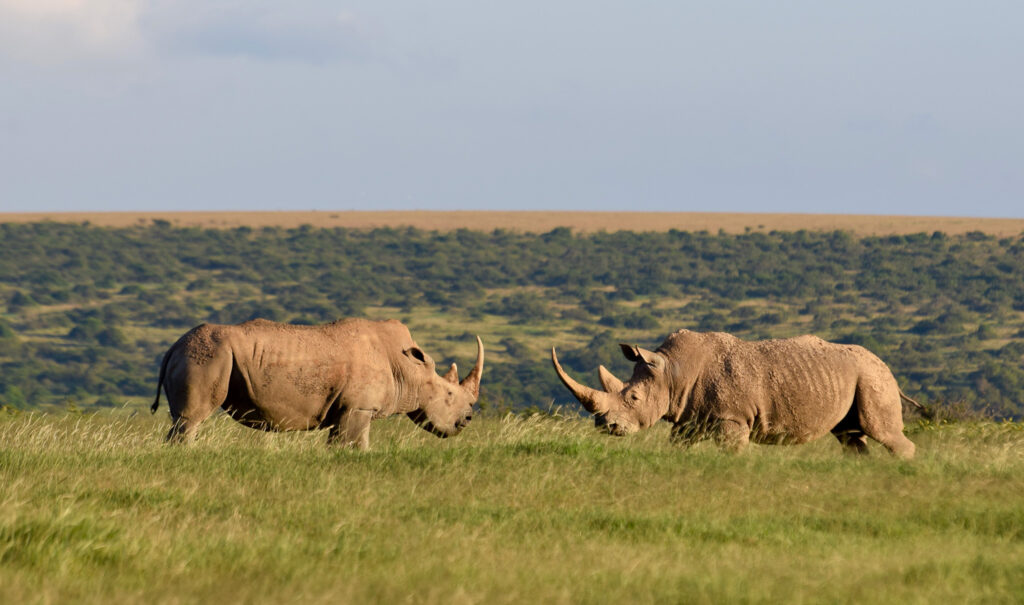
Black rhinos are browsers rather than grazers, feeding on leaves, shoots, and thorny shrubs with their distinctive hooked upper lip, the key physical difference from the square-lipped white rhino. They are typically solitary and can be aggressive when startled. The Serengeti also has a small and growing black rhino population in the Moru Kopjes area, and the remote Mkomazi National Park in northeastern Tanzania has a dedicated rhino sanctuary. Patience and an experienced guide are essential for a rhino sighting; the black rhino is the one member of the Big Five where luck plays the largest role.
Expert tip: Black rhinos are most active in the early morning and late afternoon. They use seasonal waterholes, particularly during the dry season, making water sources around Ngorongoro’s Gorigor Swamp and the Munge River productive waiting points. Do not mistake poor visibility for absence; black rhinos often rest in dense bush and can be invisible from 30 metres.
Best Parks for Big Five Game Drives in Tanzania: Park-by-Park Guide
Tanzania’s Big Five are not evenly distributed across its 16+ national parks and game reserves. Knowing which park excels for which species and when is the difference between a good game drive and an exceptional one. Here is our expert park-by-park assessment, drawn from years of guiding private Tanzania safaris across the entire Northern and Southern Circuits.
| Park | Lion | Leopard | Elephant | Buffalo | Rhino |
| Serengeti NP | Excellent | Excellent | Good | Excellent | Rare (Moru Kopjes) |
| Ngorongoro Crater | Excellent | Good | Good | Excellent | Best in East Africa |
| Tarangire NP | Good | Good | Excellent | Good | None |
| Lake Manyara NP | Good | Good | Good | Good | None |
| Ruaha NP | Excellent | Good | Excellent | Excellent | Very Rare |
| Nyerere (Selous) NP | Good | Good | Excellent | Excellent | None |
| Katavi NP | Good | Rare | Good | Excellent | None |
Serengeti National Park: The Icon of Big Five Safaris
At 14,763 km², Tanzania’s most celebrated wilderness is also one of the world’s best all-round Big Five destinations. The Serengeti’s extraordinary lion population, over 3,000 individuals in the ecosystem, offers the continent’s most reliable lion viewing. The Seronera Valley, where the Seronera and Orangi rivers converge, is quite simply the finest leopard-viewing location in East Africa. Elephants move between the western Corridor, Lobo area in the north, and Seronera in the center. Vast buffalo herds sometimes several thousand animals cross the plains in the dry season. Rhino sightings require a specific detour to the Moru Kopjes area in the south.
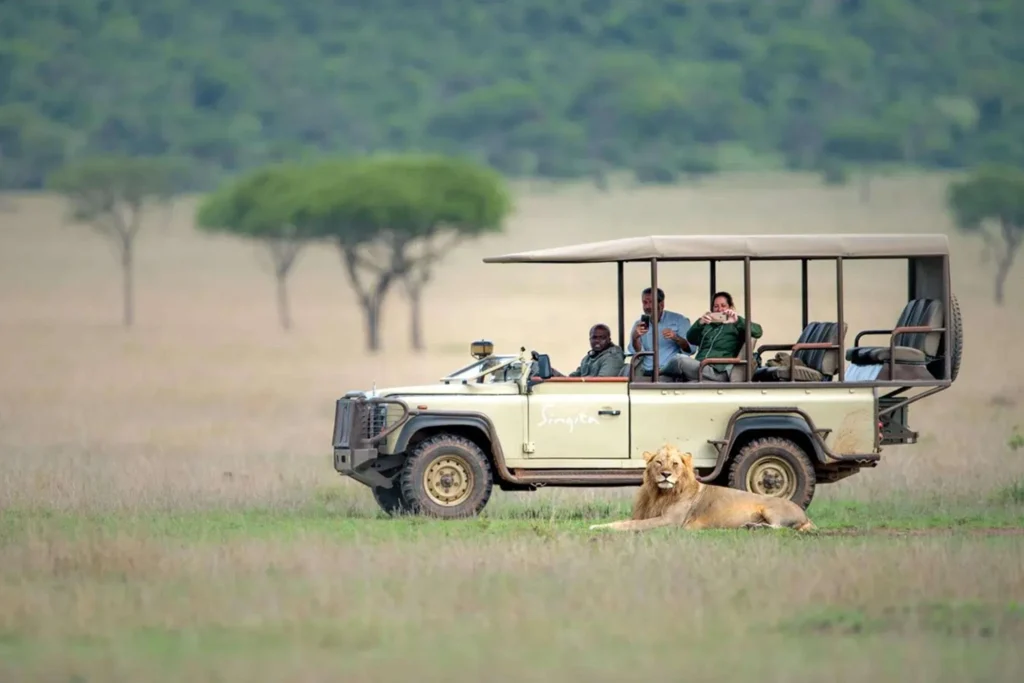
The Serengeti is also home to the Great Wildebeest Migration, the world’s largest overland migration of mammals, which creates dramatic predator-prey interactions from January through December as over 1.5 million wildebeest circuit the ecosystem. Combining Big Five game drives with the migration on a single itinerary represents the absolute pinnacle of safari experience. For an aerial perspective on these landscapes, our hot air balloon safaris over the Serengeti are extraordinary; drifting above lion prides, elephant herds, and migration columns at dawn is an experience completely unlike anything on the ground.
Ngorongoro Crater: Africa’s Greatest Natural Arena for Big Five
The Ngorongoro Crater, a 260 km² volcanic caldera enclosed by 600-meter walls, is arguably the single best Big Five game drive location in Africa. Its enclosed geography means wildlife stays year-round with no seasonal migration out. The crater floor supports approximately 25,000 large mammals, including 60–70 lions, 4,000 buffalo, 30 black rhinos (the most reliably viewable wild population in East Africa), large elephant herds, and exceptionally habituated leopards in the Lerai Forest.
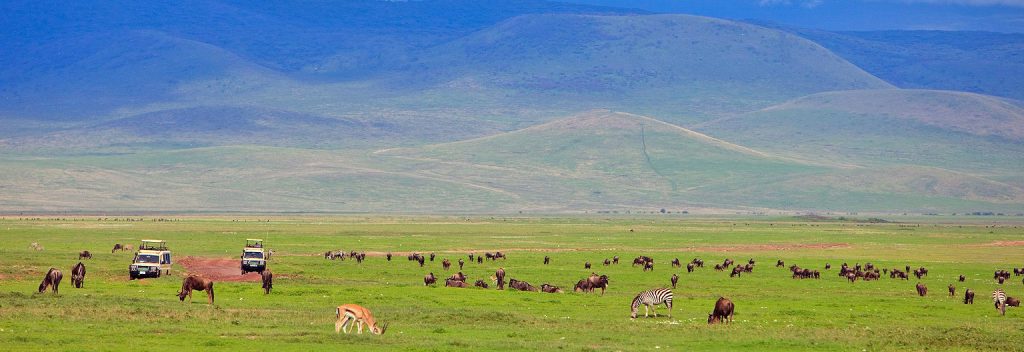
The Ngorongoro Conservation Area also includes the Ngorongoro Crater Lodge, perched dramatically on the crater rim, one of Africa’s most iconic luxury properties, with private butler service, open fireplaces, and views across the caldera that redefine the concept of a room with a view. For photographers, the crater’s contained geography provides extraordinary lighting conditions at dawn. Enter the crater at gate opening (6am) to have the floor almost to yourself during the golden hour.
Tarangire National Park: Tanzania’s Elephant Paradise
Often overlooked in favor of the Serengeti, Tarangire National Park is consistently the most spectacular park in East Africa for elephant game drives, particularly between June and October. The Tarangire River, the only permanent water source for 100+ km in the dry season, draws elephant herds of 200–300+ animals, creating scenes of extraordinary scale. The park also supports strong lion and leopard populations in its ancient baobab and acacia woodlands, and the bird diversity (550+ species) is unmatched on the Northern Circuit.
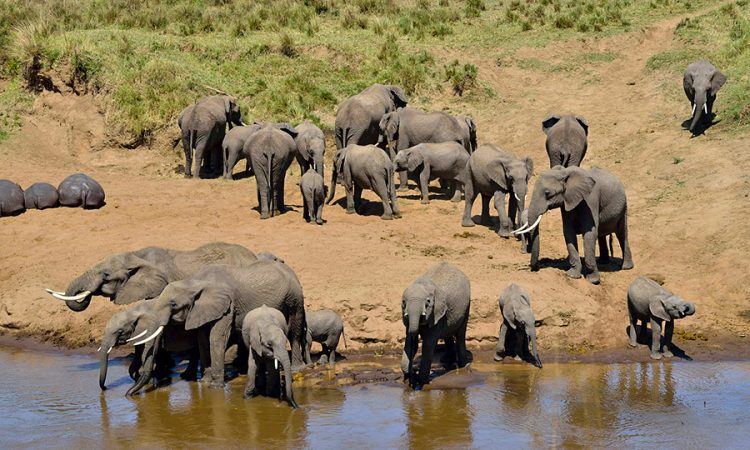
The park’s landscape is itself a photographic gift: ancient baobab trees (some over 1,000 years old), acacia woodland, and the broad Tarangire River provide a visual texture entirely different from the open plains of the Serengeti. The lodge Tarangire Treetops by Elewana offers one of Tanzania’s most extraordinary sleeping experiences: luxury treehouses built around and inside living baobab trees, with elephants frequently passing within metres of the decks at dusk.
Lake Manyara National Park: Compact Big Five Diversity
At just 325 km², Lake Manyara National Park punches well above its weight. Famous for its tree-climbing lions, a unique behavior exhibited by a handful of Manyara’s prides that lounge in the branches of yellow fever trees (Acacia xanthophloea), the park also offers strong elephant sightings in its groundwater forest, excellent leopard habitat in the forest zone, and vast buffalo concentrations on the alkaline floodplains. The alkaline lake itself hosts flamingo flocks that can reach 75,000 individuals in the right season.
Ruaha National Park: Wild and Remote Big Five Wilderness
For those who want extraordinary Big Five game drives without another vehicle on the horizon, Ruaha National Park in southern Tanzania is a revelation. Tanzania’s largest national park, at 20,226 km², supports the largest lion population in East Africa, exceptional leopard density in its rocky escarpments, enormous elephant populations along the Great Ruaha River, and vast buffalo herds that rival anything on the Northern Circuit. It is a genuine wilderness, visited by a fraction of the tourists who crowd the Serengeti, making every encounter feel genuinely private.
Nyerere National Park (formerly Selous): Untamed Southern Circuit
The Nyerere National Park, formerly the Selous Game Reserve, is Africa’s largest protected area at 54,600 km² and offers uniquely diverse game drive experiences, including boat safaris on the Rufiji River that bring you eye-level with hippos, crocodiles, and elephant herds wading across channels. Lion and buffalo sightings are excellent throughout, and the park’s elephant population is in strong recovery after devastating poaching losses in the 1980s–2000s.
Best Time for Big Five Game Drives in Tanzania: Month-by-Month Breakdown
Tanzania’s wildlife is accessible year-round, but the season you choose dramatically shapes your Big Five game drive experience. For comprehensive seasonal planning across all of Tanzania’s ecosystems, read our full guide, Best time to visit Tanzania. Here is what each season means specifically for Big Five viewing:

| Month | Season | Big Five Viewing | Crowds | Notes |
| Jan–Feb | Warm dry | Excellent | Medium | Serengeti calving; lion action. Ngorongoro is superb. |
| March | Transition | Very Good | Low | Landscapes green; predator activity high. |
| Apr–May | Long rains | Moderate | Very Low | Muddy tracks; some camps close. Great for exclusivity. |
| June | Early dry | Very Good | Medium | Grass shortening; easier wildlife spotting. |
| Jul–Aug | Dry peak | Excellent | High | Migration crossings + Big Five. Best overall combo. |
| Sep–Oct | Late dry | Excellent | High | Waterhole concentrations: Tarangire elephants peak. |
| Nov | Short rains | Very Good | Low | Brief showers, lush scenery, and migratory birds arrive. |
| Dec | Transition | Very Good | Medium | Calving season starts; Ngorongoro & Serengeti are excellent. |
Dry Season Game Drives (June–October): Our Top Recommendation
The dry season is our primary recommendation for Big Five game drives in Tanzania. As waterholes shrink and seasonal rivers dry up, wildlife concentrates around permanent water sources, making large mammal sightings more frequent, more predictable, and more dramatic. Vegetation is shorter, improving visibility. The Tarangire elephant concentrations peak in September and October. The Serengeti’s Great Migration river crossings occur in July–October at the Mara River, bringing lions, leopards, and crocodiles into explosive proximity with prey. Mornings are crisp and clear; the light for photography is extraordinary. The trade-off: peak season brings more visitors, particularly in the Serengeti.
Wet Season Game Drives (November–May): The Underrated Option
The wet season is not the enemy of a Big Five safari; it is simply different. The landscape transforms from tawny gold to luminous green; newborn animals fill the plains; bird diversity peaks with the arrival of European and Asian migrants; and the light for photography (dramatic storm clouds, rainbows, golden afternoon sun) can be extraordinary. Predator activity is high in January–February during the Serengeti calving season, when thousands of wildebeest calves are born within a compressed time window and lion prides feed with remarkable efficiency. Crowds are minimal; exclusive-use camps are at their most attainable. April–May (the long rains) is the one period we typically advise avoiding for primary Big Five objectives, though it offers the most genuinely solitary safari experience available in East Africa.
Types of Big Five Game Drives: Which Format Suits You?
Not all game drives are created equal. The format of your drive timing, vehicle type, duration, and add-ons dramatically shapes what you see and how you experience it. Here is our expert guide to the options, drawn from planning thousands of customized private luxury Tanzania safaris.
Morning Game Drives (Dawn–10am): The Most Productive Window
The morning game drive departing at first light, typically 6–6:30am, is statistically the most productive window for Big Five sightings. Lions, leopards, and cheetahs are most active at dawn. predators finishing overnight hunts are found feeding at kills; elephant herds move from overnight resting areas to water sources; rhinos descend to waterholes. The low-angle light in the first 90 minutes is extraordinary for photography. We almost always recommend clients spend at minimum one full morning drive in each park.
Afternoon and Sundowner Drives (3pm–Dusk): The Golden Hour Experience
The late-afternoon drive captures the golden hour, the 90 minutes before sunset when warm amber light bathes everything in the savannah. Predators become active again after midday rest; hippos emerge from rivers; the sky cycles through pink, orange, and deep purple as the sun drops. Sundowner stops, where your guide sets up a bush bar at a scenic viewpoint and you watch the light fade over the plains, are among the most memorable moments any safari delivers. The drive back to camp after dark often produces sightings of serval, genet, and sometimes leopard, as spotlights scan the bush for the reflective eyes of nocturnal wildlife.
Full-Day Game Drives: For Dedicated Wildlife Enthusiasts
A full-day drive departing at dawn and returning at dusk, with a bush lunch either in the vehicle or at a picnic site, maximizes time in the park and is our recommendation for clients who want to maximize Big Five completion, track specific animals over a longer period, or explore distant and less-visited areas of a park. In the Serengeti, a full-day drive can cover the Seronera Valley, the Western Corridor, and the remote northern Lobo area in a single sweep dramatically expanding your chances of encountering the full spectrum of species.
Night Game Drives: Where Available
Night game drives are permitted in a handful of Tanzania’s private concessions, conservation areas, and game reserves but notably not in the national parks themselves (TANAPA regulations prohibit after-dark driving within park boundaries). In concessions adjacent to the Serengeti or within areas like Nyerere National Park, night drives can produce extraordinary sightings of leopards, lions, servals, genets, civets, aardvarks, and bush babies, animals almost never seen during daylight hours. If nocturnal wildlife is a priority, speak with our team about itineraries that incorporate appropriate concession access.
Walking Safaris: The Ground-Level Perspective

For an entirely different Big Five experience, guided walking safaris are available in select parks and private concessions. Walking behind an armed ranger in the presence of elephants, buffalo, and lions is, quite simply, a different order of experience from being in the vehicle: slower, more sensory, and more viscerally real. The Ruaha National Park and Nyerere National Park are our top recommendations for walking safaris in Tanzania’s Southern Circuit. Walking safari regulations require minimum group sizes, licensed armed rangers, and TANAPA approval, all of which we manage seamlessly when you book with us.
Hot Air Balloon Safaris: The Big Five From Above
Our hot air balloon safaris in the Serengeti offer a perspective on the Big Five that no other format provides. Drifting silently 200–300 metres above the plains at dawn, you look down on lion prides on kills, elephant herds navigating watercourses, and migration columns moving across the savannah all without alerting the wildlife below. The balloon follows the wind direction (typically southeast–northwest in the dry season) for approximately 60–90 minutes, followed by a champagne bush breakfast. We include a standard morning game drive before the balloon launch to maximize the day’s wildlife time.
Big Five Photography on Game Drives: Expert Tips
Tanzania’s Big Five game drives are arguably the finest wildlife photography opportunity on Earth. Our team regularly guides professional photographers from National Geographic, BBC Natural History Unit, and leading conservation organizations. Here is what we have learned about capturing the Big Five from a safari vehicle:
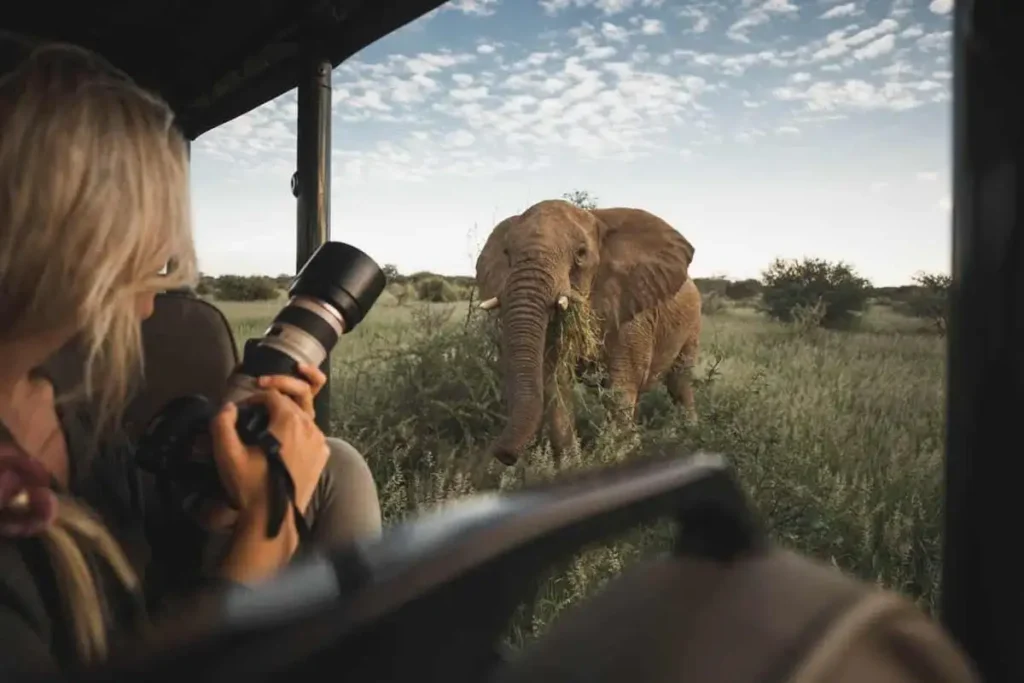
- Shoot in the golden hours (the first 90 minutes and last 90 minutes of daylight) for the most dramatic light; the warm, low-angle sun transforms standard wildlife shots into publishable images.
- Use a beanbag resting on the vehicle’s window frame as a lens support; it is more stable than a tripod in a moving vehicle and allows for rapid repositioning.
- For leopards in trees, use a wide aperture (f/2.8–f/4) to separate the animal from a busy background of branches and leaves.
- For action shots (lion hunts, elephant charges, and bird flight), set your camera to continuous autofocus (AI Servo / AFC) and a shutter speed of at least 1/1000 sec.
- Include environmental context for iconic shots, like an elephant silhouetted against a fiery sky or a leopard with Mount Kilimanjaro in the background. These environmental portraits are more compelling than pure telephoto close-ups.
- Request a vehicle with a 360-degree roof hatch rather than a fixed bar it allows unobstructed shooting in any direction and is especially important for birds and hot air balloon transition shots.
- The Serengeti’s famous atmospheric haze above 10am affects photo quality; early morning and evening shots are dramatically cleaner and warmer in tonal quality.
Our guides know which individual animals are habituated to vehicles, allowing the closest approach, which is a critical factor for photography. We also position vehicles based on light angle and background quality, not just animal proximity. For dedicated photography safaris, ask our team about tailor-made photography-focused itineraries with dedicated photo vehicles and flexible scheduling.
Combining Big Five Game Drives With Other Tanzania Experiences
Tanzania’s extraordinary geography means that Big Five game drives pair naturally with a range of complementary experiences, all of which can be managed within a single itinerary. Here are the combinations our clients most frequently request and what makes each one work: