Kilimanjaro Trekking Routes: Comparison Guide
There are seven officially recognized Kilimanjaro trekking routes, each with its own character, difficulty, and summit success statistics. Here is how they compare:
| Route |
Duration |
Difficulty |
Traffic |
Best For |
| Marangu |
5–6 days |
Moderate |
High |
Budget-conscious hut-based accommodation |
| Machame |
6–7 days |
Mod–Hard |
High |
Scenic trail with ridge traverse; most popular |
| Lemosho |
7–8 days |
Moderate |
Medium |
Best scenery and acclimatization: our #1 recommendation |
| Shira |
7–8 days |
Moderate |
Low |
High-plateau start; spectacular Shira caldera |
| Rongai |
6–7 days |
Moderate |
Low |
Kenya-side, drier, quieter, great for dry season |
| Northern Circuit |
9–10 days |
Moderate |
Very Low |
Highest success rate; full circumnavigation |
| Umbwe |
5–6 days |
Hard |
Low |
Steep & direct; experienced trekkers only |
Expert Recommendation: For most travelers, especially those combining Kilimanjaro with a Tanzania wildlife safari, we recommend the Lemosho Route (7–8 days) or the Northern Circuit (9–10 days). Both provide the most thorough acclimatization, the highest summit success rates, and extraordinary scenery that the shorter routes simply cannot match. View our full Kilimanjaro trekking expedition packages for complete daily itineraries and pricing.
Kilimanjaro National Park Fees (2024/2025)
Understanding Kilimanjaro National Park fees is essential for accurate trip budgeting. All fees are charged in USD, administered by TANAPA, and subject to annual revision. The figures below reflect the most current published rates. Please confirm with our team when booking, as fees can change.
| Fee Category |
Rate (USD) |
Notes |
| Conservation Fee |
$70 per person / per day |
Charged per 24-hour period on the mountain |
| Camping Fee (standard routes) |
$50 per person / per night |
Applies to Machame, Lemosho, Rongai etc. |
| Hut Fee (Marangu Route only) |
$60 per person / per night |
Marangu is the only hut-based route |
| Rescue Fee |
$20 per person / per trip |
Mandatory funds park rescue operations |
| VAT (18%) |
Applied to all above fees |
Collected directly by TANAPA at the gate |
| Guide & Porter Gate Fees |
Included in operator packages |
TANAPA charges per guide/porter. Operators handle this |
For a 7-day Lemosho climb, park fees alone typically total $840–$1,120+ USD per person (7 days conservation + 7 nights camping + rescue + VAT) before operator fees, porter wages, accommodation, and flights. When you book through Active African Vacations, all park fees are built transparently into your all-inclusive package. Contact our safari planning team for a detailed, no-obligation cost breakdown.
Best Time for a Kilimanjaro Hike
You can technically climb Kilimanjaro year-round, but the season you choose dramatically affects your summit experience. For full seasonal context across Tanzania’s parks and ecosystems, see our comprehensive guide to the best time to visit Tanzania.

January – March: Warm Dry Season (Excellent)
This period is one of the two premium climbing windows. Skies above 4,000 metres are generally clear, temperatures are warmer than in the mid-year season, and the trails are less crowded. The lower forest zone receives some light rainfall, but the moisture rarely impacts higher elevations. Summit views in January through March can be exceptional.
April – May: Long Rains (Not Recommended)
Tanzania’s long rains make forest trails slippery, and clouds frequently obscure summit views. Most experienced operators, including our team, advise against scheduling a climb during these months unless your travel dates leave no alternative.
June – October: Classic Dry Season (Peak Season)
The most popular and reliable climbing window. Days are crisp and clear; nights above 4,000 m are bitingly cold (well below -10°C at the summit). The Serengeti’s Great Wildebeest Migration is also at its most dramatic during this period, making a combined Kilimanjaro climb and migration safari one of the most extraordinary two-for-one adventures in travel.
November – December: Short Rains (Good)
Short, sharp afternoon showers are common but typically clear by morning. This period is quieter than peak season, prices can be slightly lower, and conditions at the summit are generally excellent. This time frame is a smart choice for flexible travelers who want to avoid crowds.
Wildlife in Kilimanjaro National Park
While Kilimanjaro is primarily a trekking destination, the national park’s montane forest harbors genuine wildlife. This is not a Big Five game drive, but it is far from an empty mountain. Stay alert in the forest zone for the following:
- Black-and-white colobus monkeys abundant on the Lemosho and Machame routes
- Blue monkeys regularly spotted in family groups at lower forest elevations
- African elephants occasionally cross the lower forest tracks on the western slopes
- Buffalo present in the forest though rarely seen by trekkers
- Leopards are nocturnal and shy; marks are sometimes found near low camps
- Serval & caracal, small, elusive wild cats of the forest zone
- 179+ bird species, including Hartlaub’s turaco, scarlet-tufted malachite sunbird, and white-necked raven
For a truly immersive wildlife experience, we strongly recommend combining your climb with a private game drive safari in the Serengeti, a descent into the Ngorongoro Crater, or an elephant encounter in Tarangire National Park.
Mount Kilimanjaro Map: Key Landmarks and Locations.
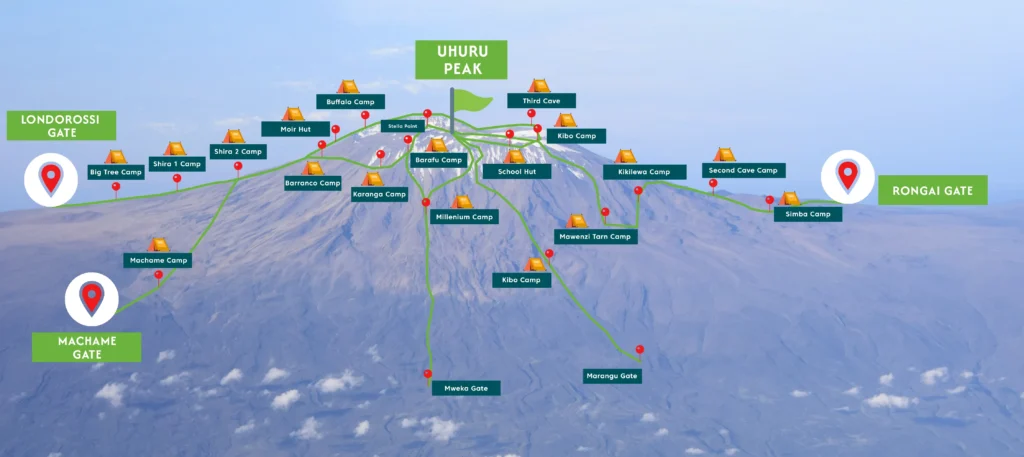
Understanding the mountain’s geography before you go makes every milestone on your trek more meaningful. Here is a brief orientation of the landmarks you will encounter on a standard Kilimanjaro map:
- Uhuru Peak (5,895 m): The summit of Kibo cone, the highest point in Africa
- Stella Point (5,739 m): The crater rim reached from the main southern approach; an official TANAPA achievement point
- Gilman’s Point (5,681 m): Crater rim access point on the Marangu Route; also an official achievement
- Barafu Camp (4,673 m): Primary high camp for summit bids on Machame and Lemosho routes
- Shira Plateau (3,840 m): A vast volcanic caldera offering one of Kilimanjaro’s most otherworldly landscapes
- Mawenzi Tarn (4,330 m): Dramatic high camp beneath Mawenzi’s jagged ridgeline
- Horombo Hut (3,720 m): Main overnight stop on the Marangu Route
- Marangu Gate (1,879 m): Most common entry gate; south-east slopes
- Londorossi Gate (2,100 m): Entry point for Lemosho and Shira routes on the western slopes
- Rongai Gate (1,950 m): North-east approach gate near the Kenyan border
How to Prepare for a Kilimanjaro Trek
Physical Fitness Training
You do not need to be an elite athlete to climb Kilimanjaro, but you should be comfortably capable of hiking 6–8 hours a day with a daypack over several consecutive days. Begin a dedicated training program at least 3–4 months before your climb. Long hill walks, stair training, and sustained cardio work (running, cycling, swimming) are all excellent preparation. Our team provides a structured pre-climb training plan upon booking.
Altitude Acclimatisation
Acute mountain sickness (AMS) is the primary reason climbers turn back from Kilimanjaro, not fitness. Choose the longest feasible route, ascend slowly, drink 3–4 liters of water daily, and follow your guide’s pace. Consider consulting your doctor about acetazolamide (Diamox). Our lead guides hold Wilderness First Responder (WFR) certifications and carry pulse oximeters throughout the climb to monitor blood oxygen saturation.
Essential Gear Checklist
The key to summit comfort is the layering system; you will pass through tropical, temperate, and sub-zero Arctic conditions within a single trek.
- Quality waterproof hiking boots fully broken in before travel (essential)
- Layering system: moisture-wicking base layer, insulating mid layer, waterproof outer shell
- Expedition sleeping bag rated to at least -15°C
- Trekking poles invaluable for summit descent
- Quality headlamp with fresh batteries; summit night begins at midnight
- Warm gloves, balaclava, buff, and UV-protective glacier glasses
- High-SPF sunscreen and lip balm: UV radiation above 4,000 m is intense
- Gaiters for muddy forest sections and snowfields near the summit
Frequently Asked Questions About Mount Kilimanjaro National Park
1. How difficult is climbing Mount Kilimanjaro?
Kilimanjaro is a non-technical climb; no ropes, harnesses, or ice axes are required. However, it is a serious high-altitude undertaking that demands excellent cardiovascular fitness, mental determination, and proper acclimatization. The primary challenge is altitude, not technical terrain. With the right route (7+ days) and experienced guides, a fit, determined person with no prior mountaineering experience has a genuine chance of standing on the Roof of Africa.
2. What is the overall summit success rate on Kilimanjaro?
The overall summit success rate across all routes is approximately 60–65%. However, on longer routes the percentage rises considerably: the 9–10 day Northern Circuit route has an estimated success rate above 90%, precisely because it allows far more time for proper acclimatization. Choosing a qualified operator with certified guides rather than the cheapest option is the single most impactful decision you will make in planning your climb.
3. How much does it cost to climb Kilimanjaro in total?
A complete, guided Kilimanjaro climb with a reputable operator typically costs between $2,500 and $6,000+ USD per person all-inclusive, depending on route, duration, group size, and service level. This encompasses park fees, guide and porter wages, mountain equipment, camping gear, and all meals on the mountain. Budget operators exist but frequently compromise on guide certification, safety equipment, and porter welfare. Contact our team for a fully transparent quote.
4. What are the current Kilimanjaro National Park entry fees?
The main fees are: a conservation fee of $70 per person per day; a camping fee of $50 per person per night (or $60/night for Marangu hut accommodation); and a mandatory rescue fee of $20 per person per trip. All fees are charged in USD and are subject to 18% VAT, payable to TANAPA. For a 7-day climb, park fees alone typically total $840–$1,120+ USD per person before VAT. All fees are included transparently in our operator packages.
5. Which Kilimanjaro route has the highest summit success rate?
The Northern Circuit Route (9–10 days) has the highest success rate, estimated above 90%, because it circumnavigates the northern slopes, providing the most gradual and comprehensive acclimatization profile of any route on the mountain. The Lemosho Route (7–8 days) is a close second and is our top recommendation for most travelers, offering exceptional scenery, excellent acclimatization, and significantly fewer crowds than the Machame or Marangu routes.
6. Is a licensed guide required on Kilimanjaro?
Yes, it is mandatory. TANAPA regulations require all trekkers to hire a licensed guide. Unguided ascents are not permitted. Our guides hold KINAPA (Kilimanjaro National Park Authority) licenses and are trained in wilderness first aid and high-altitude rescue. Our lead guides have typically summited Kilimanjaro 50–200+ times and understand every weather pattern, campsite nuance, and medical risk indicator on the mountain.
7. What is the best time of year to climb Kilimanjaro?
The two premium climbing seasons are January–March and June–October, both during Tanzania’s dry seasons when skies are clearest and trails are at their firmest. April–May (long rains) is the least advisable period. For comprehensive seasonal guidance across all of Tanzania’s national parks and ecosystems, see our best time to visit Tanzania guide.
8. Can children climb Kilimanjaro?
TANAPA recommends a minimum age of 10 years, and most reputable operators, including our team, advise a minimum of 12–14 years for the full summit attempt, given the significant altitude risks for young developing bodies. For families seeking extraordinary shared adventures in Tanzania, we offer excellent alternatives: walking safaris, cultural experiences, and family-friendly game drives in the Ngorongoro Conservation Area or Serengeti, followed by Zanzibar beach time. Speak with our team about family itineraries.
9. Do I need a visa to visit Tanzania for a Kilimanjaro climb?
Most nationalities, including citizens of the USA, UK, EU, and Australia, require a tourist visa for Tanzania. This can be conveniently obtained as an e-Visa online before departure via the Tanzania Immigration Services portal (immigration.go.tz), or on arrival at Kilimanjaro International Airport (JRO). At time of writing, a standard single-entry tourist visa costs approximately $50 USD. Always verify current requirements through official channels before travel, as regulations can change.
10. How fit do I need to be to summit Kilimanjaro?
You should be capable of hiking comfortably for 6–8 hours per day, carrying a daypack, over several consecutive days. Begin a dedicated training program 3–4 months before your climb. Long hill walks, sustained cardio sessions, and stair training are all excellent preparation. Our team provides a structured pre-departure training plan and packing guide for every booking.
11. Is altitude sickness a serious risk?
Yes, Acute Mountain Sickness (AMS) is the leading reason climbers fail to summit. Symptoms include headache, nausea, fatigue, loss of appetite, and dizziness. Prevention is primarily about pace: choose a longer route, ascend slowly, stay very well hydrated, and heed your guide’s advice. Our lead guides carry pulse oximeters and hold Wilderness First Responder certifications and are trained to recognize the early signs of High Altitude Pulmonary Edema (HAPE) and High Altitude Cerebral Edema (HACE), both of which require immediate descent.
12. What vaccinations are recommended for Tanzania?
No vaccinations are legally required to enter Tanzania unless arriving from a yellow-fever-endemic country. However, the CDC and WHO recommend hepatitis A and B, typhoid, meningitis, rabies (if at risk), and routine immunizations. Malaria prophylaxis is strongly recommended for lowland Tanzania; the risk at high altitude on Kilimanjaro is negligible. Consult a travel medicine specialist at least 6–8 weeks before departure.
13. Can I combine Kilimanjaro with a Tanzania safari?
Absolutely, and it is one of Africa’s greatest trip combinations. Many of our clients spend 7–8 days on the mountain, then transition seamlessly into a 5–7 day luxury Tanzania safari in the Serengeti or Ngorongoro before finishing with restorative beach days in Zanzibar. Our team manages every transfer, lodge booking, and flight you simply experience.
14. What is a fair porter-to-trekker ratio on Kilimanjaro?
A responsible operator typically provides approximately 3 porters per trekker, plus a dedicated cook and at least one assistant guide for every 3–4 climbers. Active African Vacations is a proud supporter of the Kilimanjaro Porters Assistance Project (KPAP), which sets minimum wage, equipment, and load standards for porters. All our porters are paid above KPAP minimums, properly equipped with warm gear, and treated with full professional dignity.
15. How do I travel from Arusha to Kilimanjaro National Park?
Kilimanjaro National Park is approximately 80 kilometers from Arusha and 50 kilometers from Moshi, a 1.5–2 hour drive from Arusha or 45 minutes from Moshi. Kilimanjaro International Airport (JRO), served by KLM, Ethiopian Airlines, Qatar Airways, Turkish Airlines, and others, lies between the two towns and is the most convenient international gateway. Our team provides all airport transfers and road transport as part of every booking.
Why Book Your Kilimanjaro Climb with Luxury Safaris Tanzania?
Active African Vacations has been guiding luxury safaris and Kilimanjaro expeditions from Arusha for over 12 years. With more than 10,000 satisfied travelers, full ATOL protection, and a team of expert local guides who know this mountain with extraordinary intimacy, we are one of Tanzania’s most trusted boutique operators.

- Fully tailor-made: Every itinerary is designed around your fitness, timeframe, and aspirations never a generic package.
- ATOL protected: Your investment is safeguarded. Travel with complete financial peace of mind.
- Expert certified guides: KINAPA-licensed, WFR-certified guides who have summited hundreds of times.
- Transparent all-inclusive pricing: Park fees, guide wages, porter wages, meals, and equipment included with no hidden costs.
- Ethical operator: Proud KPAP partners. All porters were paid above minimum wage and properly equipped.
- Seamless combinations: We handle every detail of your Kilimanjaro + safari + Zanzibar itinerary from start to finish.
Whether this trip is your first African adventure or a return to deepen your lifelong love of the continent, we are here to make it extraordinary. Explore our full Tanzania safari packages, discover our Kilimanjaro trekking expeditions, or browse our wildebeest migration safaris to begin planning the trip of a lifetime. Our expert team is ready when you are