There is a place in Tanzania where the crowds thin to nothing, where the only sounds at dawn are chimpanzee calls echoing across ancient forest and the slap of a Nile perch breaching glassy water. That place is Rubondo Island National Park, a 457-square-kilometer island sanctuary rising from the southwestern shores of Lake Victoria, the largest lake in Africa. It is, quite simply, one of the best-kept secrets on the continent.
At Luxury Safaris Tanzania, we have been introducing discerning travelers to Rubondo for over 12 years. It is the park we recommend when clients tell us they want to see Tanzania beyond the famous names beyond the Serengeti’s sweeping plains and the Ngorongoro Crater, into the quiet, the wild, and the genuinely undiscovered. If that speaks to you, read on.
Rubondo Island is not for everyone, and that is precisely its appeal. It rewards the curious, the patient, and the traveler who understands that true luxury is not the size of a swimming pool but the depth of an experience. Combined with a classic Tanzania safari or a post-trek recovery in Zanzibar, a visit to Rubondo creates an itinerary unlike anything else in Africa.
Rubondo Island National Park at a Glance
| Location | Lake Victoria, Kagera Region, north-western Tanzania |
| Park Size | 457 km² (240 km² land; 217 km² water) |
| Established | 1977 (National Park); RAMSAR Wetland of International Importance |
| Nearest City | Mwanza (~140 km) | Bukoba (~100 km by boat) |
| Access | Charter flight from Mwanza or Arusha; boat transfer from Nshara Port |
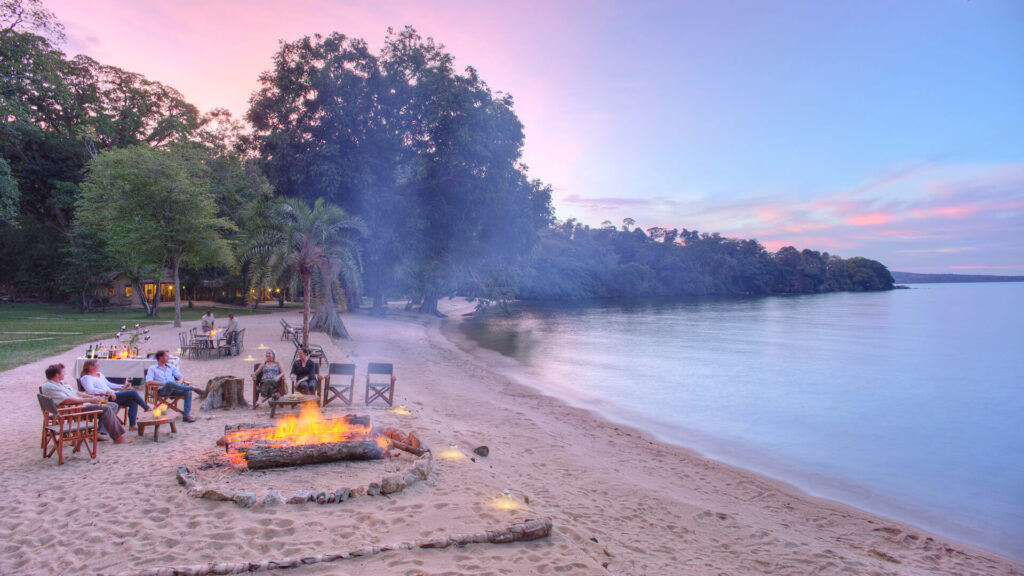
| Accommodation | Rubondo Island Camp (Asilia Africa), the island’s only permanent luxury lodge, |
| Key Wildlife | Chimpanzees, forest elephants, sitatungas, hippos, crocodiles, 300+ bird species |
| Key Activity | Chimpanzee trekking, Nile perch fly-fishing, forest walks, birdwatching, boat safaris |
| Best Months | June–October (dry season); December–February (good alternative) |
| Park Currency | USD (fees payable to TANAPA) |
About Rubondo Island National Park, Tanzania
Rubondo Island sits in the south-western corner of Lake Victoria, Tanzania’s largest lake and the world’s second-largest freshwater lake by surface area. The island, along with several smaller satellite islets, was gazetted as a national park in 1977 and is today also recognized as a RAMSAR Wetland of International Importance, underscoring its ecological significance. The park is about 457 square kilometers in size, with about 240 square kilometers of land and 217 square kilometers of water around it.
What makes Rubondo extraordinary in the context of Tanzania’s national parks is its sheer isolation and the mosaic of habitats it preserves. Dense equatorial rainforest, open woodland, papyrus swamps, and lakeshore beaches coexist within a compact island, each sustaining different communities of wildlife. There are no roads in the conventional sense, just forest trails, sandy beaches, and waterways. Game viewing here is on foot, by boat, or from a kayak. It is as far removed from the jeep-filled plains of the northern circuit as Africa gets.
One of the most remarkable chapters in Rubondo’s history is its role as a rehabilitation sanctuary. Between the 1960s and 1980s, the Frankfurt Zoological Society introduced several species to the island that had become locally extinct or had never previously occurred there: chimpanzees from various parts of West Africa, as well as African grey parrots, black-and-white colobus monkeys, giraffes, roan antelope, and others. The chimpanzees in particular have thrived, establishing a wild population of approximately 40 individuals across the island’s forest, making Rubondo one of the few places in Tanzania where you can track wild chimpanzees in a rainforest setting.
Why Visit Rubondo Island? Five Things That Make It Unmissable
Wild Chimpanzee Trekking in Rainforest
Rubondo’s chimpanzee population descended from animals introduced to the island decades ago has returned to fully wild behavior, and habituating them for visitor encounters has been a careful, years-long process. Tracking chimpanzees through Rubondo’s dense, dripping rainforest alongside an expert guide is a profoundly different experience from the highland chimp treks of Mahale or Gombe. The forest is quieter, the groups smaller, the proximity more intimate. For travelers combining Rubondo with a visit to Mahale Mountains National Park or Gombe National Park on Lake Tanganyika, the experience creates a genuinely world-class primate itinerary.
World-Class Nile Perch Fly-Fishing
Lake Victoria’s waters surrounding Rubondo Island hold some of the most exciting Nile perch fishing on the planet. These prehistoric-looking leviathans regularly exceed 50 kilograms; the IGFA all-tackle world record was set on Lake Victoria, and on fly tackle, they are one of Africa’s most thrilling freshwater targets. Rubondo Island Camp offers guided fly-fishing excursions with dedicated boats and specialist equipment. It attracts serious anglers from across the world, particularly between June and October when water clarity peaks. If you are a fly-fisher who also loves wildlife, there is no better address in Africa.
Outstanding Birdwatching: 300+ Species
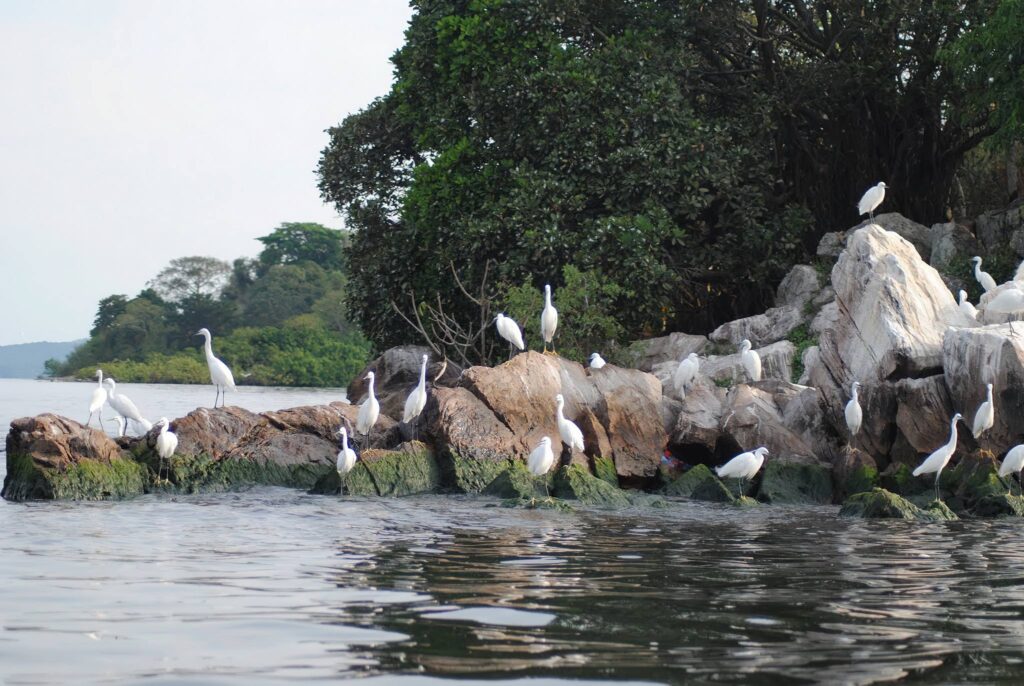
Rubondo is a birder’s paradise. The island sits at the intersection of the Albertine Rift and the Lake Victoria basin, two of Africa’s most important biogeographical zones, and the resulting species diversity is extraordinary. Over 300 bird species have been recorded within the park, including the rare and localized African finfoot, the papyrus gonolek, the white-winged warbler, and the shoebill stork, a prehistoric-looking bird that draws ornithologists from across the globe. The forest interior harbors superb sunbirds, numerous bee-eaters, and African fish eagles calling from every shoreline tree.
Sitatunga and Forest Elephants
Rubondo is one of the best places in East Africa to observe the sitatunga, a semi-aquatic antelope that wades chest-deep through papyrus swamps on its widely splayed hooves. Dawn and dusk boat trips along the papyrus fringes regularly produce close-range sightings. The island also supports a population of forest elephants, smaller and more elusive than their savannah counterparts, which emerge at dusk to feed along the forest margins. Hippos are abundant and easily observed from boats, while Nile crocodiles patrol every beach and marshy inlet.
Total Seclusion and Zero Crowds
Rubondo receives fewer visitors in an entire year than the Serengeti receives in a single weekend. There are no other lodges, no other tented camps, no tour buses, and no photo-jeep convoys. The island’s only permanent luxury accommodation, Rubondo Island Camp, takes a maximum of a handful of guests at any given time. This is one of the last places in Tanzania where the wilderness feels entirely yours. Rubondo is the perfect destination for honeymooners, photographers seeking undisturbed shots, and seasoned African travelers who have already visited the famous parks and are looking for something rarer.
|