
Chimpanzee Trekking in East Africa | Gombe & Mahale Safaris

Chimpanzee Trekking Safaris in East Africa: Gombe, Mahale & Nyungwe | Trek Humanity’s Closest Wild Relatives.

Chimpanzee trekking is a guided wildlife experience in which small groups of visitors hike through tropical rainforest led by expert trackers to find and spend time observing wild, habituated chimpanzees (Pan troglodytes) in their natural habitat. Chimpanzees share approximately 98.7% of human DNA, making them our closest living relatives, and observing them in the wild is one of the most intellectually and emotionally powerful wildlife experiences available anywhere on Earth. The primary destinations for chimpanzee trekking in East Africa are Tanzania’s Gombe National Park (made famous by Jane Goodall’s research beginning in 1960) and Mahale Mountains National Park, both on the shores of Lake Tanganyika, as well as Rwanda’s Nyungwe Forest National Park and Uganda’s Kibale National Park, which hosts the highest density of chimpanzees in Africa. Permits are required at all destinations and vary in cost; Tanzania’s TANAPA charges USD 100 per person per trek at Gombe and USD 50 at Mahale.

Quick Facts: Chimpanzee Trekking at a Glance

DNA Similarity to Humans 98.7% our closest living relative after bonobos
Wild Chimpanzee Population Estimated 172,700–299,700 (IUCN 2016) Endangered
Primary Trek Destinations Gombe NP & Mahale NP (Tanzania), Kibale (Uganda), Nyungwe (Rwanda)
Trek Group Size Max 6 visitors at Gombe; varies at other parks
Time with Chimps 1 hour at Gombe; unstructured at Mahale (no strict limit)
Permit Cost: Gombe USD 100 per person per trek (TANAPA rate)
Permit Cost: Mahale USD 50 per person per trek (TANAPA rate)
Trek Duration 1–5 hours depending on chimp group location
Best Months June–October dry season; chimps lower altitude and more active
Minimum Age 15 years at most parks
Other Wildlife Olive baboons, red colobus, red-tailed monkeys, hippos, crocodiles
Contact +255 683 311 134  |  info@luxurysafaristanzania.com

Why Chimpanzee Trekking Belongs on Your East Africa Safari

The moment a chimpanzee makes eye contact with you in the wild, something fundamental shifts. It is not the same as seeing lions or elephants, magnificent as those encounters are. With chimpanzees, the feeling is uncanny and deeply personal. They vocalize in ways that sound like they are on the edge of speech. They manipulate tools with deliberate, purposeful intelligence. Young ones play and squabble with an energy indistinguishable from human children. A dominant male gestures with political cunning that would be recognizable in any boardroom. This activity is not wildlife watching; it is a conversation across the thinnest possible membrane between species.
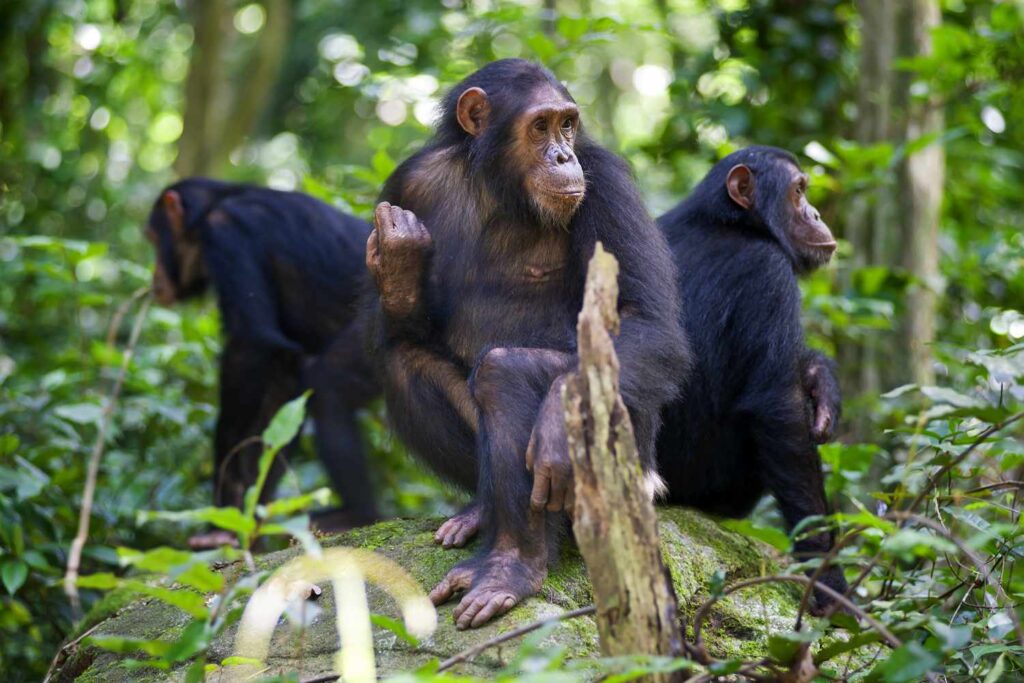
Tanzania Wildlife and Chimp Trekking Safari (Katavi and Gombe Stream National Parks)

Gombe Stream National Park

Tanzania holds two of the world’s most extraordinary chimpanzee trekking destinations: Gombe National Park on the northeastern shore of Lake Tanganyika, where Jane Goodall began her landmark research in 1960 and the breathtakingly remote Mahale Mountains National Park, 150 kilometers to the south, where the forest descends dramatically into the world’s second deepest lake. Together, they form what our guides call the most compelling two-park combination in all of Tanzania and arguably in Africa.

Our Tanzania Wildlife and Chimp Trekking Safari combines both of these extraordinary parks into a single private itinerary, managed entirely by our team from Arusha. Combine them with Rwanda’s Nyungwe Forest National Park or a northern Tanzania luxury safari, and you have the definitive East Africa primate itinerary.

Gombe National Park: Where Jane Goodall Changed Our Understanding of Life

Covering just 52 square kilometers of steep, forested ridges on the eastern shore of Lake Tanganyika, making it Tanzania’s smallest national park, Gombe National Park carries a scientific weight far beyond its size. It was here, in 1960, that 26-year-old British primatologist Jane Goodall arrived under the sponsorship of Louis Leakey and began a study of wild chimpanzees that continues to this day and is now the longest continuous wildlife research project in history. It was at Gombe that Goodall first observed chimpanzees making and using tools, a discovery so significant that it prompted Leakey to famously remark: ‘Now we must redefine tool, redefine man, or accept chimpanzees as humans.’

Gombe National Park

Today, Gombe is home to several habituated chimpanzee communities, the most studied of which is the Kasekela community, the family group Goodall observed continuously for decades. This extraordinary research history means that every chimpanzee at Gombe is named, documented, and understood as an individual. When your guide points to a specific animal and tells you that this female is the daughter of Fifi, the most studied chimpanzee in history, or that this silverback-like elder male has been observed for 40 years of continuous data, the experience transcends ordinary wildlife watching.

Getting to Gombe: The Lake Tanganyika Boat Journey

Gombe’s remoteness is part of its extraordinary character. The park is accessible only by boat across Lake Tanganyika from the town of Kigoma, approximately 16 kilometers to the south. The 2-to-3-hour boat journey over waters of impossible clarity and depth is itself an adventure, with occasional sightings of olive baboons on the shoreline cliffs and kingfishers skimming the lake surface. We arrange all Kigoma transfers, boat bookings, and park logistics as part of our Gombe itineraries. The nearest airport, Kigoma Airport, receives scheduled flights from Dar es Salaam with Coastal Aviation and Regional Air.

What to Expect: Chimpanzee Trekking in Gombe

The Kasekela chimpanzee community is the primary trekking group at Gombe, and in a park this compact, encounters are remarkably reliable. Treks begin in the early morning when chimps are most active, led by experienced TANAPA rangers who have often spent decades tracking the same individual animals. The forest at Gombe is steep; the ridges rise abruptly from the lakeshore, and the trekking requires moderate fitness. But the encounter’s intimacy, often at extremely close range in the dense forest understory, produces photographic and experiential results that larger, more open-terrain parks cannot match.

Beyond chimpanzees, Gombe offers a remarkable supporting cast: olive baboons that share the forest with the chimps and are entirely unperturbed by human presence; red-tailed monkeys in the canopy; vervet monkeys on the lakeshore, and over 200 bird species, including rare African fish eagles, Bohm’s bee-eaters, and the stunning African paradise flycatcher. The beaches of Lake Tanganyika within the park are swimming-safe; the lake is crocodile-free at Gombe, and the snorkeling in its crystal waters reveals cichlid fish found nowhere else on Earth.

Mahale Mountains National Park: The World’s Most Remote Chimpanzee Sanctuary

If Gombe is Africa’s most historically significant chimpanzee destination, Mahale Mountains National Park is its most visually spectacular. Set against the dramatic Mahale Mountain range, with peaks rising to 2,462 metres above the lakeshore and the deep blue waters of Lake Tanganyika glittering at the forest edge, Mahale is one of the most beautiful settings for any wildlife encounter in Africa. The park covers 1,613 square kilometers of mountain forest, montane grassland, and lakeshore 30 times larger than Gombe and has no roads. Access is exclusively on foot or by boat.
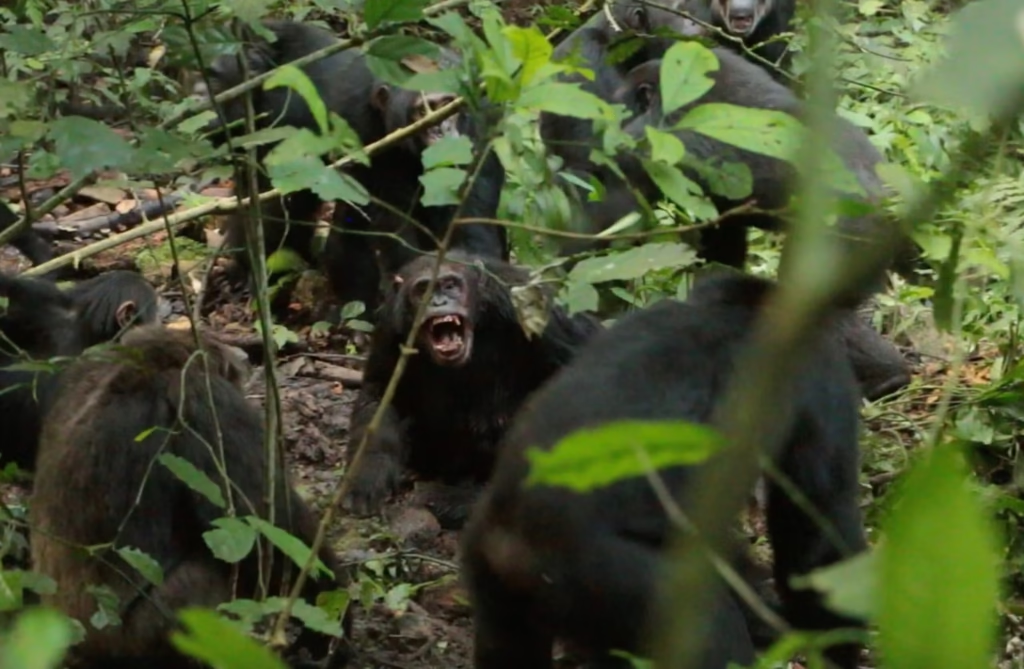
M-Group chimpanzee community in Mahale Mountains

The M-Group chimpanzee community at Mahale is the primary trekking family: approximately 60 individuals, all named, all habituated, all studied since the 1960s by Japanese primatologists from Kyoto University (whose research predates Goodall’s in some areas of social behavior). The M-Group’s territory ranges across the lower forest slopes, and the trek to find them through riverine forest, bamboo groves, and rocky stream beds is itself an experience of rare wilderness beauty.

Mahale vs Gombe: Which Should You Choose?

Our guides are constantly asked this question. The honest answer is that both parks are worth visiting, if possible. But if you must choose, here is our assessment:

Factor Gombe National Park Mahale Mountains National Park
Size 52 km² Tanzania’s smallest park 1,613 km² vast mountain wilderness
Chimp Groups Kasekela community (approx. 60 chimps) M-Group community (approx. 60 chimps)
Research Heritage Jane Goodall / JGI since 1960 Kyoto University primatologists since 1965
Trek Terrain Steep forest ridges from lakeshore Mountain forest with stream crossings
Scenery Intimate forest + lake views Dramatic mountain backdrop + pristine lake beach
Accessibility Boat from Kigoma (2–3 hrs) + fly in Fly-in only (no road access)
Luxury Accommodation Gombe Forest Lodge (tented camp) Greystoke Mahale (renowned as Africa’s finest)
Other Wildlife Baboons, monkeys, 200+ birds Red colobus, Angolan black-and-white colobus
Swimming Safe: no crocodiles at Gombe Safe: pristine beach at camp edge
Our Recommendation First-timers & Jane Goodall devotees Luxury travellers & photographers

Many of our clients spend 2 nights at Gombe and 3 nights at Mahale on the same itinerary, flying between them on a charter aircraft that provides stunning aerial views of Lake Tanganyika’s impossible blue. It is one of the most singular journeys we offer and one that invariably produces our most enthusiastic post-safari feedback.

🐒 Ready to Trek Chimpanzees in Tanzania? Let Our Experts Plan Everything.

📞 WhatsApp / Call: +255 683 311 134   |   ✉   info@luxurysafaristanzania.com

-> Plan My Chimpanzee Trekking Safari Now

Chimpanzee Trekking in Rwanda: Nyungwe Forest National Park

Rwanda’s Nyungwe Forest National Park is one of Africa’s oldest rainforests and one of its most biodiverse: 1,019 square kilometers of Afro-montane forest, marsh, and grassland straddling the Congo-Nile divide in southwestern Rwanda. It is home to 13 primate species, the highest in any East African forest, including approximately 500 wild chimpanzees across multiple communities, as well as the beautiful Angola colobus monkey, whose black-and-white troops swing through the canopy in groups of up to 400 individuals (the largest colobus troops in Africa).

Chimpanzee trekking in Nyungwe is managed by the Rwanda Development Board and offers a different character from Tanzania: the forest here is dense, misty, and atmospheric in a way that feels genuinely primeval. The Cyamudongo and Uwinka community chimps are the most reliably accessible for trekking. Unlike Gombe and Mahale, Nyungwe also offers the remarkable Canopy Walk, a suspension bridge system through the rainforest at treetop height that provides a genuinely unique perspective on the forest ecosystem.

For travelers combining luxury trekking for gorillas in Rwanda’s Volcanoes National Park with chimpanzee trekking in Nyungwe, Rwanda offers an extraordinary primate double that combines two UNESCO-recognized forest ecosystems in a single country itinerary. Add Akagera National Park for Big 5 game drives, and you have the complete Rwanda experience.

What Happens on a Chimpanzee Trek: A Step-by-Step Guide

For clients who have never done a chimp trek, understanding the day’s structure removes uncertainty and heightens anticipation. Here is what to expect on a typical chimpanzee trekking day at Gombe, our most frequently booked Tanzania chimp destination:

Stage Time What Happens
Morning Briefing 6:30–7:00am Meet your TANAPA ranger guide at the park office. Briefing covers chimp behavior, safety rules, group protocols, and the day’s likely trekking direction.
Trek Begins 7:00am Enter the forest on foot. Your guide follows radio contact from pre-dawn trackers who have already located the chimp group’s overnight nest site.
Forest Trek Variable Hike through Gombe’s ridge forest, steep, forested, and extraordinarily beautiful. Duration depends entirely on chimp movement. Average 1–3 hours.
First Contact Variable Trackers signal proximity. You hear them first: calls, branch-shaking, and the distinctive pant-hoot vocalizations that travel across the entire valley.
The Encounter 1 hour (Gombe) Stay within 8 metres. No flash. Follow ranger instructions. Observe, photograph, absorb. Chimps move fast, stay alert, and are quiet.
Return Trek 1–2 hours Return to the lakeshore. Fresh fruit and cold drinks await. Your ranger debrief covers what you observed and its behavioral significance.
Afternoon Options Variable Swim in Lake Tanganyika, snorkel over cichlids, walk the Jane Goodall Trail, watch olive baboons on the beach, or simply read on the lakeshore.

The Rules of Chimpanzee Trekking

  • Maintain a minimum distance of 8 metres from chimpanzees at all times
  • Maximum group size is 6 visitors at Gombe; this limit is strictly enforced
  • No flash photography under any circumstances
  • Do not eat or drink within sight of the chimpanzees; they are fully capable of taking food directly from you and will attempt to do so
  • If a chimpanzee charges or approaches you, follow your ranger’s instruction: crouch, avoid direct eye contact, remain still
  • Anyone with cold, flu, or respiratory symptoms must not trek chimpanzees are highly susceptible to human respiratory infections
  • Do not mimic chimp vocalizations; their calls have specific social meanings and can trigger aggression or flight.

Understanding Chimpanzee Behaviour: What You Will Witness

Our expert guides brief every client the evening before their trek with a detailed overview of chimpanzee social behavior. Understanding what you are seeing transforms a wildlife encounter into something far more resonant. Here is what our naturalists explain:

Social Structure and Politics

Chimpanzees live in communities of 20–80 individuals organized around a male dominance hierarchy. The alpha male maintains status through a combination of physical intimidation (displays involving branch-dragging, rock-throwing, and charging runs) and political coalition-building, allying with other males who support his position. Jane Goodall’s four decades of observation at Gombe documented what she called ‘chimpanzee politics’ with a sophistication that shocked the scientific world. When you observe two male chimps grooming each other with apparent affection, you may be watching a political negotiation.

Tool Use

Chimpanzees are the most accomplished tool-users in the animal kingdom after humans. At Gombe, they are regularly observed using grass stems to fish termites from mounds, using leaves as sponges to extract water from tree holes, and cracking open hard-shelled nuts using stone anvils and hammers. These behaviors are culturally transmitted; young chimps learn them by watching their mothers and vary between communities, exactly as human cultures vary between populations. Witnessing tool use in the wild is a genuinely humbling experience.

Vocalisations to Listen For

  • Pant-hoot: The signature long-distance call consists of a series of ‘hoos’ that build to screams and then hoots. Groups use these calls to locate each other and signal dominance.
  • Food calls: High-pitched barks when a chimp discovers a food source, which rapidly attract other group members.
  • Alarm calls: Sharp barks or screams in response to perceived threats, including unfamiliar humans at close range.
  • Soft grunts: Contact calls between individuals during grooming or feeding, the chimpanzee equivalent of quiet social conversation.

Photographing Chimpanzees: Expert Technical Guidance

Chimpanzee photography is technically demanding in ways that differ fundamentally from open-savannah wildlife photography. The challenges are extremely low and variable light under the forest canopy, fast and unpredictable subject movement, cluttered backgrounds of branches and leaves, and the emotional intensity of the encounter itself, which can distract even experienced photographers from their camera settings. Here is what our photography specialists recommend for chimp trekking:

Essential Camera Settings

  • Use a fast zoom lens: 70–200mm f/2.8 is ideal. A 100–400mm zoom provides more versatility for chimps in the canopy versus on the ground
  • Set aperture priority mode with the aperture wide open (f/2.8 or f/4) to maximise light in dark forest conditions
  • Auto-ISO with a maximum ceiling of 12800–25600 modern camera sensors handle forest ISO well
  • Set minimum shutter speed to at least 1/500s to freeze fast chimp movement; 1/800s or faster for charging males
  • Continuous autofocus with eye-tracking or animal subject detection if your camera supports it
  • Shoot RAW format exclusively; the post-processing flexibility is essential for rescue in dark forest light

What to Photograph

Resist the temptation to spend the entire encounter photographing the alpha male’s dramatic charges. Some of the most powerful chimp images are a mother nursing an infant in dappled light, two juveniles engaged in a wrestling match on a forest floor, a single hand or face in extreme close-up, or the wide environmental shot of a chimp dwarfed by the scale of the ancient forest. For our clients who want a dedicated professional alongside them, we offer a Luxury Safari in Tanzania with a Personal Photographer who accompanies the trek and provides real-time technical guidance throughout.

Where to Stay: Luxury Accommodation for Chimpanzee Trekking

Gombe National Park
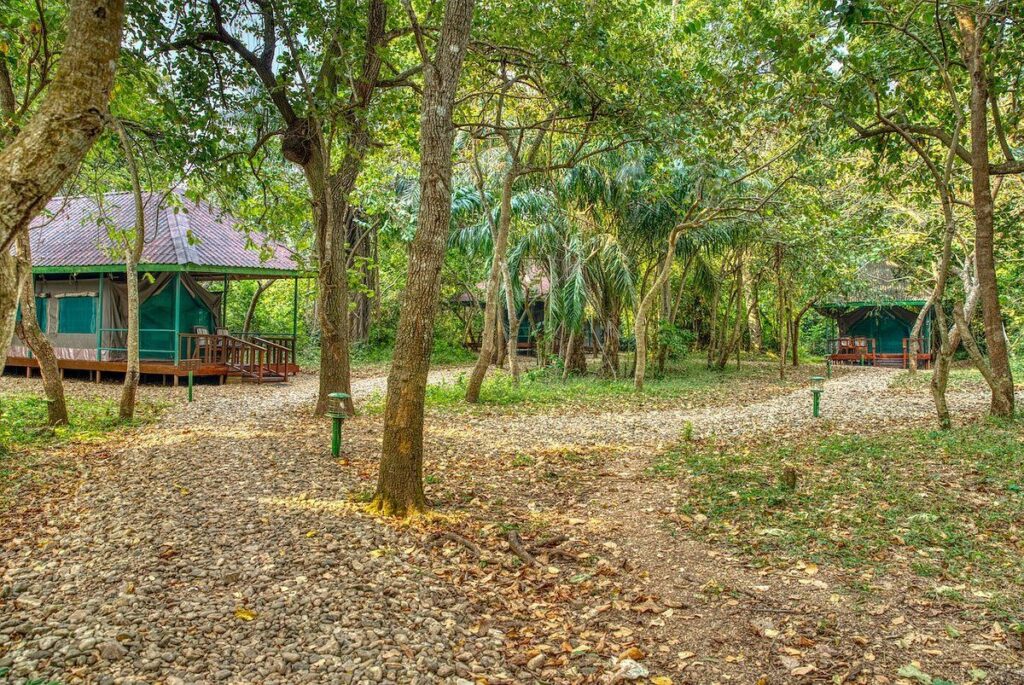
Tanzania Wildlife & Chimp Trekking Safari – Katavi & Gombe

Mbali Mbali Gombe Lodge

Gombe Forest Lodge is the park’s only permanent accommodation option, a collection of spacious safari tents positioned directly on the lakeshore, with the forest rising steeply behind them and the extraordinary blue waters of Lake Tanganyika in front. The design is deliberately understated, allowing the forest, the lake, and the chimpanzees, which regularly pass through camp, to dominate. Meals are served on a lakeside deck at sunset. It is one of the most peaceful, remote lodges in Tanzania, and its remoteness is precisely its appeal.

Mahale Mountains National Park
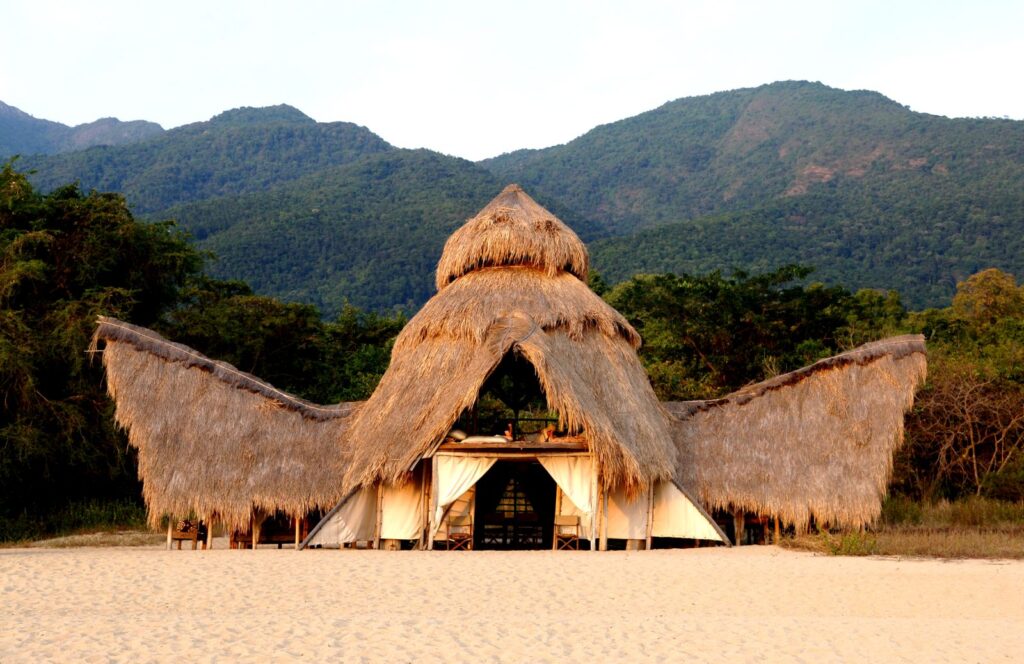
Luxury Tanzania Safari Lodges: Greystoke Mahale Camp

Greystoke Mahale Camp

Greystoke Mahale is, without exaggeration, considered by many of the world’s most experienced safari professionals to be the finest bush camp in Africa. Eight bandas (open-fronted bush chalets) are positioned on the beach at the edge of the forest, each with a private deck overlooking Lake Tanganyika. Meals are served on a raised platform in the forest canopy. There is no electricity grid; the lodge runs on solar power, and evenings are lit by lanterns. The swimming, snorkeling, and kayaking on the lake are extraordinary. Getting there via charter aircraft to an airstrip cleared in the forest is an adventure in itself.

Combining Gombe and Mahale with Other Tanzania Parks

You can most efficiently reach both parks from Kigoma or by charter aircraft from Arusha. We recommend combining Gombe and Mahale with a Serengeti National Park game drive safari, perhaps adding the Ngorongoro Conservation Area or Tarangire National Park, and finishing with 3–4 nights on the beach at Zanzibar, a circuit that represents one of the most complete and varied Tanzania safari experiences possible.

Our Luxury Chimpanzee Trekking Itineraries

Every chimpanzee trekking safari we arrange is private, fully managed, and tailored to your preferences, schedule, and fitness level.

Here are the most popular itineraries we offer:

Tanzania Wildlife & Chimp Trekking Safari 7 Days

Our flagship chimpanzee itinerary, the 7-day Tanzania Wildlife and Chimp Trekking Safari, combines 2 nights at Gombe and 3 nights at Mahale with a game drive in northern Tanzania, typically in the Serengeti or Tarangire National Park. This itinerary is our single most recommended option for travelers who want to see chimpanzees in their most extraordinary Tanzanian settings, combined with the classic big-game wildlife of the northern parks.

Tanzania Wildlife & Chimp Trekking Safari 7 Days

Rwanda Primate Grand Tour: 10 Days

Our Best of Rwanda’s National Parks combines gorilla trekking in Volcanoes National Park with chimpanzee trekking in Nyungwe Forest National Park and Big 5 game drives in Akagera National Park, three of Rwanda’s four national parks on a single 10-day private circuit. This is the ultimate Rwanda primate safari, giving you encounters with three separate remarkable ape and primate species across two distinct ecosystems.

Rwanda Primate Grand Tour: 10 Days

🌿 Combining Chimp Trekking with a Tanzania Safari? We Handle Everything.

📞 WhatsApp / Call: +255 683 311 134   |   ✉   info@luxurysafaristanzania.com

-> Plan My Chimpanzee Trekking Safari Now

Best Time for Chimpanzee Trekking in East Africa

Chimpanzees are residents year-round in all the parks where they are habituated for trekking; unlike migratory species, they stay in their home range throughout the year. However, the timing of your visit significantly affects the quality of the experience:

When is the Best Time to go on a Luxury Safari in Tanzania

Dry Season: June to October (Peak Season)

The long dry season is the most popular and comfortable period for chimpanzee trekking. At Gombe and Mahale, lower rainfall means firmer forest paths, less mud, and generally shorter and more comfortable treks. Chimpanzees tend to be more active and visible in the dry season as they range widely in search of food. The lake water at both parks is calmer and clearer for swimming and snorkeling. July and August are the peak months; permits and accommodation at Greystoke Mahale should be booked at least 6 months ahead for these dates.

Short Dry Season: December to February

The December to February window offers a shorter dry season that is excellent for chimpanzee trekking, with fewer visitors than the June–October peak. This is also an outstanding period for combining a chimp trek with a northern Tanzania circuit game safari; the Ngorongoro Conservation Area is spectacular in the green season, and January to March is the wildebeest calving season in the southern Serengeti.

Green Season: March to May and November

The long and short rains make forest trails muddier and treks physically more demanding. Chimpanzees also tend to range higher into the forest in wet periods, which can mean longer treks to locate them. However, the green season brings extraordinary forest scenery; the forest is intensely lush, birds are breeding and displaying, and the reduced visitor numbers mean the encounter feels even more exclusive. We do arrange green-season chimp treks for appropriate clients, and many clients rate the experience as equal to or even better than the dry season.

Practical Planning: Everything You Need to Know

Fitness Requirements

Chimpanzee trekking at Gombe and Mahale requires moderate fitness. The terrain is steep, the forest floor uneven, and the altitude at Mahale can reach 1,000+ metres above the lake level during longer treks. Most of our clients manage the treks comfortably; the key is honest self-assessment and good footwear. No technical climbing is involved. If you have any medical conditions that might affect sustained uphill walking in heat and humidity, please discuss these with us before booking.

What to Wear and Pack

  • Sturdy, waterproof hiking boots with ankle support the most critical item of clothing
  • Long-sleeved shirt and long trousers in neutral colors are essential for vegetation and insect protection
  • Waterproof jacket forest rain can arrive without warning at any season
  • Gardening-style gloves for gripping branches on steep terrain
  • Hat and sunscreen for exposed lakeshore sections
  • Insect repellent DEET-based is most effective
  • At least 2 litres of water and high-energy snacks
  • Camera with extra batteries (no charging points in the forest; at Mahale, solar power only at the lodge)

Health and Vaccinations

Standard East Africa vaccinations apply: hepatitis A, typhoid, and yellow fever if transiting through an endemic country. Antimalarial medication is strongly recommended for western Tanzania, as Gombe and Mahale are in a higher malaria-risk zone than the highland safari parks. The critical health rule: anyone with cold, flu, COVID, or any respiratory symptoms must not trek. Chimpanzees share 98.7% of human DNA and are devastatingly vulnerable to human respiratory infections. If you fall ill on the morning of your trek, you will not be permitted to enter the forest.

Getting to Gombe and Mahale

Both parks are in western Tanzania and require internal flight connections. We arrange all logistics from Arusha or Kilimanjaro International Airport. Coastal Aviation and Regional Air operate scheduled flights to Kigoma, the gateway for Gombe; charter aircraft serve the Mahale forest airstrip directly. We include all internal transfers, boat crossings, and park logistics in our quoted itinerary prices.

For a complete view of seasonal travel timing across Tanzania, see our Best Time to Visit Tanzania guide.

Who Is Chimpanzee Trekking Right For?

Couples and Honeymooners

There is something profoundly intimate about a chimpanzee trek the physical challenge of the forest, the anticipation, and then the extraordinary stillness required during the encounter creates a shared experience unlike any other. Mahale, in particular, with its exquisite beach camp at the edge of the world’s deepest forest, is one of the most romantic settings in all of Africa. Combine it with our Serengeti Honeymoon Safari for the complete luxury Tanzania honeymoon.

First-Time Africa Travellers

Chimpanzee trekking is frequently a revelation for first-time Africa visitors who arrive expecting the Serengeti and discover that the primate experience in the western parks is equally extraordinary and far less expected. We recommend combining a Gombe or Mahale chimp trek with the classic northern circuit of Serengeti National Park, Ngorongoro Conservation Area, and Tarangire for a first Tanzania itinerary of genuine breadth.

Repeat Africa Travellers

Gombe and Mahale are the answer every experienced Africa traveller needs when they say, ‘I’ve done the Serengeti, I’ve done Ngorongoro, I’ve done Zanzibar what’s next?’ These parks are genuinely off the well-worn circuit and deliver experiences that 95% of Tanzania visitors never see. See our Luxury Safari in Tanzania for Repeat Travelers guide for a comprehensive overview of the parks and experiences that best reward a return visit.

Wildlife Photographers

Chimpanzees are among the most demanding and rewarding subjects in wildlife photography. The low light, the speed of movement, the extraordinary expressiveness of their faces, and the emotional intensity of the encounter combine to produce images that stand apart from standard safari wildlife photography. Our Luxury Safari in Tanzania with a Personal Photographer service extends to chimp trekking; a dedicated professional photographer accompanies you in the forest and guides your technique throughout the encounter.

Families with Teenagers

For teenagers interested in biology, conservation, wildlife, or simply adventure, a chimpanzee trek produces a formative experience that changes how they understand their relationship with the natural world. We recommend Gombe for family Itineraries given its shorter, more accessible treks and the extraordinary Jane Goodall scientific legacy that gives the visit a powerful educational context. Our minimum age recommendation for chimp trekking with teenagers is 15 years.

Chimpanzee Conservation: Why Your Trek Matters

The IUCN lists common chimpanzees (Pan troglodytes) as Endangered, with an estimated wild population between 172,700 and 299,700 individuals, a range that reflects how poorly monitored many chimpanzee habitats still are. The primary threats are habitat loss from agricultural expansion, bushmeat hunting, and infectious disease transmission from humans. Jane Goodall’s research at Gombe was not merely academic; it transformed global conservation policy and public perception of our obligations to other primates.

Chimpanzee Trekking

Every permit fee paid at Gombe and Mahale funds TANAPA conservation operations, local ranger employment, and community development programs that give surrounding villages a direct economic stake in the chimpanzees’ survival. At Gombe, the Jane Goodall Institute continues decades of community-centered conservation work, including tree planting, educational programs, and sustainable agriculture support for farmers living at the park boundary.

Luxury Safaris Tanzania actively practices responsible primate tourism. We strictly observe all TANAPA health and distance regulations, we brief every client comprehensively before their trek, and we actively support the conservation organizations working in both parks. For clients who want to go further, we can arrange behind-the-scenes access to research operations at both Gombe and Mahale; please contact us to discuss options.

What is chimpanzee trekking and where can I do it in East Africa?

Chimpanzee trekking is a guided wildlife experience in which small groups visit wild, habituated chimpanzee communities in their natural forest habitat. In East Africa, the primary destinations are Tanzania’s Gombe National Park and Mahale Mountains National Park, both on the shores of Lake Tanganyika, and Rwanda’s Nyungwe Forest National Park. Uganda’s Kibale National Park also offers chimpanzee trekking and hosts the highest density of chimps in Africa. We specialize in the Tanzania destinations and Rwanda’s Nyungwe, arranging all permits, accommodation, and transfers as part of our private safari service.

How does chimpanzee trekking differ from gorilla trekking?

Chimpanzee trekking and gorilla trekking are both extraordinary primate wildlife experiences but are fundamentally different in character. Gorillas are generally calmer, more sedentary, and easier to observe during the permitted hour; chimpanzees are faster, louder, more unpredictable, and travel higher in the forest canopy, making them more physically demanding to follow. Gorilla permits (USD 1,500 in Rwanda) are significantly more expensive than chimp permits (USD 100 at Gombe). The chimpanzee encounter is often described as more ‘electric’ and emotionally overwhelming precisely because of their obvious intelligence and expressiveness; the gorilla encounter tends to be more contemplative and awe-inspiring. Many of our clients do both on the same East Africa itinerary.

How much does chimpanzee trekking cost in Tanzania?

TANAPA charges USD 100 per person per trek at Gombe National Park and USD 50 per person per trek at Mahale Mountains National Park. We include these permit fees in all our quoted itinerary prices. Additional costs at both parks include daily park entry fees (USD 30–50 per adult per day), accommodation, internal flights to Kigoma or Mahale airstrip, and boat transfers. A complete 3-night Gombe itinerary, including accommodation, flights, permits, and all park fees, typically costs from USD 2,500 to USD 5,000 per person depending on lodge selection and departure timing. Contact us for a personalized quote.

Which is better for chimpanzee trekking in Gombe or Mahale?

Both offer extraordinary encounters with habituated chimpanzee communities of comparable size (approximately 60 individuals each), and both have decades of research heritage. Gombe is more historically significant; Jane Goodall’s work here changed science’s understanding of animal cognition, and the treks are generally shorter and more accessible. Mahale offers more dramatic scenery, more remote wilderness, and the finest luxury accommodation (Greystoke Mahale) of any chimpanzee destination in Africa. For first-timers, we often recommend Gombe; for luxury travelers and photographers, Mahale. Our ideal recommendation is both, combined on the same itinerary.

How long do you spend with the chimpanzees on a trek?

At Gombe National Park, the time with the chimpanzees is structured at approximately 1 hour, similar to the gorilla trekking model. At Mahale Mountains National Park, there is no strict time limit for the encounter; you stay with the chimp group for as long as they remain in the same area and the tracking is productive, which can mean 2–4 hours of intermittent contact as the chimps move through their territory. The Mahale model is generally preferred by photographers for this reason.

Is chimpanzee trekking safe?

Yes, habituated chimpanzees in properly managed parks are accustomed to human presence, and strict ranger supervision governs chimpanzee trekking. The primary safety concern with chimpanzees is unpredictable behavior during displays or territorial confrontations between males, which can involve charging runs and branch-throwing. Your ranger guide will manage your group’s position to minimize risk. Thousands of visitors trek safely at Gombe and Mahale each year. The 8-meter minimum distance rule is both a safety measure and a conservation requirement and is enforced by rangers throughout the encounter.

When is the best time for chimpanzee trekking in Tanzania?

The best time for chimpanzee trekking at Gombe and Mahale is the long dry season from June to October, when forest trails are firmer, chimpanzees are more active and visible at lower altitudes, and lake swimming conditions are excellent. The short dry season from December to February is also excellent. The wet seasons (March–May and November) make treks more demanding due to mud and higher chimp-ranging altitude, but the encounters themselves are equally powerful and visitor numbers are lower. We arrange chimp treks year-round and can advise on the best timing to suit your overall East Africa itinerary.

How physically fit do I need to be for chimpanzee trekking?

A moderate level of fitness is required; you should be comfortable walking uphill for 2–4 hours in warm, humid conditions carrying a day pack. The terrain at both Gombe and Mahale is steep and the forest floor uneven. Gombe’s treks are generally shorter; some Mahale treks can involve several hours of sustained climbing. Neither location offers porter services in the way that gorilla trekking parks do, so you carry your own day pack throughout. We always discuss fitness levels with clients during itinerary planning and can factor these considerations into which park and chimp community we recommend.

Can I visit both Gombe and Mahale on the same trip?

Yes, and this is our most recommended chimpanzee itinerary. Both parks are on the shores of Lake Tanganyika and can be connected by charter aircraft. A typical combined itinerary spends 2 nights at Gombe (with one or two chimp treks) and 3 nights at Mahale (multiple treks plus lake activities), either flying between them directly or routing via Kigoma. The contrast between the intimate, historically charged Gombe experience and the wild, visually spectacular Mahale setting makes the combination far more than the sum of its parts.

Do I need to book permits far in advance?

For Gombe and Mahale during the peak dry season (June–October), we recommend booking at least 3–6 months in advance. Greystoke Mahale, the park’s only luxury accommodation, has limited capacity and books out well in advance for July–September. During the green season and short dry season, shorter advance booking (4–8 weeks) is generally adequate. We handle all permit procurement at both parks as part of our full planning service contact us at info@luxurysafaristanzania.com with your preferred dates to begin the process.

Can I combine chimpanzee trekking with a Serengeti safari?

Absolutely, and this is one of our most popular Tanzania itinerary combinations. After your Gombe and/or Mahale chimp trekking itinerary, charter aircraft can connect you to the northern Tanzania circuit: Serengeti National Park, Ngorongoro Conservation Area, and Tarangire National Park. Finishing with nights on the beach in Zanzibar creates the complete Tanzania experience: chimpanzees, big game, and a tropical island finale in a single seamless itinerary.

Are there other primates to see on a chimp trekking safari?

Yes, Gombe and Mahale both have remarkably rich primate communities beyond the chimpanzees. Olive baboons are extremely common at Gombe and are entirely habituated to human presence, allowing close-range observation. Red-tailed monkeys and red colobus monkeys inhabit the forest canopy, and vervet monkeys frequent the lakeshore. At Mahale, the Angolan black-and-white colobus is particularly striking. Rwanda’s Nyungwe Forest National Park hosts 13 primate species, including Angola colobus troops of up to 400 individuals, which are the largest colobus groups in Africa.

Can I see Jane Goodall's research station at Gombe?

Yes, a key component of the Gombe experience is visiting the Gombe Stream Research Centre (GSRC) and learning about Jane Goodall’s work, which is included in standard park visits. Park rangers and guides discuss Goodall’s research in detail during treks, and some of our itineraries include a more in-depth visit to the research facilities. The Jane Goodall Institute (janegoodall.org) provides extensive information on ongoing research at Gombe. For clients who want the deepest possible engagement with the science, we can arrange access to current researchers working in the park.

Is chimpanzee trekking suitable for families and children?

The minimum recommended age for chimpanzee trekking is 15 years, the same as gorilla trekking. This restriction reflects both the physical demands of the trek and the importance of group discipline during the encounter. For teenagers who are fit and enthusiastic about wildlife and conservation, chimpanzee trekking is one of the most formative experiences we can offer. The Jane Goodall legacy at Gombe gives the visit extraordinary educational depth for young visitors with any interest in science, primatology, or conservation.

What other experiences can I combine with chimpanzee trekking in Tanzania?

Chimpanzee trekking pairs naturally with the full range of Tanzania’s extraordinary wildlife experiences. Kilimanjaro trekking combines with a western Tanzania chimp itinerary for an adventure circuit. The Great Wildebeest Migration in the Serengeti is a natural pairing on a longer itinerary. For primate specialists, combining Tanzania chimp trekking with gorilla trekking in Rwanda creates the definitive East Africa primate circuit: mountain gorillas in Volcanoes National Park and chimpanzees on Lake Tanganyika in a single multi-country journey. Contact our team to design the exact combination that suits your time, budget, and travel style.

Related Safari Experiences & Destinations

🐒 Begin Planning Your Chimpanzee Trekking Safari Today

📞 WhatsApp / Call: +255 683 311 134   |   ✉   info@luxurysafaristanzania.com

-> Plan My Chimpanzee Trekking Safari Now