The biodiversity of Udzungwa is its defining characteristic. Here is a comprehensive overview of what the park protects and what visitors are most likely to encounter:
| Species / Group |
Status & Notes |
| Udzungwa Red Colobus |
Endemic to the Eastern Arc regularly seen in forest canopy on guided walks |
| Sanje Mangabey |
Critically Endangered; endemic; ~1,000–1,800 global population; one of the rarest primates in Africa |
| Angola Colobus |
Black-and-white colobus, found throughout the forest at all elevations |
| Yellow Baboon |
Common in forest margins and clearings |
| Sykes’ Monkey |
Widespread in montane and mid-altitude forest zones |
| African Elephant |
Wide-ranging; moves between Udzungwa and Kilombero Valley; regularly seen on lower trails |
| Lion |
Present but rarely seen; moves between park and adjacent wilderness areas |
| Leopard |
Nocturnal and elusive; pugmarks common on trails |
| African Buffalo |
Common in lower forest margins and valley grasslands |
| Bushbuck |
Frequently encountered on forest trails |
| Giant Forest Hog |
Africa’s largest pig; shy but present in dense forest areas |
| Mongoose species |
Banded and dwarf mongoose seen in forest clearings |
| Birds (400+ species) |
30+ endemics/near-endemics, including Udzungwa forest partridge, rufous-winged sunbird, Iringa akalat |
| Reptiles & Amphibians |
Exceptionally high endemism; chameleons, skinks, frogs unique to Eastern Arc a highlight for herpetologists |
| Butterflies |
Hundreds of species; exceptional diversity in forest clearings and along stream margins |
Udzungwa Mountains Hiking Trails: A Complete Guide
All hikes in Udzungwa Mountains National Park are conducted on foot with a mandatory TANAPA park guide. There are no self-guided trails. The park’s trail network covers a wide range of difficulty and duration, from a gentle half-day waterfall walk to a challenging 4–5 day summit ridge traverse. Here is a guide to the main trails:
Sanje Waterfall Trail (Easy–Moderate | 3–5 hours return)
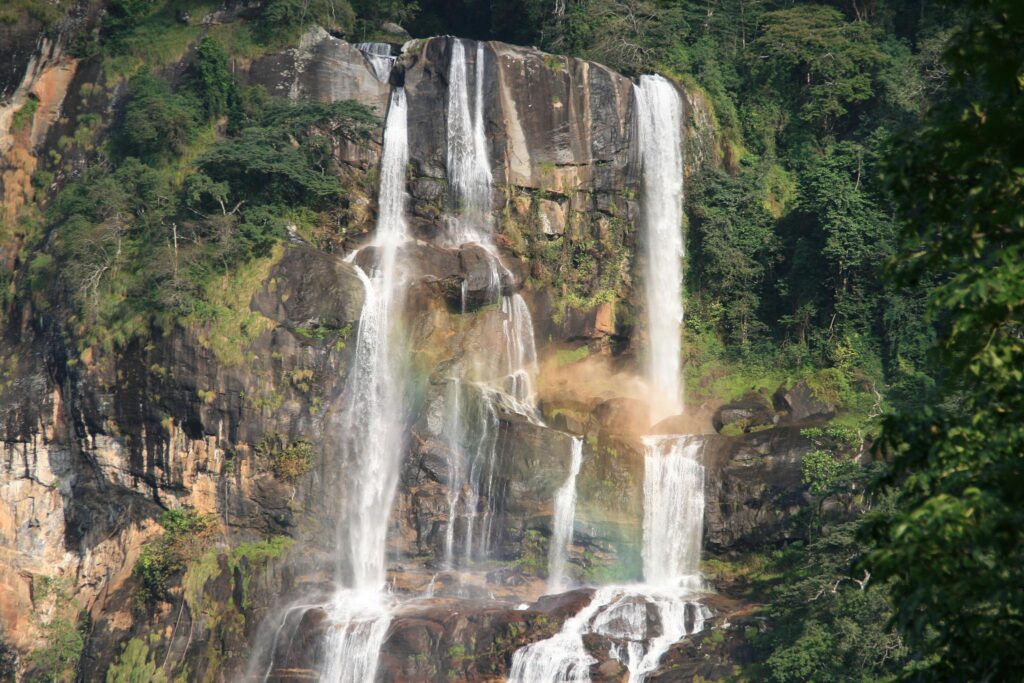
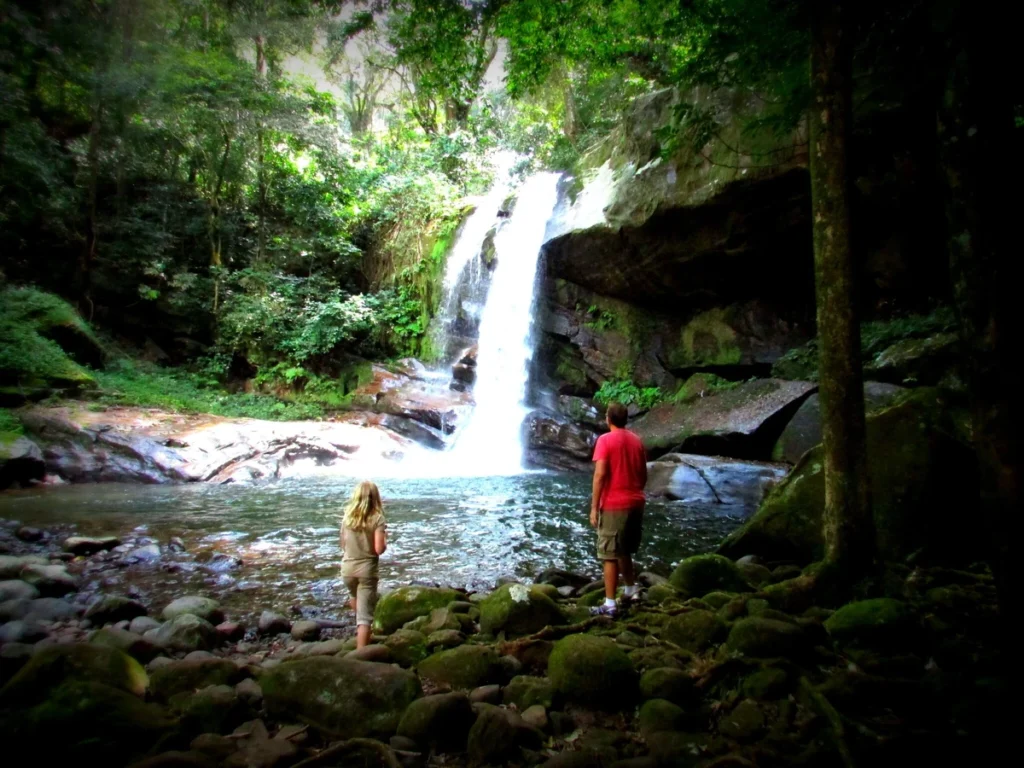
The park’s most popular and accessible trail. Starting from Sanje village near the main park gate, the trail follows the Sanje River upstream through rich lowland forest before climbing a series of natural terraces to the two-tiered Sanje Falls. Total elevation gain is approximately 300 metres. The trail crosses the river multiple times; water sandals are recommended in addition to boots. You can commonly see primates (particularly colobus and Sykes’ monkeys), forest birds, and butterflies en route. The lower pool, where the falls plunge into a crystal basin, provides one of the best swim spots in any national park in Tanzania. A full-day option is available to reach the upper falls and viewpoint.
Mwanihana Trail (Moderate–Hard | 2–3 days)
The classic multi-day forest traverse. This is the most rewarding trail for wildlife and botanical diversity, climbing from the park headquarters at Mang’ula through multiple vegetation zones to the Mwanihana Forest block, one of the park’s most botanically intact and scientifically important areas. The trail offers the best chance of encountering Sanje mangabeys, Udzungwa red colobus, and forest elephants. Camping en route (basic campsites provided by TANAPA) is part of the experience. Our guides know exactly which trails and which elevations give the best chances for each target species.
Luhomero Summit Trail (Hard | 4–5 days)
For serious hikers and peak-baggers. The trail to Luhomero Peak (2,576 m) is Udzungwa’s most demanding and most rewarding multi-day hike. It passes through all of the park’s vegetation zones, from lowland forest through the bamboo belt to sub-alpine heath, with panoramic views from the summit across the Kilombero Valley and, on clear days, to the mountains of the Southern Highlands. This trail is physically challenging and requires excellent fitness, proper equipment, and an experienced TANAPA guide throughout. It is the Udzungwa equivalent of a Kilimanjaro trek: sustained, physically demanding, and deeply rewarding.
Sonjo Trail and Valley Walks (Easy | 2–4 hours)
For travelers who want a gentle introduction to the forest without a major hike, the Sonjo Trail and various shorter valley walks offer accessible options with high wildlife reward. These are ideal for families with children, older travelers, or those who want a morning forest walk before continuing their journey to other destinations. Primate sightings, birdwatching, and botanical interest are excellent even on the shorter routes.
Night Forest Walks (Moderate | 2–3 hours)
An often-overlooked but extraordinary option: TANAPA guides lead night walks from the park gate into the adjacent forest, searching for nocturnal species: bushbabies, civets, chameleons, and the remarkably diverse community of night-flying moths and insects. The forest at night sounds entirely different from the forest by day, a layered symphony of frogs, insects, and owls that reveals just how alive the ecosystem is after dark.
Best Time to Visit Udzungwa Mountains National Park
Udzungwa can be visited year-round, but the experience varies significantly by season. For a complete seasonal overview of Tanzania’s national parks and ecosystems, see our detailed best time to visit Tanzania guide.

June – October: Dry Season (Best Overall)
This is unquestionably the prime window for hiking, primate tracking, and birdwatching at Udzungwa. Trails are drier and firmer underfoot, leeches (a real consideration in wet season!) are absent, river crossings are lower and safer, and wildlife visibility is at its best as animals concentrate around water sources. The forest is slightly less lush than in the wet season, but the walking conditions are far superior. This window also aligns perfectly with the Serengeti’s Great Migration season, making a combined Udzungwa trek and northern circuit safari one of Tanzania’s finest all-round itineraries.
January – February: Short Dry Season (Excellent)
The period between the long and short rains is another excellent window, particularly for birdwatching. The forest is intensely green after the November–December short rains, and the bird activity is extraordinary as species take advantage of the post-rain flush of insects and fruit. Sanje Falls is at its most spectacular during and immediately after the rains; the volume of water is tremendous. Leeches begin to appear in this period but are manageable.
March – May: Long Rains (Avoid for Hiking)
The long rainy season makes forest trails extremely muddy, river crossings potentially dangerous, and leeches abundant on every trail. Waterfall views impress, but the hiking experience suffers significantly. We advise most clients to schedule their Udzungwa visit outside this window.
November – December: Short Rains (Manageable)
Short afternoon showers in November–December can make trails slippery, but mornings are often clear and excellent for hiking. The forest is vibrantly lush. This is a viable option for flexible travelers who are comfortable with the occasional rain shower. Waterfalls are at their most dramatic immediately following heavy rainfall.
How to Get to Udzungwa Mountains National Park
Udzungwa Mountains National Park is located in south-central Tanzania, approximately 350 kilometers from Dar es Salaam and 65 kilometers from Mikumi. The park headquarters and main trailhead are located near the village of Mang’ula.
By Road from Dar es Salaam (5–6 hours)
The most common route is by road from Dar es Salaam along the TANZAM Highway (A7) through Morogoro and Mikumi. The drive takes approximately 5–6 hours in good conditions, passing through Mikumi National Park, where roadside wildlife sightings (elephant, giraffe, buffalo, and lion) are common even from the main road. This makes for a genuinely scenic approach drive that can be incorporated into a broader southern circuit itinerary.
Via Mikumi National Park (65 km | 1 hour)
For travelers already visiting Mikumi National Park, which sits adjacent to the eastern boundary of Udzungwa, a 65-kilometer drive along a well-maintained tarmac road connects the two parks in under an hour. Combining Mikumi’s game drives with Udzungwa’s forest hiking creates a well-rounded southern circuit experience that balances traditional Big Five safari experiences with something far more active and intimate.
By Charter Flight to Mikumi Airstrip
Charter flights operate from Dar es Salaam, Arusha, and Zanzibar to Mikumi’s grass airstrip, from where Udzungwa is a 90-minute road transfer. For clients on tight schedules, the fly-in approach avoids the long road trip and allows more time in the parks. Active African Vacations arranges all charter connections as part of our all-inclusive southern circuit packages.
As Part of a Southern Circuit Safari
The most natural context for a Udzungwa visit is as part of a broader southern Tanzania itinerary combining Mikumi, Udzungwa, and Nyerere National Park (the former Selous Game Reserve). This southern circuit is Tanzania’s most underrated safari experience: vast, wild, and almost entirely devoid of the tourist traffic that characterizes the northern parks. Our team has refined this routing over 12+ years of southern circuit safari operations.
Frequently Asked Questions about Udzungwa Mountains National Park
What is Udzungwa Mountains National Park famous for?
Udzungwa Mountains National Park is most renowned for its extraordinary biodiversity, particularly its endemic primates (the Udzungwa red colobus and the Sanje mangabey, both found nowhere else on Earth) and its 400+ bird species, including approximately 30 Eastern Arc endemics. The park is also renowned for the spectacular 170-meter Sanje Waterfall and for offering Tanzania’s finest forest hiking experience outside of a game drive context.
What animals live in Udzungwa Mountains National Park?
Udzungwa protects an exceptional diversity of wildlife across its multiple habitat zones. Primates include the endemic Udzungwa red colobus and critically endangered Sanje mangabey, along with the Angola colobus, Sykes’ monkey, yellow baboon, and blue monkey. Large mammals include the African elephant, lion, leopard, African buffalo, and bushbuck. The park’s reptile and amphibian fauna includes numerous Eastern Arc endemics, and its butterfly diversity is exceptional. Over 400 bird species have been recorded.
Is Udzungwa Mountains National Park excellent for hiking?
Yes, Udzungwa is Tanzania’s premier forest hiking destination and one of the finest walking parks in East Africa. All experiences are on foot, guided by TANAPA park guides. Trails range from a half-day waterfall walk (Sanje Falls, 3–5 hours return) to a challenging 4–5 day summit traverse to Luhomero Peak (2,576 m). The forest terrain is lush, dramatic, and richly biodiverse at every elevation, making it rewarding for walkers of all fitness levels.
How do I get to Udzungwa Mountains National Park?
The park headquarters at Mang’ula is approximately 350 km from Dar es Salaam (5–6 hour road transfer) and 65 km from Mikumi National Park (1 hour). Charter flights are available from Dar es Salaam, Arusha, and Zanzibar to Mikumi airstrip. Most travelers visit Udzungwa as part of a southern circuit itinerary combining it with Mikumi and Nyerere National Park.
What is the best time of year to visit Udzungwa?
The best time to visit Udzungwa Mountains National Park is during the dry season, June to October, when hiking trails are dry, river crossings are safe, leeches are absent, and wildlife visibility is at its peak. The short dry season from January to February is an excellent secondary window, especially for birding, when the forest is intensely green after the November rains. See our best time to visit Tanzania guide for full seasonal details.
How many days do you need at the Udzungwa Mountains?
We recommend a minimum of 2 nights / 2 full days to experience the Sanje Waterfall trail and a forest primate walk. For a more comprehensive experience, including Mwanihana Forest and a chance of Sanje mangabey encounters, 3–4 nights is ideal. The Luhomero Summit trek requires 4–5 days dedicated entirely to the mountain. Most of our clients combine 2–3 nights at Udzungwa with adjacent parks as part of a longer southern circuit itinerary.
Are there luxury lodges inside Udzungwa Mountains National Park?
There is currently no large-scale luxury lodge within the national park itself. Accommodation options near the park gate at Mang’ula include small lodges and tented camps of varying quality. For our clients who prefer guaranteed luxury, we arrange stays at the nearest high-quality properties and use the park purely for day activities, returning to comfortable accommodation each evening. Contact our team for the most current recommended properties near the park.
Are the Udzungwa Mountains suitable for families with children?
Udzungwa can be excellent for families with older children (typically 8+) who are genuinely interested in nature, hiking, and wildlife. The Sanje Waterfall trail is manageable for older children and offers a high wildlife reward. For families with younger children, the easier valley walks are a good introduction to forest wildlife. Mikumi National Park, which is immediately adjacent, offers excellent vehicle-based safari activity for families seeking a complementary game drive experience.
Can I see chimpanzees in the Udzungwa Mountains?
No, chimpanzees are not found in Udzungwa Mountains National Park. The park’s star primates are the endemic Udzungwa red colobus and the Critically Endangered Sanje mangabey. For chimpanzee trekking in Tanzania, the premier destinations are Mahale Mountains National Park and Gombe National Park on Lake Tanganyika, or Rubondo Island National Park on Lake Victoria. Our team can incorporate chimp trekking into a broader western Tanzania itinerary.
How does Udzungwa compare to other Tanzania hiking destinations?
Udzungwa and Mount Kilimanjaro are Tanzania’s two premier hiking destinations, but they offer fundamentally different experiences. Kilimanjaro is a high-altitude summit challenge through open alpine zones; Udzungwa is a tropical forest immersion through some of the most biodiverse terrain in Africa. Kilimanjaro requires significantly more preparation and fitness for the summit; Udzungwa’s trails are more accessible. Many of our clients do both in the same Tanzania itinerary, a superb combination.
What should I pack for a Udzungwa Mountains trek?
Essential items include waterproof hiking boots (the trails involve river crossings regardless of season), long-sleeved shirts and trousers for forest trekking (insect and leech protection), a quality rain jacket, DEET-based insect repellent, binoculars (essential for primates and birds), a daypack, water bottles, and high-energy snacks. In wet season, leech socks or gaiters are strongly recommended. A detailed kit list is provided to all our clients upon booking.
Is there malaria in the Udzungwa Mountains?
Yes, Udzungwa Mountains National Park is a malaria zone, particularly in the lower elevation areas and valley floors. Anti-malarial prophylaxis is strongly recommended and should be arranged with a travel medicine specialist at least 6–8 weeks before departure. Long-sleeved clothing at dawn and dusk, DEET repellent, and sleeping under nets are standard precautions. At higher elevations (above 2,000 m) the malaria risk is significantly lower, but protection should be maintained throughout the trip.
Can Udzungwa Mountains be combined with a Serengeti safari?
Yes, and it creates a wonderfully varied Tanzania itinerary. A standard combination might spend 3–4 nights in Udzungwa hiking and forest tracking, then fly from Dar es Salaam or Mikumi to Serengeti National Park for 4–5 days of private game drive safari before finishing with a Ngorongoro Crater visit. The contrast between the mossy, dripping forest world and the vast open plains could not be more dramatic, and that is precisely the point.
Are guided walks mandatory in Udzungwa Mountains National Park?
Yes, TANAPA regulations require all visitors to be accompanied by a licensed park guide on all trails within Udzungwa Mountains National Park. Self-guided walking is not permitted. This regulation exists both for visitor safety (the park contains elephants, buffaloes, and other potentially dangerous wildlife) and for the protection of the park’s sensitive ecology. Our guides are TANAPA-licensed naturalists who add enormous value to every forest walk through their expert knowledge of primate behavior, bird identification, and plant ecology.
How does Udzungwa fit into a broader Tanzania safari itinerary?
Udzungwa works best as the ‘active adventure’ component of a broader Tanzania itinerary, the part of the trip that gets you off the game drive vehicle and into the forest on foot. Most commonly it is paired with the southern safari circuit (Mikumi, Nyerere, and Ruaha) or combined with Zanzibar beach time as a post-trek wind-down. A southern safari featuring Udzungwa is the single most distinctive offering for repeat Africa travelers seeking something beyond the well-worn northern circuit.
Why Book Your Udzungwa Mountains Trek with Luxury Safaris Tanzania?
Active African Vacations has been planning bespoke Tanzania itineraries, including southern circuit experiences featuring Udzungwa, from our Arusha base for over 12 years. With more than 10,000 satisfied travelers, full ATOL financial protection, and a team of expert local guides and safari specialists, we bring the same rigor and personal attention to a 3-night forest trek that we bring to a 14-day northern circuit luxury safari.
- Fully tailor-made itineraries: Your Udzungwa trek is designed from scratch around your fitness level, interests, and overall Tanzania ambitions.
- Our TANAPA-licensed guides know Udzungwa’s trails, primates, and bird species with genuine depth, not just surface-level identification.
- Seamless logistics: Road transfers, charter flights, accommodation, park permits, and guide arrangements managed invisibly by our Arusha team.
- ATOL protects your investment with full financial protection, so you can travel with complete peace of mind.
- Transparent pricing: Park fees, guide fees, accommodation, and transfers are quoted clearly and completely from the start.
- Unique combinations: We connect Udzungwa seamlessly with Mikumi, Nyerere, Ruaha, Zanzibar, the Serengeti, and beyond.
Udzungwa Mountains National Park is the Tanzania that most visitors never find and those who do never forget. Explore our full range of Tanzania safari experiences, discover our southern Tanzania safari destinations, or reach out directly to begin planning a trip that takes you somewhere genuinely extraordinary.