
Photography Safaris in Tanzania: Capture Africa’s Wildlife in Perfect Light
A photography safari in Tanzania is a tailor-made wildlife experience specifically optimized for capturing images of Africa’s most extraordinary animals, landscapes, and natural phenomena. Unlike a standard game drive, a photography safari is built around the mechanics of exceptional photography: private vehicles with roof hatches for 360-degree access, low-angle shooting platforms, and flexible schedules structured around golden-hour light rather than fixed park timetables. Tanzania’s Serengeti National Park, Ngorongoro Conservation Area, Tarangire National Park, and Lake Manyara National Park together form one of the world’s most productive wildlife photography destinations, offering a range of subjects from the river crossings of the Great Wildebeest Migration to tree-climbing lions, ancient elephant herds beneath baobab trees, and the calving season’s newborn wildebeest and their predators. With specialist photography guides trained in animal behavior, private vehicles that can be positioned precisely for the light and angle, and an unparalleled density of wildlife subjects, Tanzania consistently delivers images that appear in the world’s leading wildlife photography publications and competition galleries.
Quick Facts: Tanzania Photography Safari at a Glance.
| DETAIL | INFORMATION |
| Best Parks | Serengeti, Ngorongoro Crater, Tarangire, Lake Manyara, Ruaha, Nyerere |
| Best Light | 06:00–08:30 hrs (golden hour) & 16:30–18:30 hrs: plan game drives around this |
| Best Season | June–October (dry) for concentrations; Jan–March for calving & green-season texture |
| Vehicle Setup | Private 4×4 Land Cruiser with roof hatch, bean bags, beanbag mounts, charging points |
| Recommended Lenses | 70–200mm f/2.8; 100–400mm; 500–600mm prime; 16–35mm wide for habitat shots |
| Guide Type | Specialist photography guides trained in animal behaviour prediction |
| Balloon Option | Serengeti hot air balloon safari aerial photography from 06:00 hrs |
| Add-On Destination | Zanzibar macro, marine, portrait, and lifestyle photography |
| Contact | info@luxurysafaristanzania.com | WhatsApp: +255 683 311 134 |
Why Tanzania is the World’s Premier Photography Safari Destination
Ask any serious wildlife photographer where they would choose to spend two weeks with unlimited film, metaphorically speaking, and the answer, more often than not, is Tanzania. Not Kenya, not Botswana, not South Africa (all of which are extraordinary in their own right), but Tanzania. And specifically: the Serengeti. It is the most photographed wildlife landscape on Earth, and it earns that distinction every single day.
The reason is density. The Serengeti National Park hosts the highest concentration of large predators on Earth, an estimated 3,000 lions, 1,000 leopards, and 250 cheetahs across its 14,763 square kilometers, alongside the famous Great Wildebeest Migration of 1.5 million wildebeest and 500,000 zebra that move in a perpetual clockwise rotation through the ecosystem. Every drive in this landscape is an encounter with life and death at its most elemental, and for a photographer, every drive is a portfolio session.
Beyond the Serengeti, the Ngorongoro Conservation Area offers the world’s most productive Big Five photography within the confines of a 260-square-kilometer volcanic caldera, a natural amphitheater where every subject stays within the bowl. Tarangire National Park delivers Africa’s most dramatic elephant herds against a backdrop of ancient baobab trees that no other park on the continent can rival. Lake Manyara National Park specializes in tree-climbing lions and flamingo flocks that create abstract impressionist images from the lakeside. And the remote Ruaha National Park, Tanzania’s largest and least-visited, is a secret that professional photographers guard closely, with wild dog packs, sable antelope, and a photographic density that rivals the Serengeti at a fraction of the tourist volume.
We have designed specialist photography safaris for 12+ years, working with everyone from hobbyists shooting their first mirrorless camera to professionals published in National Geographic and Wildlife Photographer of the Year. In that time, we’ve learned exactly what makes a Tanzania photography safari exceptional and what amateurs get wrong that prevents them from bringing home the images their equipment is capable of capturing. This guide is our answer to both groups.
What Makes a Photography Safari Different from a Standard Game Drive?
A photography safari is a fundamentally different product from a standard lodge-based game drive, and understanding the difference is essential before booking. Here is exactly what distinguishes a purpose-built Tanzania photography safari from a conventional wildlife drive:
1. The Private Vehicle Advantage
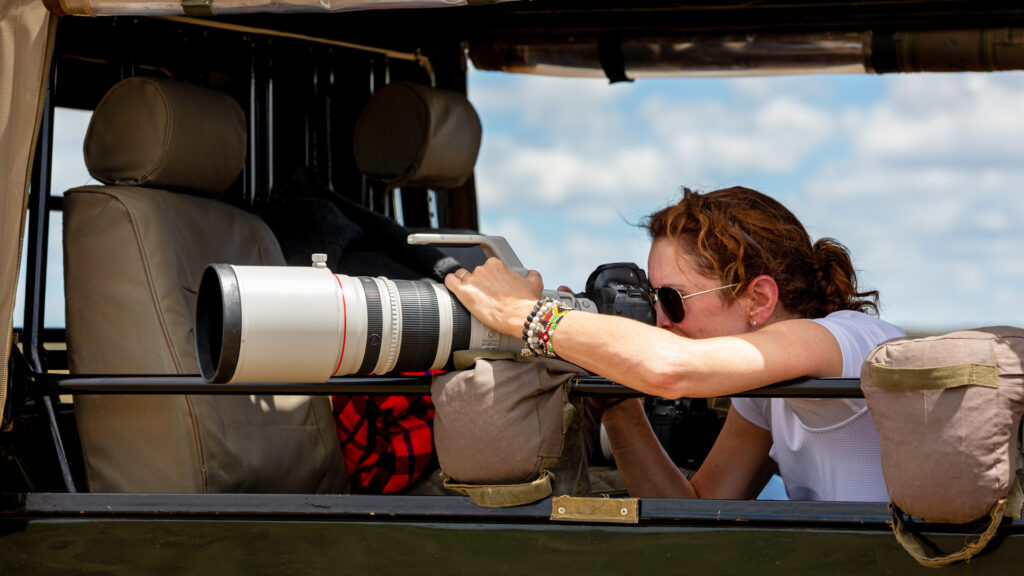
Every photography safari we design uses a private 4×4 Land Cruiser or Land Rover, never a shared group vehicle. This is non-negotiable for serious photography for one simple reason: positioning. Wildlife photography is 70% about vehicle placement relative to subject, light angle, and background. In a shared vehicle, you cannot reverse 30 metres to position the elephant against the open sky rather than the acacia bush. In a private vehicle, you can. You can stop for 45 minutes on a lion’s kill while the group vehicle has moved on. You can be at the Mara River at 05:45 before any other vehicle when the crossing begins. This singular advantage in positioning is what separates publishable wildlife photographs from tourist record shots.
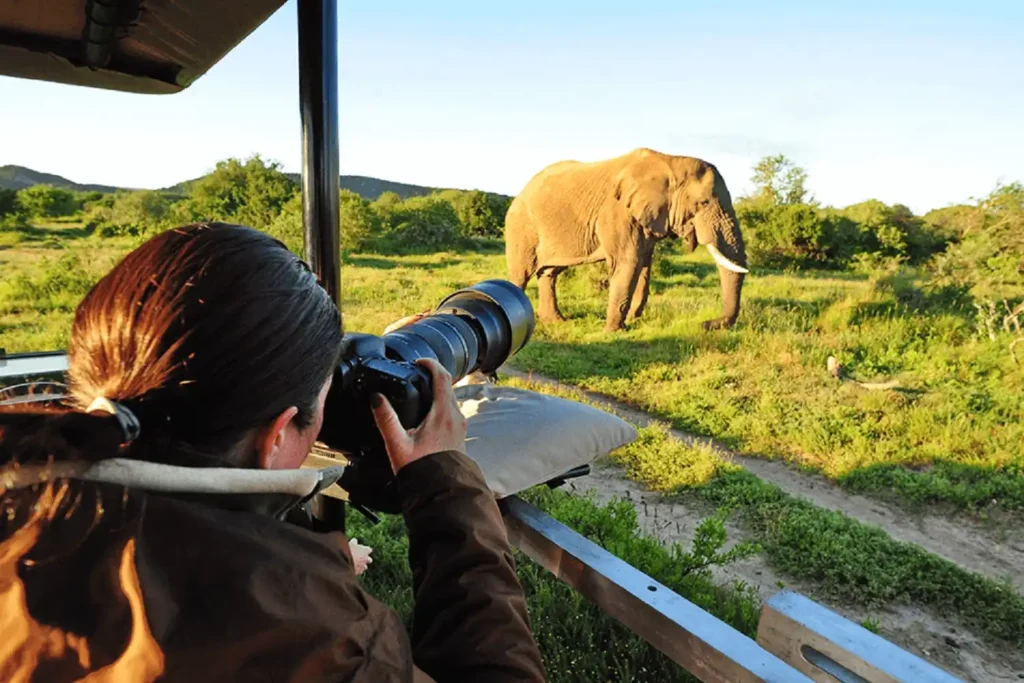
Our vehicles are fitted with roof hatches that open fully to allow 360-degree shooting from a standing position, and each seat position is equipped with a professional beanbag or window mount for camera stabilization. Charging points for camera batteries and laptop computers are standard. Cool boxes for water and snacks allow genuinely extended time in the field we do not limit game drive hours to suit a lodge timetable.
2. Specialist Photography Guides
“The quality of your guide determines the quality of your photography,” a statement that every professional wildlife photographer will endorse without hesitation. Our specialist photography guides are trained not only in the conventional skills of tracking and species identification but also specifically in animal behavior prediction, the ability to read a cheetah’s posture and know that it is about to begin a hunt; to read a wildebeest herd’s movement and know that it is building to a river crossing; to position the vehicle at the precise angle that places the lion’s face in the last shaft of golden-hour sunlight before it disappears.
These guides understand f-stops, focal lengths, and the relationship between shutter speed and subject motion. They know when to advise you to switch from your 400mm to your wide-angle for an environmental context shot. They know that the most powerful predator images are almost never the ones taken at maximum zoom; they’re the ones taken at 200mm that show the lion in relationship to its landscape.
3. Light-First Scheduling
A standard safari departs at 06:00 hrs and returns at 10:00 hrs for breakfast, then departs again at 16:00 hrs and returns at 19:00 hrs for dinner. This structure is designed around lodge mealtimes, not photography. A photography safari departs at 05:30 hrs to be in position before sunrise. The hour between 06:00 and 07:00 hrs is when the finest warm light falls on the plains and when predators are most active. We stay in the field through the mid-morning if an active hunt or river crossing is developing, and we are positioned for the return of golden light from 16:30 hours onwards. Meals happen when the light is bad. Game drives happen when the light is exceptional.
4. Extended Field Time
Patience is the foundation of extraordinary wildlife photography. The difference between a technically competent image and a world-class image is almost always the willingness to wait for the lion to turn its head, for the elephant to raise its trunk, or for the cheetah to freeze at the exact moment the setting sun catches its spotted coat. Our photography safaris are designed with buffer time built in at every stage, and our guides are trained to stay with a subject for as long as it takes to capture the definitive image.
Best Parks for Wildlife Photography in Tanzania: A Complete Guide
| Park | Peak Photo Season | Signature Shot Opportunities | Best For |
| Serengeti NP | Year-round | Migration columns, lion hunts, cheetah sprints, Mara River crossings from balloon | All skill levels |
| Ngorongoro Crater | Year-round | Dense Big Five, black-maned lions, giant tusker elephants, flamingos | Intermediate–Pro |
| Tarangire NP | Jun–Oct | Ancient baobabs + elephant herds; stunning wide-angle habitat shots | Landscape + Wildlife |
| Lake Manyara NP | Year-round | Tree-climbing lions, flamingo flocks (100,000+), forest-edge light | Specialist/Macro |
| Ruaha NP | Jun–Oct | Tanzania’s wildest park: kudu, sable, wild dog packs, low tourist density | Advanced/Remote |
| Nyerere NP | Jun–Oct | Boat safaris on Rufiji River; hippo pools, croc banks, waterbird flocks | Aquatic/Unique |
| Mahale Mountains | May–Oct | Chimpanzee portraits in forest light: unique primate photography | Primate specialist |
| Zanzibar Island | Year-round | Marine life, dhow sunsets, Stone Town portraits, spice-farm macro | Lifestyle/Portrait |
Serengeti National Park: The World’s Greatest Photography Stage
The Serengeti needs no introduction, but its photography-specific qualities deserve elaboration beyond the general wildlife statistics. The park’s open, gently rolling topography means sightlines are often clear across hundreds of metres, allowing telephoto compositions that place a single cheetah against an unobstructed golden horizon. The grass height varies dramatically by season: short, photogenic carpet-turf in January–March in the south; tall golden savannah grass in July–October in the north, creating entirely different visual aesthetics in the same location across the year.
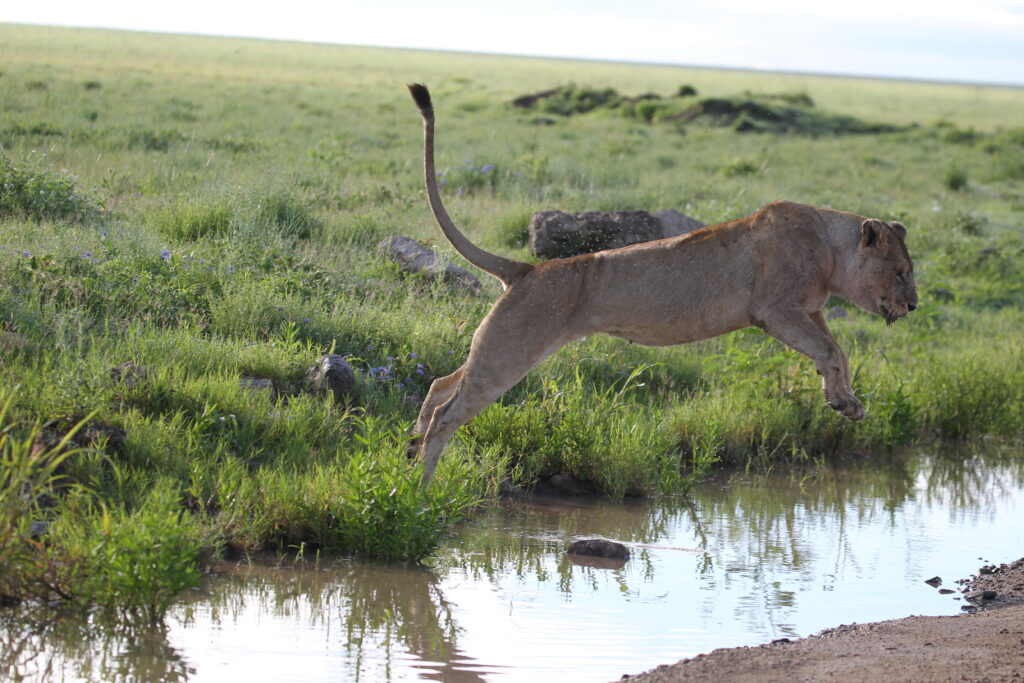
The Seronera River valley in central Serengeti is the year-round core of predator photography, with resident lion prides that have been studied and documented continuously since the 1960s, making them the most habituated lion populations on Earth, comfortable with vehicle presence at distances of 5–10 metres. For the Great Migration crossings, the Mara River at the park’s northern boundary is the destination between July and October, the most dramatic wildlife photography location in the world, where columns of wildebeest plunge into crocodile-filled water in scenes of controlled chaos that only the most prepared photographers manage to frame coherently.
We also offer Serengeti hot air balloon safaris as a photography safari add-on: departure at 05:30 hrs positions you above the plains at the precise moment of golden-hour light, allowing aerial composition opportunities of migration columns, elephant family groups, and the Serengeti’s undulating topography that no ground-level photographer can replicate.
Ngorongoro Conservation Area: The Big Five Bowl
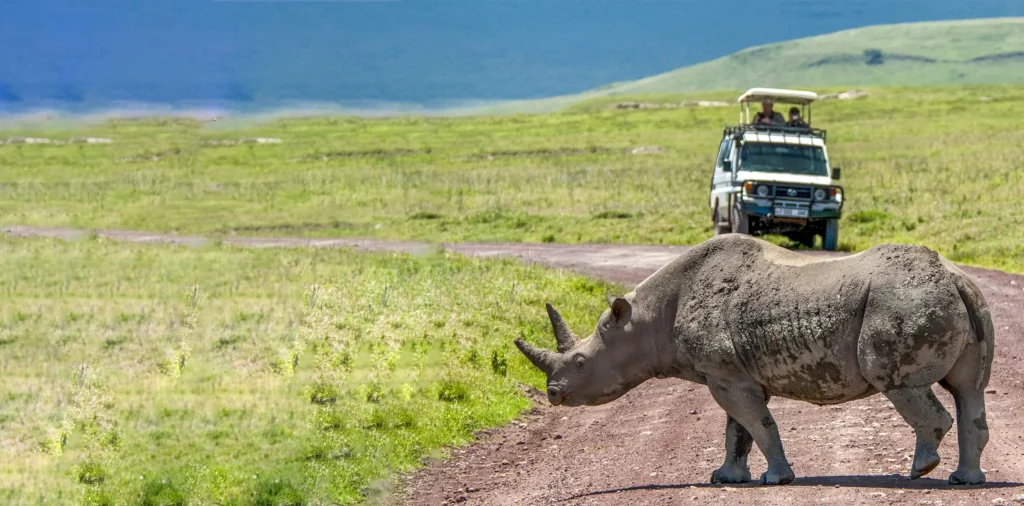
The Ngorongoro Crater is a photographic environment unlike anywhere else in Africa. The crater’s 260-square-kilometer floor holds approximately 25,000 large mammals in a permanent, self-contained ecosystem; you cannot drive five minutes without encountering a photographic subject. The black-maned lions of Ngorongoro are legendary in wildlife photography circles; the distinctive dark manes are a genetic adaptation to the crater’s cooler, wetter climate and produce portrait images of exceptional drama.
The crater’s geography creates another photographic phenomenon that few guides mention: morning mist. On clear nights, cool air drains into the caldera after dark and creates a low-lying mist layer that sits on the crater floor until approximately 08:30 hrs. Descending into the crater at first light and finding the mist-shrouded herds emerging from the fog, with wildebeest silhouettes in grey mist gradually resolving into detail as the sun burns through, is one of the most extraordinary photographic experiences available anywhere in Africa.
Tarangire National Park: Landscapes, Elephants, and Baobabs
Tarangire National Park is unmissable for photographers who value the relationship between wildlife subjects and their natural environment, which National Geographic editors refer to as ‘environmental portraits.’ The park’s defining visual element is its ancient baobab trees, some estimated to be over 1,000 years old, whose swollen grey trunks create a backdrop of surreal, almost architectural grandeur behind which elephant herds of 200 or more individuals move in slow-motion splendor.
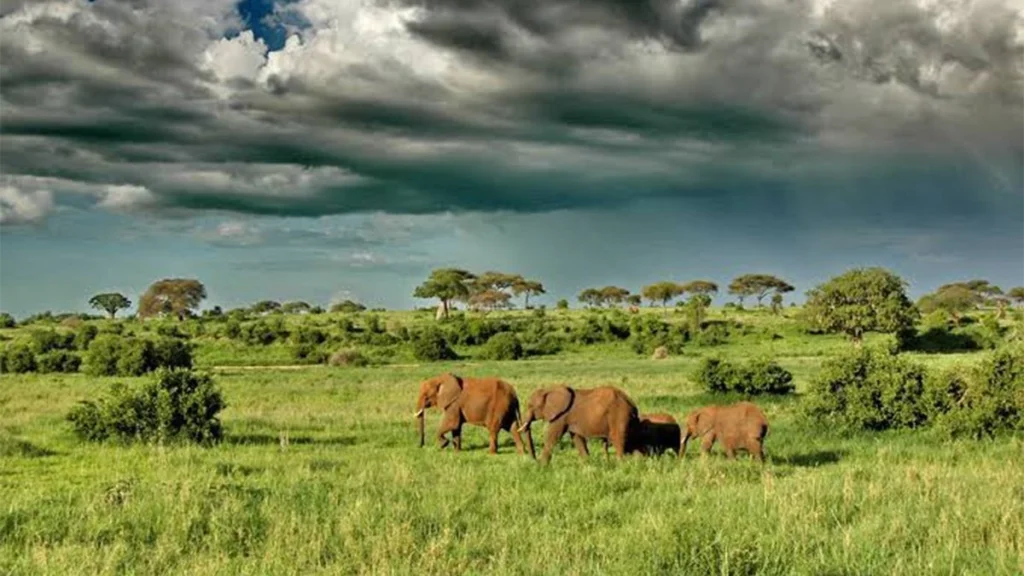
During the dry season (June–October), the Tarangire River becomes the only water source for hundreds of kilometers of surrounding wilderness, and the resulting concentration of wildlife at its banks creates a sustained photographic opportunity of a density that approaches the Serengeti at its best. The park’s birdlife is also exceptional, with over 550 recorded species, including the spectacular yellow-collared lovebird and the endemic Ashy Starling, making Tarangire the best park in Tanzania for dedicated bird photography alongside mammal work.
Lake Manyara National Park: Specialist Subjects
Lake Manyara is a compact park, only 330 square kilometers, but its specialties are genuinely unique. The famous tree-climbing lions of Manyara are the park’s headline subject: typically sleeping in the crooks of acacia trees during the warm midday hours, they create compositional opportunities that combine the familiar (lion) with the extraordinary (5 metres off the ground in a tree) in a way that consistently produces award-winning images. Timing is critical: the lions typically ascend by 09:30 hrs and descend around 16:00 hrs, so your visit timing matters enormously.

The lake itself hosts flamingo aggregations of up to 100,000 birds during optimal water-level periods, creating abstract pink-and-white impressionist images that look unlike any other wildlife photographs. A telephoto compression shot along the flamingo line, 400mm or longer, at ground level from the lake’s edge, is a Lake Manyara signature image.
Ruaha National Park: The Pro’s Choice
When professional wildlife photographers ask us where to go in Tanzania for serious work away from the crowds, we send them to Ruaha National Park in the Southern Circuit. Tanzania’s largest national park by area (20,226 square kilometers), Ruaha receives fewer than 5% of the tourists who visit the Serengeti, meaning you will regularly have key wildlife subjects entirely to yourself, without the competitive positioning that can frustrate serious photographers at busy northern circuit waterholes during peak season.
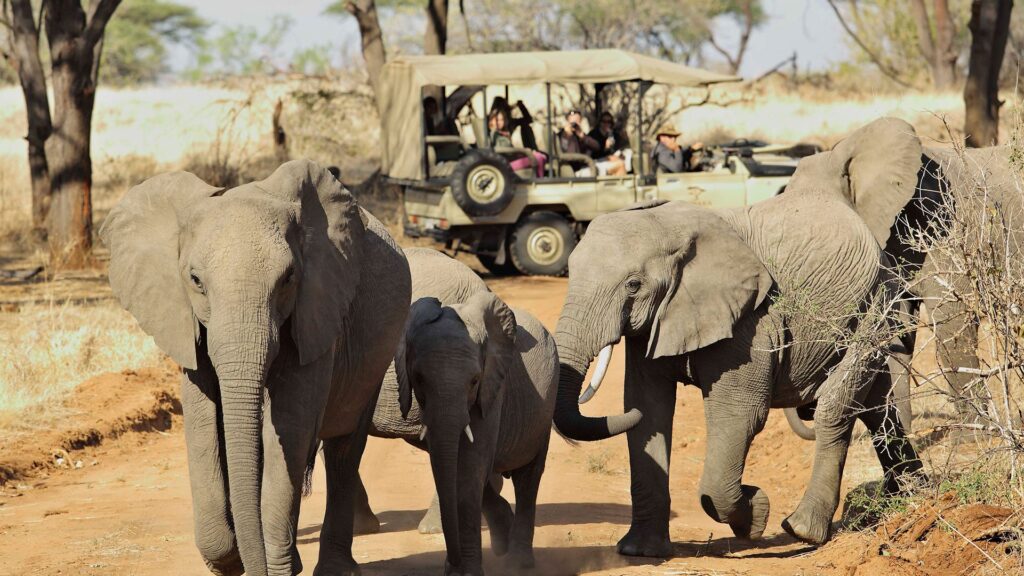
Ruaha’s specific wildlife subjects are also unique within Tanzania: African wild dog packs are reliably encountered and have been extensively studied, giving our guides excellent predictive knowledge of their denning and hunting patterns. Sable antelope, greater kudu, and roan antelope, all rarely seen in the northern parks, appear regularly. The Great Ruaha River’s diminishing dry-season pools create extraordinary waterhole photography at a scale of intimacy that the northern parks’ larger permanent rivers cannot match.
Nyerere National Park: Boat Safari Photography
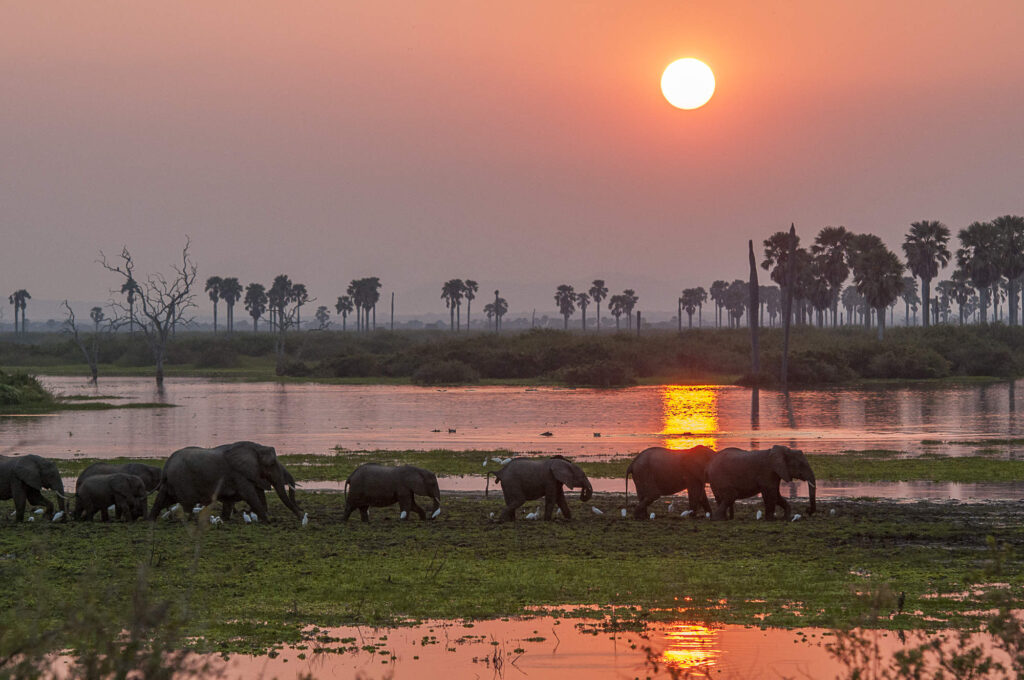
The addition of Nyerere National Park (formerly Selous Game Reserve, now Africa’s largest national park at 50,000 square kilometers) to a photography safari itinerary introduces a dimension that no other northern circuit park can provide: boat safari photography on the Rufiji River. From a motorized inflatable raft or traditional wooden boat at water level, you photograph hippos from below eye level, their heads emerging from reflective dark water, surrounded by rings of ripples, at distances of 4–8 metres. Nile crocodiles on river sandbanks. Fish eagles diving for prey. Elephant herds crossing the river, trunks raised. This is photography that cannot be obtained from any land vehicle, and the results are images that immediately distinguish a Tanzania portfolio.
Best Time for a Photography Safari in Tanzania: Month-by-Month
Tanzania’s photography calendar is genuinely complex; what constitutes ‘best’ depends entirely on what you want to photograph. The month-by-month guide below reflects our assessment purely from a photography perspective, taking into account light quality, wildlife behavior, and subject availability.

| Month | Photography Conditions | Rating |
| Jan | Calving season, Ndutu. Predator-prey interactions at peak intensity. Green landscape. | ★★★★★ |
| Feb | Calving continues. Newborn wildebeest = intense cheetah & lion action. Soft light. | ★★★★★ |
| Mar | Long rains begin. Dramatic storm clouds. Fewer tourists. Green-season texture. | ★★★★ |
| Apr | Heavy rains. Some tracks are impassable. Low light. Deep green vegetation. | ★★ |
| May | Rains easing. Lush, empty parks. Low angles of light through wet grass. | ★★★ |
| Jun | Dry season opens. Migration is moving north. Excellent clarity. | ★★★★ |
| Jul | Peak season. Mara River crossings begin. High drama, golden dust. | ★★★★★ |
| Aug | River crossings continue. Dust haze adds texture. Book well ahead. | ★★★★★ |
| Sep | Northern Serengeti. Migration still active. Increasingly clear skies. | ★★★★★ |
| Oct | Migration returns south. Dramatic skies; short rains possible by end-month. | ★★★★ |
| Nov | Short rains. Storm-light photography. Green grass returning. Fewer visitors. | ★★★★ |
| Dec | Festive season. Short rains ending. Migration in the south. Varied light. | ★★★★ |
The Calving Season (January–March): Our Top Recommendation
If we could direct every photography safari client to a single period, we would choose January through early March without hesitation. The calving season on the Ndutu short-grass plains in southern Serengeti and northern Ngorongoro is the most concentrated predator-prey interaction event in the world. During this period, up to 500,000 wildebeest calves are born in a short 2–3 week window, a deliberate evolutionary strategy that overwhelms predator capacity and creates extraordinary scenes of cheetahs, lions, hyenas, and wild dogs hunting in conditions of extraordinary abundance.

The light in January and February is also particularly soft and warm, with a lower sun angle than peak dry season, frequent dramatic cloud formations that diffuse harsh midday light, and the green landscape of the just-rained-on short-grass plains providing a richness of color that the tawny brown of the dry season cannot match. The best time to visit Tanzania guide on our website covers the calving season in detail, as well as the migration calendar.
Dry Season (June–October): Peak Migration Photography
The dry season is peak tourist and photography season for the wildebeest migration’s northern movement and Mara River crossings. From July through October, the Mara River crossings deliver the most dramatic wildlife images captured anywhere in Africa each year. The light in July and August can be hazy (dust raised by the migration herds hangs in the morning air), which can add atmospheric texture to certain compositions but can also reduce contrast and clarity in others.
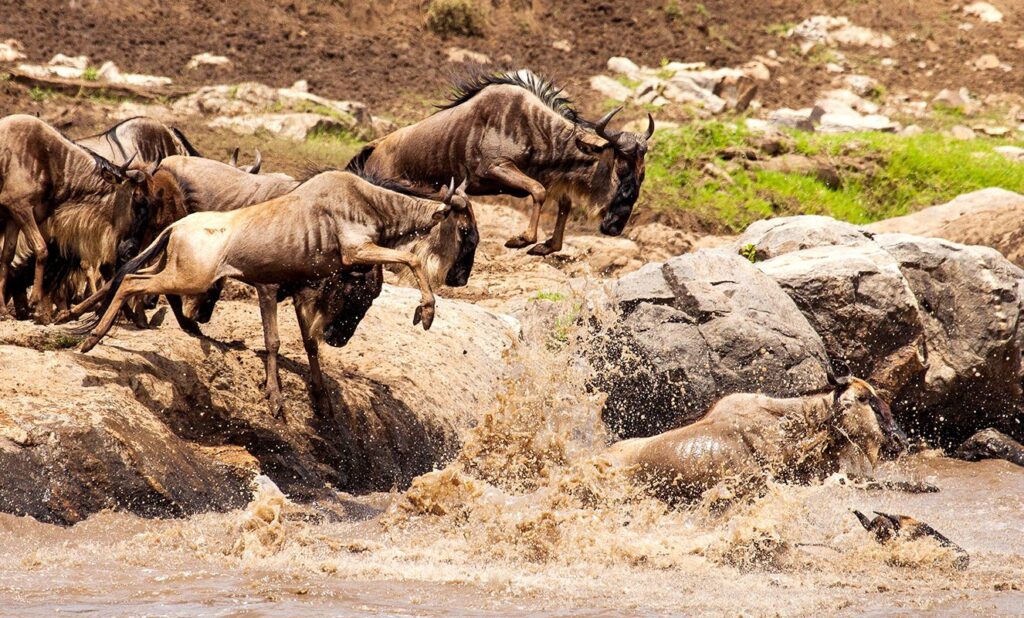
October is often our preferred month for serious photography: the migration is in the north, the short rains have not yet begun, the light is cleaner than in peak season, and the lodges and camps are slightly less crowded, giving our guides better vehicle positioning options at key locations. Our Tanzania safari packages include dedicated October photography itineraries for guests who want the migration without the peak-season vehicle concentration.
Green Season (November–May): The Photographer’s Secret
The green season is chronically underrated by photographers who prioritize convenience over image quality. The short rains of November and December, and the green landscapes of March through May, create visual conditions that professional photographers often prefer: dramatic cumulus cloud formations that provide natural light diffusion and moody backgrounds; the rich green savannah grass that makes even a mediocre predator image look extraordinary; and the absence of tourist vehicles that means the landscape behind your subject is clean, empty, and uncontaminated by Toyota dust clouds.
Photography Safari Gear: What to Bring and Why
The question we receive most frequently from first-time photography safari guests is about gear, specifically whether their current equipment is adequate for Tanzania. Our general position: the quality of your images on a photography safari is determined by 80% skill and positioning (which we provide through our guides and vehicles) and 20% equipment. That said, certain equipment limitations will prevent you from capturing specific subjects regardless of skill. Here is our definitive photography safari gear guide:
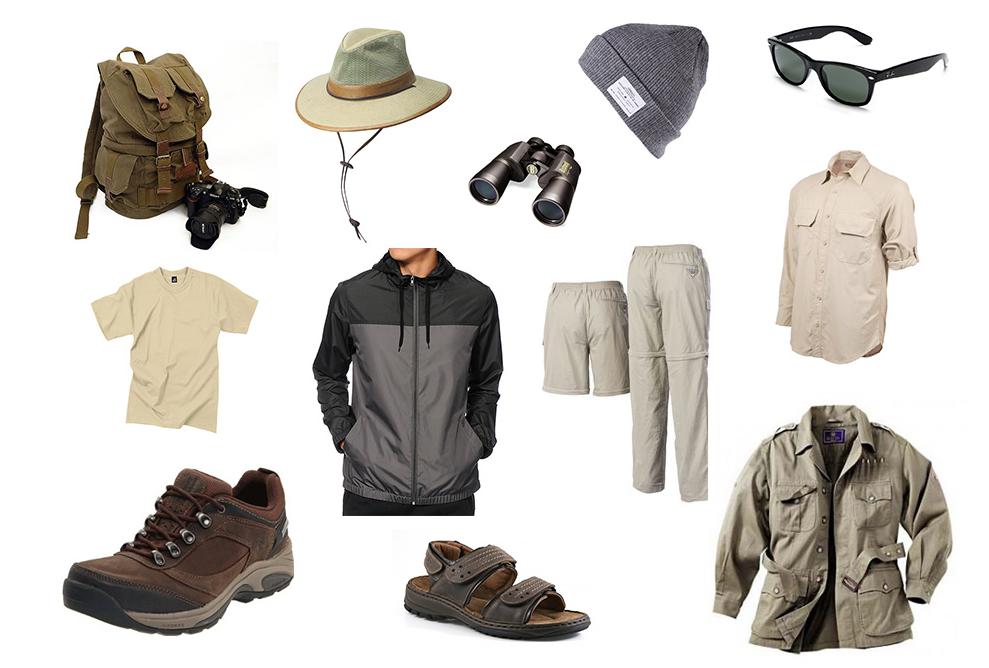
| Item | Notes & Recommendations |
| Camera Body (Primary) | Full-frame mirrorless (Sony A9 III, Nikon Z9, Canon R3) or DSLR. Dual card slots are essential. |
| Camera Body (Backup) | Always bring a second body. Dust and humidity are real; never rely on a single body. |
| Telephoto Zoom | 70–200mm f/2.8 or 100–400mm f/4.5–5.6 is the most versatile safari lens range. |
| Super-Telephoto | A 500mm or 600mm prime for lions and cheetahs at a distance. f/4 minimum for usable shutter speeds. |
| Wide-Angle | 16–35mm or 24–70mm for habitat landscapes, the Milky Way, and environmental portraits. |
| Bean Bag / Window Mount | Essential. No tripod is stable enough in a moving vehicle bean bags beat tripod heads every time. |
| Memory Cards | Minimum 10 × 128GB high-speed cards (UHS-II or CFexpress). You will fill them. |
| Batteries & Chargers | 4–6 batteries per body minimum. Vehicle charging adapters (12V). Solar backup. |
| Sensor Cleaning Kit | Dust is pervasive. Use the Arctic Butterfly, sensor swabs, and Sensor Gel Stick. Learn to use them before leaving home. |
| Rain Cover / Protection | LensCoat or Think Tank rain covers. Even dry-season afternoons can deliver brief showers. |
| Laptop + Hard Drives | For daily backup and tethered review. 2 × external SSDs (2TB each) for redundancy. |
| Neutral Density Filters | For vehicle motion panning shots, waterfall effects at Ngorongoro, and sunset river scenes, this filter is ideal. |
| Polarising Filter | Eliminates water surface glare for waterhole and river photography. Saturates sky and foliage. |
📷 PRO TIP: The Single Most Important Thing You Can Do Before DepartureSpend one full day before your safari shooting moving subjects in low light with your actual safari kit: dogs running in a park, birds in flight at a pond, cyclists on a street at dusk. Learn the continuous autofocus tracking modes on your specific camera body. Know how to switch focus modes without looking at the camera. Set your camera to a high-speed burst mode and leave it there. The Serengeti will not wait while you navigate menus. |
Photography Techniques and Settings for Safari Wildlife
A complete technical guide to wildlife photography settings would fill a book. What follows are the specific techniques and settings most relevant to the Tanzania safari environment, the things our guides brief guests on before their first drive.
Shutter Speed: The Non-Negotiable Foundation
Shutter speed is the single most critical variable in wildlife photography and the most commonly misunderstood. The general rule: your shutter speed should be no slower than 1/focal length for static subjects (1/400s for a 400mm lens), but for moving wildlife, you need considerably faster. A running cheetah at 30 metres requires a minimum shutter speed of 1/2000 seconds to freeze leg motion. A bird in flight requires 1/3200 s or faster. A lion turning its head requires 1/1000th minimum. Photographers should err on the side of using a higher ISO and accept minor noise rather than allowing motion blur; a sharp image at ISO 6400 is always more publishable than a perfectly exposed blur.
Aperture and Depth of Field: When to Open Up
New photographers instinctively shoot at maximum aperture (f/2.8 or f/4) for the creamy bokeh background they’ve seen in published wildlife images, which is correct in principle but needs nuance in practice. A lion face at 5 metres on f/2.8 risks throwing one eye out of focus while the other is sharp technically, an arresting image, but frustrating if the out-of-focus eye is the one facing the camera. When shooting single animals at close range, we recommend f/4–f/5.6 for sufficient depth of field to cover the animal’s face. Reserve f/2.8 for extreme low light or when deliberate selective focus is your creative intent.
Golden Hour: Managing the Magic and Its Limitations
The golden hour (the first and last hour of sunlight) delivers the warm, directional, low-angle light that defines the best safari images. The challenge is that this light lasts only 40–50 minutes at the equatorial latitudes of northern Tanzania; it comes up fast, changes rapidly, and disappears. Our guides structure the drive to be with the best available subject at the onset of golden light, not travelling toward a subject when the light is at its peak. This means scouting in the morning before identifying an active predator or promising waterhole the previous afternoon so you arrive at your chosen subject at first light rather than discovering it after the golden window has already opened.
Composition: The Three Rules That Matter in the Field
Composition theory has many rules, but in the field when you have 3 seconds to frame and fire before the cheetah turns only three matter:
- Eye-level is everything: get the vehicle as low as possible and shoot out the side window rather than the roof hatch when the subject is at ground level. A lion photographed at eye level looks powerful and intimate. Photographed from above, it looks like a zoo.
- Place the eye on the rule of thirds intersection: the viewer’s gaze goes immediately to the subject’s eye. Put it on a grid intersection point, not dead center, and leave space in the direction the animal is looking or moving.
- Simplify the background before you touch the focus ring: look past the animal at what is behind it. A clean sky or open grass background elevates every image. Move the vehicle even 5 metres before shooting if it cleans the background.
Panning for Motion: Capturing the Serengeti in Movement
One technique that consistently produces images unavailable in any zoo or captive wildlife setting is the motion panning shot: tracking a running animal at a 1/60s–1/125s shutter speed, following its movement to create a sharp subject against a blurred background. A wildebeest at full gallop, panned at 1/80s, with the green plains streaked horizontally behind it this is a technique that requires practice but produces images of kinetic energy that freeze-frame shots at 1/2000s can never replicate. We dedicate time on longer photography safaris to practicing this technique when running subjects are present.
Ready to Design Your Tanzania Photography Safari?Our specialist photography guides, private vehicles, and tailor-made light-first scheduling deliver the images your camera is capable of capturing. → Talk to Our Photography Safari Team WhatsApp / Call: +255 683 311 134 | info@luxurysafaristanzania.com |
Photography Safari Itineraries: How We Design Your Trip
Every photography safari we design is bespoke, built around your specific photographic goals, experience level, and travel dates. That said, certain itinerary structures have proven particularly effective for different photography objectives: