While the chimpanzees are Mahale’s undisputed stars, the park’s forests and lakeshore harbor impressive diversity. Mahale sits within the Congo Basin forest biodiversity zone, meaning its wildlife roster looks very different from Tanzania’s savannah parks and includes numerous species rarely seen elsewhere in East Africa.
| Species / Group |
Status and Viewing Notes |
| Chimpanzee |
M-Group (~60 individuals) fully habituated; unparalleled encounter quality |
| Red Colobus Monkey |
Common in the canopy, sometimes hunted by chimps, dramatic predator-prey encounters |
| Red-tailed Monkey |
Abundant throughout; colourful and active at all elevations |
| Blue Monkey |
Regular forest dweller; seen on almost every chimp trek |
| Yellow Baboon |
Common at forest margins and clearings; large troops |
| Olive Baboon |
Western subspecies present in lower forest zones |
| African Leopard |
Present but nocturnal and elusive, with marks found on beach sand |
| African Buffalo |
Herds move through the forest; they are occasionally encountered on trails |
| Bushbuck |
Common; often seen at forest margins at dawn and dusk |
| Hippopotamus |
Abundant in lake shallows; easily observed from boats and kayaks |
| Nile Crocodile |
Present at lake margins, lodge guides designate safe swimming zones |
| Giant Forest Squirrel |
Frequently spotted in the forest canopy |
| Birds (355+ species) |
Palm-nut vulture, African broadbill, crowned eagle, Congo Basin specialities |
| Lake Tanganyika Fish |
350+ endemic cichlid species visible while snorkelling in crystal-clear water |
Activities at Mahale Mountains National Park
Chimpanzee Trekking
The primary activity and the reason most visitors make the considerable journey to western Tanzania. Treks depart after the morning briefing, typically 7:00-8:00 AM. A maximum of six visitors per group ensures an uncrowded, quality experience. Permits cost approximately USD 150 per person per trek (subject to TANAPA revision) and are arranged through the lodge. We recommend a minimum of two treks during a 3-night stay. Active African Vacations handles all permit bookings as part of your all-inclusive package. Contact our team for current permit pricing and availability.
Lake Tanganyika Snorkelling and Swimming
Greystoke Mahale sits on a white-sand beach with extraordinary lake clarity; visibility regularly exceeds 20 metres. Snorkeling the submerged rocks and papyrus fringes reveals hundreds of endemic cichlid species: brilliantly colored, remarkably varied, and found nowhere else on Earth. It is, quite unexpectedly, one of the finest freshwater snorkeling experiences in Africa. Lake temperature sits at a comfortable 25-28 degrees Celsius year-round.
Kayaking on Lake Tanganyika
The lodge provides sea kayaks for paddling along the lakeshore, exploring hidden coves, observing hippos from a safe distance on the open water, and experiencing the extraordinary cobalt blue of Tanganyika from lake level. Dawn kayaking on still water, with the Mahale Mountains reflected in the surface and the forest alive with birdsong above the shoreline, is one of the most serene experiences western Tanzania offers.
Forest Walking and Birdwatching
Beyond the chimpanzee trek, guided forest walks explore different park areas with a focus on botany, birds, and smaller wildlife. The park’s 355+ bird species include numerous Congo Basin specialties absent from Tanzania’s eastern parks: the African broadbill, blue-throated roller, and numerous forest warblers that make serious ornithologists travel enormous distances. Walking quietly through Mahale’s forest between primate encounters is a privilege that very few Tanzanian visitors ever experience. For dedicated birders, Mahale pairs beautifully with the unique avifauna of Katavi National Park on an extended western Tanzania circuit.
Sunset Dhow Cruises
Each evening, guests board a traditional wooden dhow for a sunset cruise along the park’s lakeshore. Hippos surface in the shallows, fish eagles call from shoreline trees, and the sun drops behind the Congolese mountains on the opposite shore in an explosion of pink and gold reflected across 70 kilometers of open water. This is one of Africa’s finest sundowner experiences, and it is available only here.
Sport Fishing
Lake Tanganyika holds excellent sport fish, including the goliath tigerfish and numerous large cichlid species. Conventional spinning and trolling produce excellent results; fly-fishing is possible in certain areas. Fishing is conducted under TANAPA regulations and arranged through the lodge. Unlike Rubondo Island’s famous Nile perch fishery, Tanganyika offers primarily cichlid and tigerfish sportfishing, with catch-and-release widely practiced.
Where to Stay at Mahale Mountains National Park
Greystoke Mahale, operated by Nomad Tanzania, is the park’s only permanent accommodation, with six luxury forest-edge bandas set between the canopy and the white-sand beach, accommodating a maximum of 12 guests at a time. Each banda has a private veranda with unobstructed lake views. The main lodge is built around a massive fig tree that has grown here long before any of the humans. Solar power, mountain freshwater, and superb freshly prepared food served al fresco.
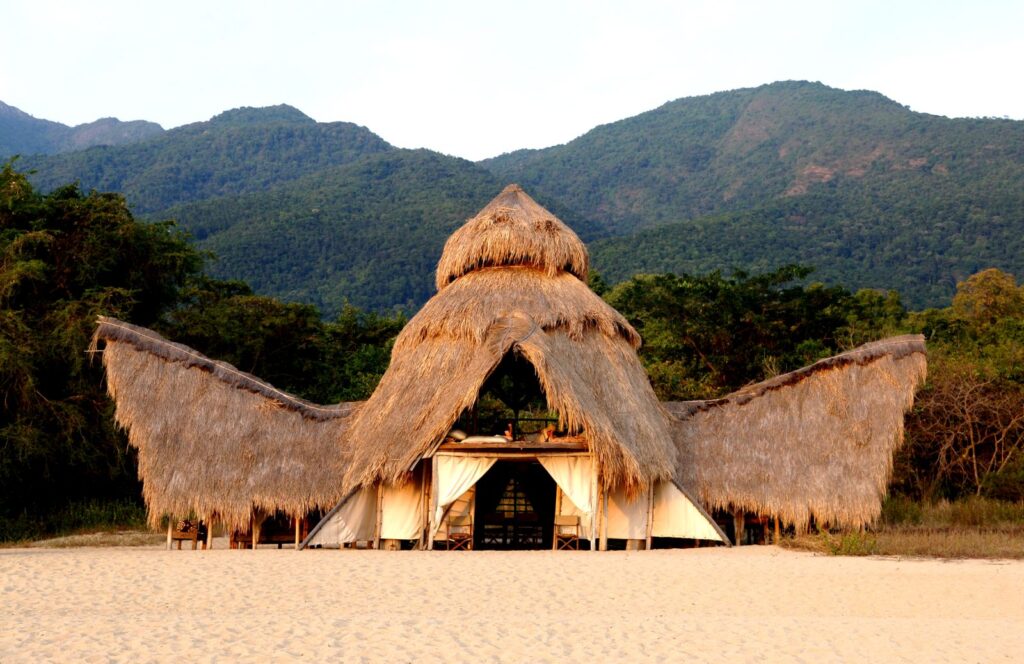
Greystoke operates fully all-inclusive: the nightly rate includes all meals, all chimpanzee trekking permits, all snorkeling, kayaking, fishing, and dhow cruises. The atmosphere feels entirely private regardless of other guests. The guiding team are among the finest naturalist guides in western Tanzania. Demand consistently exceeds supply, particularly from June to October; we recommend booking at least 9-12 months in advance for peak season dates. Contact our team to check availability immediately.
Best Time to Visit Mahale Mountains National Park
Understanding Mahale’s seasons is essential for planning a successful chimpanzee trek. For a full month-by-month seasonal overview of all of Tanzania’s parks, see our best time to visit Tanzania guide.

May – October: Dry Season (Best for Chimpanzee Trekking)
Mahale’s premier visiting window. The dry season brings clear lake conditions and firmer forest trails, and crucially, chimpanzees tend to range at lower elevations, significantly reducing trek distances and difficulty. Lake conditions are also at their calmest and clearest for snorkeling. July and August are globally the most popular months, coinciding with both the best conditions at Mahale and the peak of the Great Wildebeest Migration in the Serengeti, making a combined eastern-and-western Tanzania itinerary very natural.
November – December: Green Season (Manageable)
Short afternoon showers characterize November and December, but they typically clear quickly. Forest trails are more slippery but generally passable. The forest is vibrantly green and photogenic. Fewer visitors than peak season means even greater seclusion. A reasonable option for flexible travelers comfortable with some seasonal variability.
January – February: Short Dry Interlude
A brief dry period between the long and short rains. Trek conditions are variable but often excellent. Birdwatching is particularly excellent, as seasonal species from the Congo Basin are present. We recommend this window for dedicated birders and experienced travelers comfortable with some uncertainty around trek conditions.
March – April: Wet Season (Avoid)
Heavy, sustained rainfall makes forest trails treacherous on steep terrain. Chimps move higher into the forest, making treks significantly longer and more physically demanding. Lake access becomes weather-dependent. Greystoke Mahale typically closes during this period. We strongly advise against planning a Mahale visit in March or April.
How to Get to Mahale Mountains National Park
Getting to the Mahale Mountains is genuinely remote, a combination of long-haul flying, charter aircraft, and a lake boat transfer. This journey is part of what makes the arrival so extraordinary. Active African Vacations manages the entire logistics chain seamlessly as part of every Mahale expedition package.
Option 1: Charter Flight from Arusha or Dar es Salaam (Recommended)
The most seamless international approach. Charters operate from Arusha Airport (ARK) or Julius Nyerere International Airport (DAR) to a small airstrip at Mahale or Ikola on the lakeshore, followed by a 30- to 60-minute boat transfer to Greystoke’s beach. Total travel time from Arusha: 3-4 hours. From Dar es Salaam: 3-4 hours. Charter flights also connect Mahale directly from Katavi National Park, making a combined Katavi-Mahale itinerary logistically straightforward and one of our most popular western Tanzania pairings.
Option 2: Scheduled Flight to Kigoma + Boat Transfer
Kigoma, the regional capital approximately 120 km north of Mahale, is served by daily scheduled flights from Dar es Salaam (approximately 2 hours). From Kigoma, a park boat transfer to Mahale takes approximately 3-4 hours on the lake. This is a scenic but lengthy approach that we recommend only for travelers with specific budget considerations; the charter option is dramatically more time-efficient.
Frequently Asked Questions: Mahale Mountains National Park.
What is Mahale Mountains National Park famous for?
Mahale Mountains National Park is most famous for offering the finest wild chimpanzee trekking experience in East Africa. The M-Group community of approximately 60 chimpanzees has been habituated over more than 55 years of scientific research, allowing visitors extraordinary close-range encounters with entirely wild, naturally behaving animals. The park is also celebrated for its spectacular setting dense rainforest plunging to the white-sand shores of cobalt-blue Lake Tanganyika, the world’s second-deepest lake.
How difficult is chimpanzee trekking at Mahale Mountains?
Chimpanzee trekking at Mahale ranges from moderate to strenuous depending on where the M-Group is ranging on a given day. Treks last anywhere from 1 to 6 hours through forest terrain that can include steep, root-covered paths in humid conditions. Good basic fitness is required you should be comfortable hiking for several hours in heat and humidity. Our guides brief every client on physical expectations before the trek, and the experience is entirely proportional to the effort invested.
How many chimpanzees live in Mahale Mountains National Park?
Mahale Mountains National Park is estimated to contain approximately 800-1,000 wild chimpanzees across several communities within its 1,613 km² of forest. Only the M-Group approximately 60 individuals is habituated for visitor trekking. This habituation is the product of more than 55 years of continuous scientific research, begun by Professor Toshisada Nishida in 1965. This extraordinarily long research history is precisely what makes M-Group encounters so remarkably relaxed and natural.
How does Mahale compare to Gombe for chimpanzee trekking?
Both Gombe National Park and Mahale Mountains offer world-class wild chimpanzee trekking, but they differ meaningfully. Mahale is significantly larger (1,613 km² vs. Gombe’s 52 km²), more remote, and the M-Group is generally considered more relaxed around visitors than Gombe’s Kasekela community. Mahale also offers the extraordinary Lake Tanganyika beach experience. Gombe is more accessible (by boat from Kigoma) and carries the powerful Jane Goodall historical legacy. Many of our clients visit; we design combined itineraries specifically for this purpose.
How many visitors are allowed per chimpanzee trekking group?
TANAPA regulations strictly limit trekking groups to a maximum of six visitors per group per day at Mahale Mountains National Park. Once with the chimpanzees, visitors spend a maximum of one hour in their presence, in line with international great ape trekking protocols designed to minimize stress and disease transmission risk. These strict limits are a primary reason why the M-Group remains so naturally behaved and why advance booking is essential.
What is the best time to visit Mahale Mountains?
The best time to visit is during the dry season, May to October, when forest trails are firmest, chimpanzees range at lower elevations (reducing trek length and difficulty), and Lake Tanganyika is at its calmest and clearest. July through September are peak months globally. The wet season (December to April) is generally not recommended for most visitors due to difficult trail conditions and elevated chimp positions in the forest. See our best time to visit Tanzania guide for detailed seasonal planning across all Tanzania’s parks.
How do I get to Mahale Mountains National Park?
The most efficient route is by charter flight from Arusha, Dar es Salaam, or Katavi National Park to the Mahale or Ikola airstrip, followed by a 30-60 minute boat transfer to the lodge. Scheduled flights connect Dar es Salaam to Kigoma (~120 km from the park by boat, 3-4 hours on the lake), a longer but viable alternative. Active African Vacations arranges all charter flights and transfers as part of every all-inclusive Mahale package.
Where do you stay in Mahale Mountains National Park?
Greystoke Mahale, operated by Nomad Tanzania, is the park’s only permanent accommodation. Six luxury forest-edge bandas accommodate a maximum of 12 guests, with all meals, chimpanzee trekking permits, and all lake and forest activities included in the all-inclusive rate. The camp typically operates May through February and closes during the peak wet season. Given extreme demand, we strongly recommend booking 9-12 months in advance for peak season dates.
Is Mahale Mountains National Park suitable for children?
Mahale is generally recommended for children aged 12 and above. TANAPA regulations specify a minimum age of 12 for chimpanzee trekking. Older teenagers with genuine nature interest who can manage a demanding forest hike have extraordinary experiences. For families with younger children, we enthusiastically recommend the Serengeti, Ngorongoro Conservation Area, and Zanzibar Island as family-appropriate Tanzania destinations.
Is malaria a risk at Mahale Mountains?
Yes, Mahale Mountains National Park is a malaria zone year-round. Anti-malarial prophylaxis is strongly recommended and should be discussed with a travel medicine specialist at least 6-8 weeks before departure. DEET-based repellent, long sleeves at dawn and dusk, and sleeping under nets (provided by the lodge) are standard precautions. Risk is higher during and immediately after the wet season when mosquito activity peaks.
Can I visit Mahale without staying at Greystoke Mahale Lodge?
In practical terms, no. There is no other accommodation within the park, and the logistics of reaching Mahale without overnight lodging are prohibitive. Day visits from Kigoma involve a 3-4 hour boat each way and are not a viable option for meaningful chimp encounters. The Greystoke all-inclusive rate covers all activities including chimpanzee permits, which simplifies budgeting considerably. Guests typically stay 3-5 nights for multiple trekking opportunities.
What should I pack for a Mahale Mountains safari?
Pack lightweight neutral-coloured clothing (no bright colours for chimp trekking), long sleeves and trousers for forest trekking and evening insect protection, quality waterproof hiking boots (mandatory), a light rain jacket, DEET-based repellent, sunscreen for lake activities, a quality camera with fast lens and telephoto zoom, and binoculars. Note that charter aircraft typically restrict luggage to 15 kg in soft bags only hard-sided suitcases cannot be accommodated. A full packing list is provided to all clients on booking with Active African Vacations.
How many days should I spend at Mahale Mountains?
We recommend a minimum of 3 nights, which allows two chimpanzee treks and full enjoyment of the lake activities. Four to five nights is our preferred recommendation, allowing additional trekking, a full day on the lake, and the unhurried pace that makes Mahale truly restorative. Given the considerable journey involved in reaching the park, fewer than 3 nights represents poor value for the time invested.
Can I combine Mahale with a northern circuit safari?
Yes, and this creates one of Tanzania’s most comprehensive itineraries. Charters connect Mahale to Katavi, and from Katavi westbound aircraft reach Arusha for the northern circuit. A typical combined schedule: 3-4 nights Mahale, 2-3 nights Katavi, then 5-7 days across the Serengeti and Ngorongoro Crater. Our team builds and refines this routing regularly.
How far in advance should I book Mahale Mountains?
We strongly recommend booking 9-12 months in advance for July-October peak season dates, and a minimum of 6 months ahead for shoulder season. July and August coinciding with Northern Hemisphere school holidays frequently sell out more than 12 months ahead. Contact our team as early as possible to check current availability and secure your preferred dates.
Why Book Your Mahale Mountains Safari with Luxury Safaris Tanzania?
Active African Vacations has been designing bespoke Tanzania safari itineraries from our Arusha base for over 12 years, with more than 10,000 satisfied travellers and full ATOL financial protection. Mahale is one of our most carefully curated destinations a place we introduce only to clients for whom the depth and quality of the experience matters more than the convenience of getting there.
- Fully tailor-made: Your Mahale itinerary is designed from scratch around your interests, fitness, schedule, and travel vision never an off-the-shelf package.
- Expert logistics: Charter flights, boat transfers, lodge bookings, chimp trek permits, and park fees coordinated invisibly by our Arusha operations team.
- ATOL protected: Your investment is fully financially protected. Travel with complete peace of mind.
- Transparent all-inclusive pricing: Every cost from park fees to charter flights is quoted clearly and completely upfront.
- Ethical operator: We adhere to TANAPA chimpanzee trekking regulations rigorously. Our model actively supports park conservation funding.
- World-class combinations: We weave Mahale seamlessly into western Tanzania circuits, northern safari combinations, and Zanzibar beach finales.
Mahale Mountains National Park is the Tanzania that most visitors never reach and for those who do, it becomes the standard against which all subsequent wildlife experiences are measured. Explore our full Tanzania safari packages, browse our western Tanzania safari destinations, or contact our expert team to begin planning the greatest wildlife experience of your life.