
Best Time to Visit Ngorongoro Crater.
Few landscapes reward good timing quite like Ngorongoro Crater does. Descend the crater wall at first light, and the floor below can be wrapped in cool mist one week and be bone-dry and gold the next, and that difference shapes everything about what you’ll see, how comfortable you’ll be, and how many other vehicles you’ll share the rim road with. After years spent building tailor-made Tanzania safaris around this exact question, we’ve learned that “best time” has less to do with a single date on a calendar and everything to do with what you’re chasing dense predator action, newborn wildlife, birdlife, or simply a crater floor with fewer vehicles on it.
The best time to visit Ngorongoro Crater is during the long dry season, from June to October, when clear skies, short grass, and animals clustered around the crater floor’s permanent water sources make wildlife easy to find and photograph. Unlike Tanzania’s lowland parks, however, Ngorongoro sits at high altitude and holds a resident, non-migratory wildlife population, so it delivers genuinely excellent game viewing essentially year-round. The shoulder months of January and February, and even the greener months of March, April, November, and May, remain rewarding, just with softer light, thinner crowds, and noticeably different weather.
Quick Facts: Ngorongoro Crater at a Glance
| Fact | Detail |
| Best overall months | June – October (dry season, peak wildlife visibility) |
| Best for fewer crowds | March, April, November (green season, lower rates) |
| Best for calving nearby | Late January – February (Ndutu Plains, short transfer from the crater) |
| Coldest months (crater rim) | June – September: dawn rim temperatures can approach single digits °C |
| Crater floor elevation | Approx. 1,700–1,800 m; rim elevation approx. 2,286 m (7,500 ft) |
| Crater dimensions | 610 m deep; floor covers roughly 260 km² |
| Resident wildlife on the floor | An estimated 25,000+ large mammals, including the Big Five |
| Daily crater floor exit deadline | 4:30 PM, enforced by Ngorongoro Conservation Area rangers |
| UNESCO status | World Heritage Site, inscribed 1979 (natural) and 2010 (cultural) |
When Is the Best Time to Visit Ngorongoro Crater?
Most first-time travelers assume Ngorongoro follows the same calendar as the Serengeti’s Great Wildebeest Migration, but it doesn’t, and that’s actually good news for your planning. The crater floor holds a self-contained, largely resident ecosystem; lions, elephants, black rhinos, hyenas, buffalo, and enormous herds of zebra and wildebeest live inside or immediately around the caldera all year, so you’re not racing a migration timetable to see the Big Five here the way you sometimes are elsewhere on the Northern Circuit.

That said, the crater’s weather still swings hard between seasons, and weather is what drives visibility, comfort, and the crowd size on the descent road. During the long dry season (June to October), short grass and dwindling waterholes concentrate animals in predictable places, the roads are firm, and skies are clear for photography, which is exactly why this window is also the busiest and most expensive time to visit. During the green season (November to May), rain thickens the grass and can turn the crater’s steep, single-lane descent roads slippery, but the reward is a landscape carpeted in wildflowers, dramatic skies, prolific birdlife, and noticeably lower lodge rates, with far fewer vehicles queuing at the crater gate.
For a broader view of how Ngorongoro’s timing fits into a full Northern Circuit itinerary, our Best Time to Visit Tanzania guide breaks the whole country down month by month. This page goes deeper specifically into the crater because its high-altitude microclimate genuinely behaves differently from the Serengeti plains or Tarangire’s lowland heat just a few hours’ drive away.
Why Ngorongoro’s Climate Behaves Differently From the Rest of Tanzania
Ngorongoro Crater is, geologically, the collapsed cone of what was once a volcano as tall as Kilimanjaro. Its rim sits at roughly 2,286 meters (7,500 feet) above sea level, with the crater floor itself around 1,700–1,800 meters, a full 610 meters below the rim, with the caldera floor spreading across some 260 square kilometers. That altitude matters enormously for planning your trip, because it means Ngorongoro is consistently 8–10°C cooler than the Serengeti’s central plains or the lowland heat of Tarangire National Park, even on the same July afternoon.
What this means practically: rim lodges can feel genuinely cold before dawn, even during what’s technically the “hot,” dry, peak-season stretch of June through September. We routinely advise our guests, including those who’ve packed for a classic hot-weather African safari, to bring a proper fleece or down layer for the pre-dawn descent, because it is common for temperatures at the rim to sit in the single digits Celsius before sunrise, warming quickly once you drop onto the crater floor and the sun clears the eastern wall. This is one of the most overlooked planning details for a Ngorongoro safari and one our guides flag for every itinerary we build.
The altitude also means Ngorongoro rarely gets the punishing midday heat you’ll find in lower-lying parks, which is part of why game drives here can comfortably run later into the morning than they might in, say, Lake Manyara National Park. Wildlife stays active for longer, and photographers get a wider window of usable light.
Ngorongoro Crater Weather and Seasons at a Glance
Ngorongoro doesn’t follow a simple two-season split; East Africa’s rainfall pattern gives the crater four distinct windows, each with its own trade-offs between visibility, comfort, and crowds.
| Season | Months | Rainfall | Crater Floor Temp (Day / Night) | Wildlife Viewing | Crowds & Rates |
| Long dry season | June – October | Minimal | 20–25°C / 5–10°C (rim colder) | Excellent animals concentrate near water | Peak book rim lodges 6–12 months out |
| Short dry / holiday window | Late Dec – Feb | Light, brief showers | 22–27°C / 8–12°C | Very good; calving nearby in Ndutu | Moderate–high around the holidays |
| Long rains | March – May | Heaviest of the year | 20–24°C / 10–13°C | Good, but grass is tall and roads soften | Lowest crowds, best value rates |
| Short rains | November–early December | Moderate, often brief afternoon showers | 21–25°C / 8–12°C | Good, strong birdlife as migrants arrive | Low to moderate, easing rates |
Best Time to Visit Ngorongoro Crater, Month by Month
Here’s how each month actually plays out on the crater floor and rim, drawn from years of running private game drives through every season Ngorongoro has to offer.
January
January opens with clear, warm mornings on the crater floor, as the short rains of November and December typically taper off. Predator sightings are excellent, with lion prides often visible from the rim road itself. A short transfer away, the Ndutu Plains are entering wildebeest calving season, so many of our itineraries pair a Ngorongoro crater floor game drive with a few nights on the Serengeti’s southern plains this month. Crater visitor numbers are moderate, having eased off from the Christmas and New Year peak by mid-month. Nights on the rim remain crisp, so pack a warm layer for the pre-dawn descent.
February
This is peak wildebeest calving season on the plains bordering Ngorongoro, and it’s one of our favorite windows for combining crater game drives with predator action nearby, as newborn calves draw lions, cheetahs, and hyenas into dramatic, fast-moving hunts. Inside the crater itself, February typically holds a dry spell within the broader green season locally referred to as a mini dry season with good visibility and comfortable daytime temperatures. Crowds are noticeably lighter than the June–October peak.
March
March marks the transition into Tanzania’s long rains, and while the crater remains fully open and rewarding, you’ll notice the shift: grass grows taller, afternoon showers become more frequent, and the migration herds begin drifting toward the Serengeti’s western corridor. It’s an excellent month for value-conscious travelers and for photographers who prize dramatic, cloud-heavy skies over harsh midday sun. Crater roads can start to soften, so a private 4×4 with an experienced driver-guide (standard on all our tailor-made itineraries) matters more this month than most.
April
April is the wettest month of the year at Ngorongoro, and it’s honest to say some travelers should plan around it. The steep, single-lane descent roads into the crater can become genuinely slippery, and a number of camps in the wider Northern Circuit reduce operations or close for maintenance. That said, mornings often start clear before afternoon storms roll in, birdlife is at its most spectacular, and the landscape turns an emerald green rarely seen in guidebook photography. We frequently route April travelers toward a shorter crater visit paired with extra nights on Zanzibar’s beaches, where the rains are lighter and the value is exceptional.
May
Rains begin tapering through May, though the landscape stays lush and dramatically green well into the month. The crater’s seasonal lakes and the Gorigor Swamp fill and swell, drawing large concentrations of waterbirds, including flamingos. This remains a quiet, excellent-value month with very light crowds on the descent road, ideal for travelers who prioritize a private, unhurried crater experience over guaranteed sunshine.
June
June is where the dry season firmly takes hold. Rain becomes rare, temperatures cool noticeably (especially at night), and the crater’s grass begins to shorten, making animals easier to spot against the open floor. Meanwhile, the Great Migration is moving through the Serengeti’s western corridor toward the Grumeti River, so June is a superb month to pair a Ngorongoro crater safari with early migration viewing further north. Crowds begin building steadily from mid-month onward.
July
July is full peak season. Skies are reliably clear, dawn temperatures on the rim can dip close to freezing, and the crater floor delivers some of its best game viewing of the year as animals cluster around the remaining water sources. The Great Migration is crossing into the northern Serengeti and toward the Masai Mara border around this time, making July a favorite month for travelers combining both experiences. Rim lodges, which have limited room inventory by design, book out well in advance, so we recommend confirming your dates at least six to twelve months ahead for July travel.
August
August continues the dry-season peak, with dust rising off the crater floor by afternoon and predator sightings among the most reliable of the year. This is also prime season for hot air balloon safaris over the neighboring Serengeti, which many of our guests add to a Ngorongoro itinerary as a single, unforgettable morning. Because the descent road into the crater is single-lane and ranger-managed, we always schedule August game drives to depart before 6:00 AM, both for the best light and to beat the queue of vehicles that builds later in the morning.
September
September remains firmly within peak season, with excellent, dust-dry visibility and the migration herds spread across the far northern Serengeti and the Masai Mara border. Inside the crater, big cat sightings stay strong, and nearby Tarangire National Park begins seeing some of its largest elephant gatherings of the year, making a Ngorongoro–Tarangire pairing especially rewarding this month.
October
October is the last full month of the long dry season, and one of our favorite windows for beating the sharpest edge of the July–August crowds while keeping every advantage of dry-season visibility. The short rains haven’t arrived yet, migration herds are beginning to turn south back toward the Serengeti, and rim lodges, while still busy, are marginally easier to book than at the height of summer.
November
The short rains typically arrive in November, softening the crater’s dust and returning green to the floor within days. Migration herds are moving south toward the Ndutu Plains ahead of the December calving season, and migratory birds are arriving from Europe and Asia in large numbers, making this an outstanding month for birdwatchers. Crowds thin out noticeably compared to the June–October peak, and rates ease accordingly.
December
Short rains usually taper by mid-month, giving way to warm, mostly dry conditions. Despite technically sitting in the “green season,” December, particularly the period from mid-month through New Year, is a genuine high-season squeeze at Northern Circuit lodges, driven by festive holiday travel rather than wildlife patterns. Inside the crater, game viewing remains strong, and just beyond it the migration herds are gathering on the southern Serengeti and Ndutu plains ahead of calving season. Book room accommodation for Christmas and New Year well in advance.
Best Time to See the Big Five and Black Rhino in Ngorongoro Crater
Ngorongoro Crater is one of the very few places in Africa where the Big Five: lion, leopard, elephant, buffalo, and black rhino, can realistically be seen in a single day, and that holds true in almost any month because the crater’s wildlife is largely resident rather than migratory. That said, the dry season (June–October) still offers the highest odds, since shorter grass and concentrated water sources make animals, including the crater’s small but closely monitored black rhino population, far easier to spot against open ground.
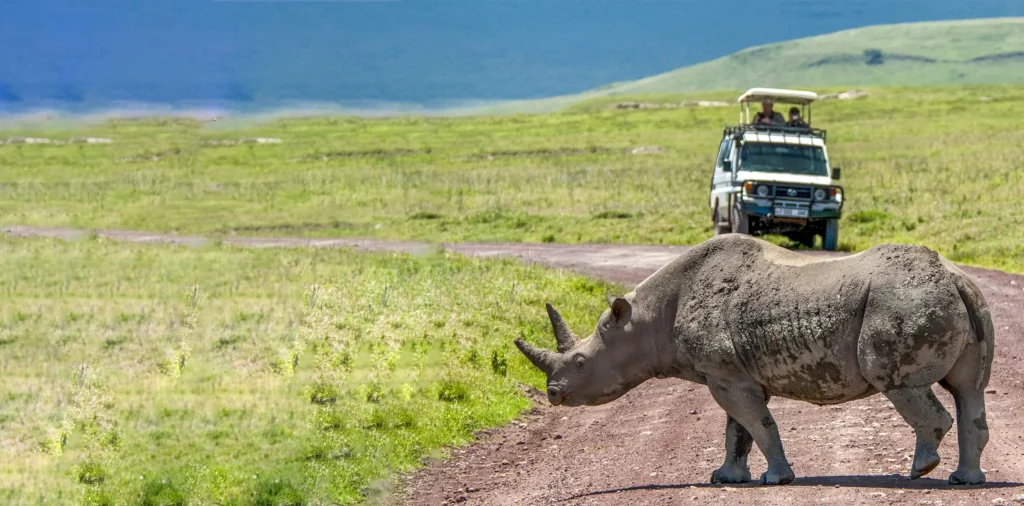
The crater floor supports an estimated 25,000-plus large mammals within roughly 260 square kilometers, one of the densest concentrations of wildlife anywhere on the continent. Lion prides frequent the open grassland near the Lerai Forest and the Gorigor Swamp; leopards favor the forest fringes; elephants (mostly large bulls) move along the crater’s forested slopes; and buffalo herds graze the open floor in large numbers year-round. Black rhino are best spotted with binoculars from a distance in the early morning, often near the base of the crater walls, when light is soft and the animals are most active.
For travelers whose primary goal is a reliable Big Five sighting in a single, efficient day, we recommend the dry season and an early departure, ideally before 6:00 AM, paired with a private vehicle and driver-guide who knows which sections of the crater floor are producing sightings that week.
Best Time to Avoid Crowds at Ngorongoro Crater
Ngorongoro’s crowding isn’t really about total visitor numbers across a season; it’s about a genuine physical bottleneck. Only two main roads descend into the crater (commonly the Seneto and Lemala descent roads), and one ascends (the Lerai ascent road), each a steep, single-lane track. During peak season, vehicles can queue at the descent point in the mid-morning, particularly between 8:00 and 10:00 AM.
The most effective way to avoid crowds isn’t necessarily choosing a quieter month; it’s timing your day well within any month. We schedule our clients’ crater descents before dawn, typically 5:45–6:00 AM, which delivers the best light, the most active predators, and a nearly empty descent road. If your travel dates are fixed to the dry season, this single scheduling decision matters more than almost anything else.
If your dates are flexible, March, April, and November offer the lightest crowds of the year on the crater floor itself, alongside the lowest lodge rates. For travelers who want dry-season conditions with somewhat softer crowds than the July–August peak, June and October are worth prioritizing over the mid-summer months.
Every itinerary we build, from a focused 3-Day Tarangire, Ngorongoro & Lake Manyara safari to a longer 7-Day Ngorongoro, Serengeti & Bwindi gorilla safari, is scheduled around these crowd patterns, not against them, because a private, tailor-made itinerary gives us the flexibility to set your own departure times rather than follow a fixed group schedule.
Choosing Your Ngorongoro Season by Type of Traveler
Best Time for Couples and Honeymooners
For a romantic, unhurried crater experience, we often steer couples toward the shoulder months of June or October dry-season game viewing without the absolute peak of July and August, paired with a rim lodge offering private plunge pools and crater-view suites, such as the &Beyond Ngorongoro Crater Lodge. For honeymooners who’d rather trade a little predictability for dramatic scenery, atmospheric storm-light photography, and genuinely private game drives, the green season months of March and April deliver a strikingly different, far less crowded crater.
Best Time to Visit Ngorongoro Crater with Family
Families traveling with children tend to do best in the July–September window, when reliable dry weather, easier road conditions, and consistently strong wildlife sightings make for a more predictable, less weather-dependent trip. If your family’s travel dates are constrained by the school calendar, the late-December to early-January period also works well, though you should expect a busier crater and higher rim-lodge rates over the holidays. We build family safaris with shorter game-drive sessions and flexible picnic stops. The Ngoitokitok picnic site near the crater’s hippo pool is a family favorite.
Best Time for First-Time Africa Travelers
If this is your first African safari, we generally recommend the dry season (June–October) precisely because it removes variables: roads are firm, flight connections into the Northern Circuit are unaffected by weather, and wildlife sightings are close to guaranteed. First-timers also tend to appreciate pairing Ngorongoro with the Serengeti National Park on a single fly-in itinerary, since the two parks together offer the fullest introduction to East African wildlife in the shortest possible time.
Best Time for Repeat Africa Travelers and Photographers
If you’ve already done a classic dry-season safari and are looking for something different, the green season is where Ngorongoro genuinely surprises. November through May brings storm-lit skies, saturated green landscapes, newborn wildlife, and a crater floor with a fraction of the vehicles you’ll find in July. Serious photographers in particular gravitate toward March and November, when dramatic cloud formations and low visitor numbers combine with still-strong wildlife activity.
How to Time a Single Day at Ngorongoro Crater
However many days you spend on the rim, most itineraries include one full day dedicated to the crater floor itself. Here’s how we structure that day for our clients, regardless of season, to maximize wildlife sightings and minimize time spent in traffic on the descent road.
- Depart the rim lodge by 5:45–6:00 AM. This beats both the sunrise light and the mid-morning queue of vehicles at the descent gate.
- Descend via the Seneto or Lemala road (your driver-guide selects based on which side of the crater is producing the best sightings that week).
- Prime predator window: 6:30–9:30 AM. Lions and hyenas are most active in the cool early hours; this is consistently our clients’ best sighting window.
- Midday break at the Ngoitokitok picnic site, near the crater’s hippo pool, a shaded rest stop with reliable hippo activity for families and photographers alike.
- Afternoon session: roughly 2:00–4:00 PM, when light softens again and animals become active after the midday heat.
- Ascend via the Lerai road by 4:30 PM. This is a hard deadline enforced by Ngorongoro Conservation Area rangers; all vehicles must exit the crater floor by this time.
This single-day structure works whether you’re visiting in peak dry season or the quieter green months; what changes with the season is mainly how much company you’ll have on the road and how much warmer or cooler that 5:45 AM departure feels.
How Many Days Do You Need at Ngorongoro Crater?
Most travelers need just one full day on the crater floor to see the Big Five and experience Ngorongoro’s highlights, paired with one or two nights on the rim. We generally recommend two nights, however, so you can do both a morning and an afternoon session on the crater floor without rushing and build in a buffer day in case there is unexpected weather.
Travelers combining Ngorongoro with the wider Northern Circuit, Serengeti, Tarangire, and Lake Manyara typically allow 7 to 10 days total, such as our 7-Day Ngorongoro, Serengeti & Bwindi Gorilla Safari or the more expansive 10-Day Luxury Kenya & Tanzania Safari, which pairs Ngorongoro with the Serengeti, Amboseli, and the Masai Mara. For travelers with less time, our 3-Day Serengeti Safari featuring Ngorongoro Crater and Olduvai Gorge or the 4-Day Fly-in Serengeti & Ngorongoro Crater Safari delivers the essentials efficiently by air, cutting out long road transfers.
Combining Ngorongoro’s Timing With the Rest of Your Safari
Because Ngorongoro’s wildlife is resident rather than migratory, it pairs well with almost any other part of a Tanzania itinerary in almost any season, which makes it one of the easiest parks to build a trip around. A few combinations we build often:
- Ngorongoro + Serengeti (June–October): Peak dry season for both parks, ideal for travelers chasing the Great Wildebeest Migration’s northern crossings alongside dense crater game viewing.
- Ngorongoro + Ndutu/Southern Serengeti (Jan–Feb): Pairs crater game drives with wildebeest calving season, one of the most predator-dense windows on the entire calendar.
- Ngorongoro + Tarangire (Aug–Sept): Combines crater predator sightings with Tarangire’s largest elephant gatherings of the year, as herds concentrate around the Tarangire River.
- Ngorongoro + Zanzibar (Apr): A practical pairing during the heaviest rains, trading a day or two of crater time for extra beach days on Zanzibar, where rainfall is typically lighter.
- Ngorongoro + Kilimanjaro (year-round, best Jun–Oct / Dec–Feb): For travelers combining a Kilimanjaro trek with a safari, dry-season windows suit both experiences simultaneously.
If your heart is set on a particular experience elsewhere in East Africa, like gorilla trekking in Rwanda, for instance, Ngorongoro’s flexible, year-round wildlife means it’s rarely the deciding factor in when you travel; it will deliver strong sightings whenever your other priorities point you toward Tanzania.
Ngorongoro Crater Entrance Fees and Permit Costs by Season
Unlike lodge rates, which swing significantly between high and low season, Ngorongoro Conservation Area entrance and crater descent fees are set by the Ngorongoro Conservation Area Authority (NCAA) and do not change with the seasons. As of recent NCAA tariffs, non-resident adult conservation fees run in the region of $81 per 24-hour entry, with an additional per-vehicle crater service (descent) fee of approximately $295 and reduced rates for children aged 5–16.
What does change seasonally is accommodation pricing. Rim lodges, several of which hold only a handful of rooms, typically charge their highest nightly rates from July through September and around the Christmas and New Year holidays, with meaningfully lower rates available from March through May and in November. Because our itineraries are entirely tailor-made rather than fixed-departure group tours, we can often secure preferential rim-lodge availability even in peak months by booking well ahead on your behalf.
Where to Stay at Ngorongoro Crater by Season.
Accommodation at Ngorongoro falls into two main categories: rim lodges, perched on the crater’s forested edge with panoramic views straight down onto the floor, and conservation area campsites, used mainly by budget and mobile camping safaris. For the luxury, tailor-made experience our clients expect, rim lodges are the standard choice, and seasonal booking lead time matters enormously here because room inventory is genuinely limited by the terrain itself.
Properties like the &Beyond Ngorongoro Crater Lodge regularly sell out six to twelve months in advance for the July–September peak and the Christmas–New Year period. If your travel dates fall within those windows, we strongly recommend confirming your booking as early as possible. Travelers visiting during the green season (March–May, November) generally have far more flexibility and can often book rim-view rooms just weeks ahead, alongside meaningfully lower nightly rates.
Insider Tips From Our Ngorongoro Safari Guides
In over 15 years of building private safaris across the Northern Circuit, our guides have picked up a handful of details that make a real difference to a Ngorongoro crater day, whatever month you travel:
- Pack a proper warm layer even for a July or August “hot season” trip; the rim genuinely gets cold before dawn, and the temperature swing to the crater floor by mid-morning can be 15°C or more.
- Book a private vehicle, not a shared one. Only a private, tailor-made itinerary lets your driver-guide choose the 5:45 AM departure and adjust the day around real-time sighting reports from other guides on the floor.
- Bring binoculars for black rhino sightings; they’re most often seen at a real distance near the base of the crater walls, and a good pair of 8×42 binoculars makes the difference between a distant silhouette and a genuine sighting.
- Ask for a rim-facing room specifically, not just a “lodge with crater views” room location within a property can vary considerably, and our team confirms exact room assignments as part of every booking.
- If you’re visiting in the dry season and crowds concern you, ask us about scheduling your crater day for a Tuesday through Thursday. Weekends and Mondays tend to see the heaviest local and regional traffic on the descent road.