Rubondo Island National Park | Tanzania's Hidden Gem Safari

Discover Rubondo Island National Park, Tanzania's secret island sanctuary. Chimpanzees, Nile perch fishing, forest walks & total seclusion. Plan your escape today.

Rubondo Island National Park: Tanzania's Untouched Island Safari Paradise

There is a place in Tanzania where the crowds thin to nothing, where the only sounds at dawn are chimpanzee calls echoing across ancient forest and the slap of a Nile perch breaching glassy water. That place is Rubondo Island National Park, a 457-square-kilometer island sanctuary rising from the southwestern shores of Lake Victoria, the largest lake in Africa. It is, quite simply, one of the best-kept secrets on the continent.

At Luxury Safaris Tanzania, we have been introducing discerning travelers to Rubondo for over 12 years. It is the park we recommend when clients tell us they want to see Tanzania beyond the famous names beyond the Serengeti’s sweeping plains and the Ngorongoro Crater, into the quiet, the wild, and the genuinely undiscovered. If that speaks to you, read on.

Rubondo Island is not for everyone, and that is precisely its appeal. It rewards the curious, the patient, and the traveler who understands that true luxury is not the size of a swimming pool but the depth of an experience. Combined with a classic Tanzania safari or a post-trek recovery in Zanzibar, a visit to Rubondo creates an itinerary unlike anything else in Africa.

Rubondo Island National Park at a Glance

Location Lake Victoria, Kagera Region, north-western Tanzania
Park Size 457 km² (240 km² land; 217 km² water)
Established 1977 (National Park); RAMSAR Wetland of International Importance
Nearest City Mwanza (~140 km) | Bukoba (~100 km by boat)
Access Charter flight from Mwanza or Arusha; boat transfer from Nshara Port
Accommodation Rubondo Island Camp (Asilia Africa), the island’s only permanent luxury lodge,
Key Wildlife Chimpanzees, forest elephants, sitatungas, hippos, crocodiles, 300+ bird species
Key Activity Chimpanzee trekking, Nile perch fly-fishing, forest walks, birdwatching, boat safaris
Best Months June–October (dry season); December–February (good alternative)
Park Currency USD (fees payable to TANAPA)

About Rubondo Island National Park, Tanzania

Rubondo Island sits in the south-western corner of Lake Victoria, Tanzania’s largest lake and the world’s second-largest freshwater lake by surface area. The island, along with several smaller satellite islets, was gazetted as a national park in 1977 and is today also recognized as a RAMSAR Wetland of International Importance, underscoring its ecological significance. The park is about 457 square kilometers in size, with about 240 square kilometers of land and 217 square kilometers of water around it.

What makes Rubondo extraordinary in the context of Tanzania’s national parks is its sheer isolation and the mosaic of habitats it preserves. Dense equatorial rainforest, open woodland, papyrus swamps, and lakeshore beaches coexist within a compact island, each sustaining different communities of wildlife. There are no roads in the conventional sense, just forest trails, sandy beaches, and waterways. Game viewing here is on foot, by boat, or from a kayak. It is as far removed from the jeep-filled plains of the northern circuit as Africa gets.

One of the most remarkable chapters in Rubondo’s history is its role as a rehabilitation sanctuary. Between the 1960s and 1980s, the Frankfurt Zoological Society introduced several species to the island that had become locally extinct or had never previously occurred there: chimpanzees from various parts of West Africa, as well as African grey parrots, black-and-white colobus monkeys, giraffes, roan antelope, and others. The chimpanzees in particular have thrived, establishing a wild population of approximately 40 individuals across the island’s forest, making Rubondo one of the few places in Tanzania where you can track wild chimpanzees in a rainforest setting.

Why Visit Rubondo Island? Five Things That Make It Unmissable

Wild Chimpanzee Trekking in Rainforest

Rubondo’s chimpanzee population descended from animals introduced to the island decades ago has returned to fully wild behavior, and habituating them for visitor encounters has been a careful, years-long process. Tracking chimpanzees through Rubondo’s dense, dripping rainforest alongside an expert guide is a profoundly different experience from the highland chimp treks of Mahale or Gombe. The forest is quieter, the groups smaller, the proximity more intimate. For travelers combining Rubondo with a visit to Mahale Mountains National Park or Gombe National Park on Lake Tanganyika, the experience creates a genuinely world-class primate itinerary.

World-Class Nile Perch Fly-Fishing

Lake Victoria’s waters surrounding Rubondo Island hold some of the most exciting Nile perch fishing on the planet. These prehistoric-looking leviathans regularly exceed 50 kilograms; the IGFA all-tackle world record was set on Lake Victoria, and on fly tackle, they are one of Africa’s most thrilling freshwater targets. Rubondo Island Camp offers guided fly-fishing excursions with dedicated boats and specialist equipment. It attracts serious anglers from across the world, particularly between June and October when water clarity peaks. If you are a fly-fisher who also loves wildlife, there is no better address in Africa.

Outstanding Birdwatching: 300+ Species

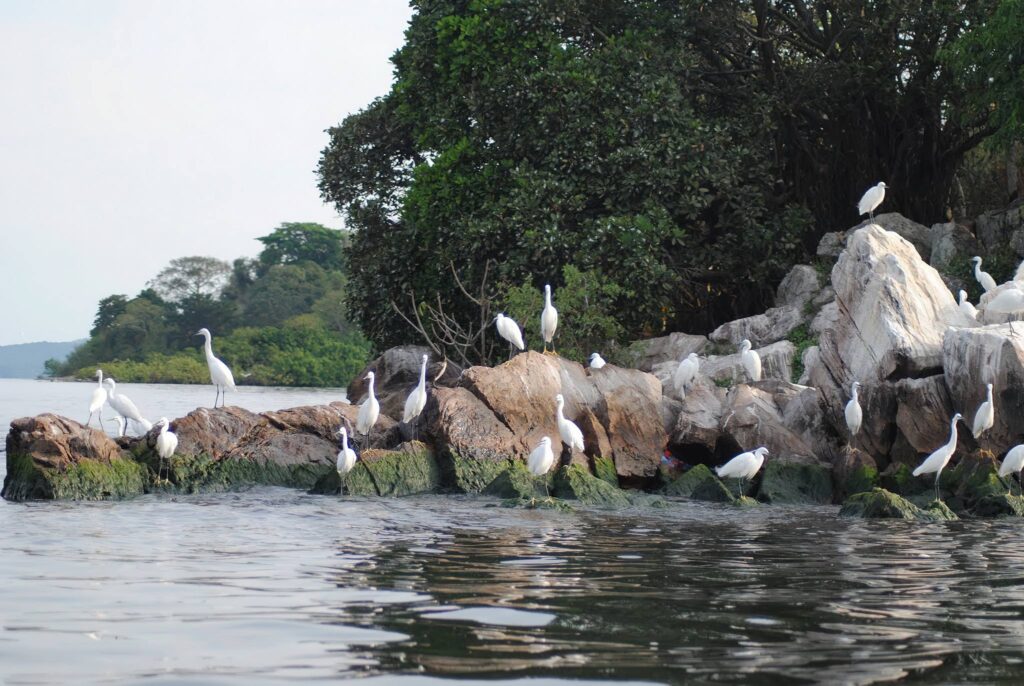
Rubondo is a birder’s paradise. The island sits at the intersection of the Albertine Rift and the Lake Victoria basin, two of Africa’s most important biogeographical zones, and the resulting species diversity is extraordinary. Over 300 bird species have been recorded within the park, including the rare and localized African finfoot, the papyrus gonolek, the white-winged warbler, and the shoebill stork, a prehistoric-looking bird that draws ornithologists from across the globe. The forest interior harbors superb sunbirds, numerous bee-eaters, and African fish eagles calling from every shoreline tree.

Sitatunga and Forest Elephants

Rubondo is one of the best places in East Africa to observe the sitatunga, a semi-aquatic antelope that wades chest-deep through papyrus swamps on its widely splayed hooves. Dawn and dusk boat trips along the papyrus fringes regularly produce close-range sightings. The island also supports a population of forest elephants, smaller and more elusive than their savannah counterparts, which emerge at dusk to feed along the forest margins. Hippos are abundant and easily observed from boats, while Nile crocodiles patrol every beach and marshy inlet.

Total Seclusion and Zero Crowds

Rubondo receives fewer visitors in an entire year than the Serengeti receives in a single weekend. There are no other lodges, no other tented camps, no tour buses, and no photo-jeep convoys. The island’s only permanent luxury accommodation, Rubondo Island Camp, takes a maximum of a handful of guests at any given time. This is one of the last places in Tanzania where the wilderness feels entirely yours. Rubondo is the perfect destination for honeymooners, photographers seeking undisturbed shots, and seasoned African travelers who have already visited the famous parks and are looking for something rarer.

Rubondo Island is Tanzania’s Best-Kept Secret. Let us show you why.

Plan Your Exclusive Rubondo Visit → 

Combining Rubondo Island with Other Tanzania Safari Destinations

Rubondo Island rarely features in isolation and rightfully so. The most rewarding Tanzania itineraries use Rubondo as the extraordinary wildcard that elevates an already outstanding trip into something genuinely unforgettable. Here is how our guests most often combine it, drawing on our 12+ years of experience crafting tailor-made Tanzania safaris:

Rubondo + Serengeti + Ngorongoro

Fly from Mwanza to the Serengeti National Park for a 4–5 day private game drive safari, then descend into the Ngorongoro Crater before flying home from Kilimanjaro International Airport. A classic northern circuit trip elevated by an extraordinary opening chapter on Rubondo.

Rubondo + Mahale + Gombe

Create one of Africa's finest primate-focused itineraries by combining Rubondo's island chimps with wild chimpanzee trekking at Mahale Mountains National Park on Lake Tanganyika and Gombe National Park, Jane Goodall's legendary research base. Three forests, three chimp communities, one extraordinary journey.

Rubondo + Great Migration

Time your Rubondo visit during July–October to align with the Great Wildebeest Migration in the Serengeti, then combine two of Tanzania's most extraordinary natural spectacles in a single trip.

Fly-Fisher’s Tanzania

Combine Rubondo's Nile perch with a broader exploration of Tanzania's fishing destinations, including the remote waters of Katavi National Park and a concluding safari. A uniquely niche itinerary we have refined over years of working with dedicated angler-adventurers.

Browse all of our Tanzania safari packages, explore our combined African safari itineraries, or browse our full safari destinations guide to discover the full canvas of what Tanzania offers.

Wildlife of Rubondo Island National Park

Rubondo’s wildlife is unusual in the Tanzanian context; it is primarily a forest and wetland ecosystem, meaning the wildlife roster looks very different from the savannah giants of the northern circuit. Here is a comprehensive overview of what you can expect to encounter:

Species / Group Notes
Chimpanzee Wild population of ~40; partially habituated for guided treks, the island’s most prized encounter
Forest Elephant Smaller than savannah elephants, seen at forest margins at dusk, and introduced from other parts of Africa
Sitatunga Semi-aquatic antelope; abundant in papyrus swamps; best seen on dawn/dusk boat trips
Hippopotamus Large populations in the lake shallows; easily observed on boat safaris
Nile Crocodile Frequently seen on beaches and in marshy inlets
Bushbuck Common in forest margins and clearings
Black-and-white Colobus Monkey Introduced population; now thriving in the forest canopy
African Clawless Otter Lake-edge sightings on evening boat trips
Nile Monitor Lizard Common on beaches and in shoreline vegetation
Birds (300+ species) African finfoot, shoebill stork, papyrus gonolek, African fish eagle, malachite kingfisher, and many more
Nile Perch (fish) Abundant in surrounding lake waters, the island’s world-famous fly-fishing target
African Grey Parrot Introduced, now wild breeding population rarely seen elsewhere in Tanzania
Roan Antelope Introduced; small population in open woodland areas
Giraffe Introduced; present in small numbers in open woodland

Activities at Rubondo Island National Park


Chimpanzee Trekking

Guided chimpanzee treks depart from Rubondo Island Camp in the early morning, when the chimps are most active and vocal. Treks vary in length depending on where the group is, ranging from 2 to 6 hours through dense rainforest. Numbers are kept small to minimize impact and maximize quality. Our guides have years of experience reading chimp behavior and will position you for the most natural, unhurried viewing experience possible. A maximum of one hour is spent with the chimps once located, per international great ape trekking guidelines.

Fly-Fishing for Nile Perch

Rubondo Island Camp operates dedicated fly-fishing expeditions with specialist boats, tackle, and guides. The target species is the Nile perch (Lates niloticus), which can exceed 100 kg in the surrounding lake. Fishing is conducted from boats on the open lake and in sheltered bays, using large streamers and poppers. The fishing season runs year-round, with June–October being the most productive months. Catch-and-release is encouraged and practiced by responsible guides.

Forest Walking Safaris

Walking through Rubondo’s rainforest with an expert naturalist guide is among the most immersive wildlife experiences in Tanzania. You move slowly, quietly, reading tracks, sounds, and subtle signs of life. The forest floor is a world unto itself: giant millipedes, chameleons, forest duiker, and a canopy alive with primates and birds. Unlike game drives, walking puts you inside the ecosystem rather than observing it from outside.

Boat Safaris and Kayaking

You can best explore the papyrus-fringed shoreline of Rubondo by boat or by kayak at dawn and dusk. Sitatunga wade in the papyrus shallows, hippos bob in the bays, otters hunt along the water’s edge, and the calling of fish-eagles echoes across the still lake. Kingfishers’ eight species have been recorded in the park line, over every overhanging branch. Sunset on the lake, with the forest reflected in the water and a gin-and-tonic in hand, is one of those moments that travel writers exhaust adjectives for.

Birdwatching

Rubondo consistently ranks among Tanzania’s top five birdwatching destinations. The diversity of habitats rainforest, woodland, papyrus swamp, open lake, and rocky shoreline ensures exceptional variety. Birdwatchers reliably see the shoebill stork, one of Africa’s most sought-after species, in the papyrus beds on the north of the island. You can arrange guided birding walks either as standalone activities or combined with chimp treks for a full-day forest immersion.

Swimming and Beach Relaxation

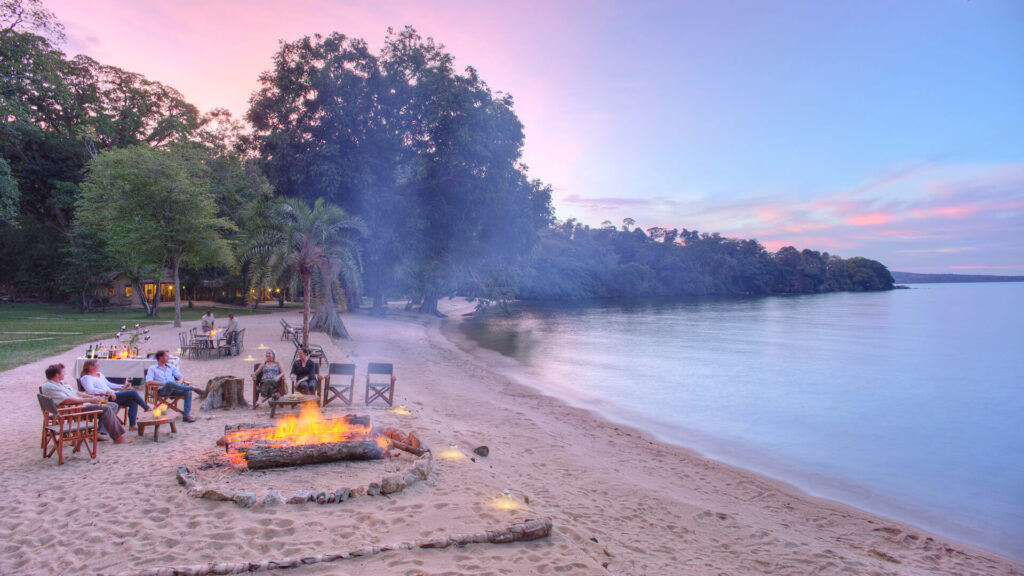
Rubondo’s beaches, with white sand completely undisturbed and framed by forest, are some of the most peaceful spots imaginable. The lake water is warm and bilharzia-free in the areas designated for swimming by the camp team. After the physical demands of chimp trekking or a morning on the lake, an afternoon on the beach with a delightful book and a cold drink is the perfect counterbalance.

Where to Stay on Rubondo Island

Rubondo Island Camp (operated by Asilia Africa) is the island’s only permanent luxury accommodation and one of the most distinctive lodges in East Africa. Eight forest-edge bandas (cottages) are set back from the lakeshore, each with a private veranda, an en-suite bathroom, and an unobstructed view across the lake. The main lodge has a bar, library, and dining room, with most meals served al fresco. The overall aesthetic is understated elegance: no marble lobbies or infinity pools, but beautifully crafted spaces that feel entirely in tune with their wild surroundings.

Rubondo Island National Park

Electricity is solar-powered, the food is freshly prepared, and the guiding team is exceptional. The camp has been awarded repeatedly for its low-impact conservation approach. Because of the very limited number of beds on the island, Rubondo Island Camp books out months in advance during peak season. We strongly recommend planning at least 6 months ahead. Contact our team to check availability and secure your dates.

Best Time to Visit Rubondo Island National Park

You can visit Rubondo Island year-round, but as with all of Tanzania’s parks, the season you choose significantly shapes your experience. For a full overview of Tanzania’s seasonal patterns across all parks and ecosystems, see our best time to visit Tanzania guide.

When is the Best Time to go on a Luxury Safari in Tanzania

June – October: Dry Season (Best for Most Activities)

This is the prime season for Rubondo Island. The dry season brings reduced rainfall, clearer lake water (ideal for fishing), and increased wildlife activity at forest edges and water sources. Chimp tracking is generally more productive as the animals concentrate around fruiting trees and water. This period also aligns with the peak of the Great Wildebeest Migration in the Serengeti, making it the perfect window for a combined Rubondo and northern circuit itinerary.

December – February: Short Dry Season (Excellent for Birding)

The short dry season between the long and short rains is an excellent window for visiting Rubondo, particularly for birdwatchers. Migratory species from Europe and Central Africa are present, and the vegetation is lush and green after the short rains. Lake conditions are generally satisfactory. Fewer visitors than peak season means even greater seclusion.

March – May: Long Rains (Not Recommended)

The long rainy season makes forest trails extremely muddy and wet, the lake can be rough and choppy (making boat activities less pleasant), and many access routes become difficult. Most operators, including our team, advise against scheduling a Rubondo visit during these months unless specific research activities require it.

November: Short Rains (Generally Fine)

Short afternoon showers characterize November but typically clear quickly. Conditions are manageable, the park is hushed, and the forest is at its most verdant and photogenic. A worthwhile option for flexible travelers comfortable with occasional rain.

How to Get to Rubondo Island National Park

Getting to Rubondo Island is part of the adventure. The island is accessible only by air or boat, and its relative remoteness contributes directly to the seclusion that makes it special.

Option 1: Charter Flight to Rubondo (Recommended)

The most seamless way to reach Rubondo is by chartered light aircraft from Mwanza Airport (MWZ), the regional hub on the southern shore of Lake Victoria. The flight takes approximately 30–40 minutes, landing on Rubondo’s small airstrip. Regular scheduled flights from Dar es Salaam, Arusha, and Kilimanjaro International Airport serve Mwanza itself. Our team arranges all charter connections as part of your all-inclusive itinerary, which ensures smooth logistics from your international arrival to the island’s forest edge.

Option 2: Boat Transfer from Nshara Port

For travelers who wish to experience the lake approach, a boat transfer from Nshara Port near Geita is possible. The crossing takes approximately 2–3 hours on the open lake. This is a scenic but weather-dependent option; lake conditions can be rough, particularly during the rainy season. We typically reserve this approach for guests specifically requesting the lake experience.

Getting There from Arusha or Kilimanjaro

Most of our clients arrive at Kilimanjaro International Airport (JRO) or Arusha Airport, then connect via scheduled flight to Mwanza (approximately 1.5 hours) before the short charter to the island. If you are combining Rubondo with a Kilimanjaro trek, Serengeti safari, or the Ngorongoro Conservation Area, we build a logical flight route that minimizes backtracking and maximizes your time in the bush.

Rubondo Island Requires Expert Logistics. We Handle Every Detail.

Speak to a Safari Expert →

Frequently Asked Questions about Rubondo Island National Park


What is Rubondo Island National Park famous for?

Rubondo Island National Park is most renowned for its wild chimpanzee population, world-class Nile perch fly-fishing on Lake Victoria, and its exceptional birdwatching, including the rarely seen shoebill stork and African finfoot. It is also renowned for its total seclusion: fewer visitors reach Rubondo in a year than visit the Serengeti in a single day, making it one of Tanzania’s last truly unspoiled safari destinations.

Can you see chimpanzees at Rubondo Island?

Yes, Rubondo Island hosts a wild chimpanzee population descended from animals introduced to the island by the Frankfurt Zoological Society in the 1960s–1980s. A portion of this population has been habituated for guided trekking, and encounters are arranged through Rubondo Island Camp with expert guides. Treks leave early in the morning and last from 2 to 6 hours, depending on where the chimps range.

How do you get to Rubondo Island National Park?

The most convenient access is by charter aircraft from Mwanza Airport (approximately 30–40 minutes). Scheduled flights from Arusha, Dar es Salaam, and Kilimanjaro International Airport serve Mwanza. An alternative is a 2–3 hour boat transfer from Nshara Port near Geita, scenic but weather-dependent. Active African Vacations arranges all charter flights and transfers as part of our all-inclusive packages.

Where do you stay on Rubondo Island?

Rubondo Island Camp, operated by Asilia Africa, is the island’s only permanent luxury accommodation. It comprises eight forest-edge bandas (cottages) with lake views, en-suite bathrooms, and private verandas. The lodge uses solar power, serves freshly prepared meals al fresco, and has an expert guiding team covering chimp trekking, fishing, birdwatching, and forest walks. We strongly recommend making advance bookings ideally 6+ months ahead for peak season.

What is the best time of year to visit Rubondo Island?

The best time to visit Rubondo Island is during the dry season, June to October, when chimp trekking is most productive, lake fishing conditions are at their peak, and wildlife is most concentrated. The short dry season from December to February is also excellent, particularly for birdwatching. See our best time to visit Tanzania guide for detailed month-by-month advice.

How many visitors does Rubondo Island receive each year?

Rubondo Island is one of the least-visited national parks in Tanzania. Visitor numbers are in the low hundreds annually, a fraction of the traffic received by the Serengeti or Ngorongoro. This extreme low-visitation is a deliberate feature of the park’s management approach and the sole lodge’s limited capacity, and it is the defining characteristic of the Rubondo experience. You will not encounter another tourist on your chimp trek or your fishing boat.

Is Rubondo Island suitable for families with children?

Rubondo Island is better suited to adults and older teenagers (typically 12+) who can genuinely engage with forest trekking, birdwatching, and fishing. The chimp trek in particular requires a full morning of forest walking and a degree of physical fitness and patience. For families with younger children seeking a Tanzania adventure, we offer outstanding alternatives, including family-friendly game drives in the Serengeti, Ngorongoro, and Tarangire, followed by beach time in Zanzibar. Our team will design the perfect family itinerary.

Is there malaria at Rubondo Island?

Yes, like all of Tanzania’s national parks at lower altitudes, Rubondo Island is a malaria zone. Malaria prophylaxis is strongly recommended and should be arranged with a travel medicine specialist at least 6–8 weeks before travel. DEET-based insect repellent, long-sleeved clothing at dawn and dusk, and sleeping under nets (provided by the camp) are all standard precautions. The camp environment and guiding team fully manage this aspect of guest safety.

What fish species can be caught at Rubondo Island?

The primary target on Lake Victoria is the Nile perch (Lates niloticus), one of the world’s largest freshwater fish, capable of exceeding 100 kg. Tiger fish are also present and provide spectacular sport on light tackle. A range of cichlid species inhabit the shallower inshore areas. Responsible guides promote and widely practice catch-and-release. Anglers achieved the IGFA world record for fly-caught Nile perch in the waters surrounding Rubondo Island.

Do I need a special permit for chimp trekking on Rubondo Island?

Chimpanzee trekking permits at Rubondo Island are arranged through Rubondo Island Camp and are typically included in the camp’s all-inclusive rate. TANAPA regulates chimp trekking and limits the number of visitors to each habituated group per day, in line with international leading ape trekking protocols. Active African Vacations manages all permit logistics as part of your tailor-made itinerary.

How does Rubondo Island compare to Mahale Mountains for chimpanzees?

Both Rubondo Island and Mahale Mountains National Park offer world-class chimpanzee trekking in remote forest settings on East African lakes. Mahale has a larger, highly habituated chimp population on the shores of Lake Tanganyika and arguably more reliable encounters. Rubondo offers a more intimate, less visited experience with the added dimensions of fishing, birdwatching, and island wildlife. Serious primate enthusiasts often visit. We design combined itineraries for exactly this purpose.

Is Rubondo Island worth visiting for just birdwatching?

Absolutely, Rubondo is one of Tanzania’s finest birding destinations even if chimpanzees and fishing are not your focus. The park sits at the intersection of two major biogeographical zones, producing an exceptionally diverse species list. The shoebill stork, African finfoot, papyrus gonolek, and white-winged warbler are all high-priority birds that Rubondo reliably delivers. For dedicated birders, 3–4 days on the island can yield 150+ species.

Can I combine Rubondo Island with a Serengeti safari?

Yes, and this is one of our most popular itinerary combinations. Rubondo Island is accessed via Mwanza, which has regular flight connections to the Serengeti’s various airstrips. A typical combined itinerary spends 3–4 nights on Rubondo, followed by 4–5 days on a private Serengeti game drive safari, then optionally a descent into the Ngorongoro Crater. Our team manages every flight, transfer, and lodge booking seamlessly.

What should I pack for Rubondo Island?

For Rubondo Island, pack neutral-colored clothing for game activities (olive, khaki, and brown; no bright colors for chimp trekking), a good pair of waterproof hiking boots for forest trails, long-sleeved shirts for insect protection, a quality rain jacket, binoculars (essential for birding and wildlife on the lake), and DEET-based repellent. For fishing, specialist tackle can be arranged through the camp. A detailed kit list is provided upon booking with Active African Vacations.

How do Rubondo Island’s park fees compare to northern circuit parks?

Rubondo Island’s park fees are generally comparable to Tanzania’s other national parks, administered by TANAPA in USD. The conservation and camping fees follow TANAPA’s standard structure. Because Rubondo is typically visited as part of an all-inclusive lodge package where fees are incorporated into the nightly rate, the fee structure is less of a standalone consideration than on self-catered safaris. Contact our team for a full, transparent cost breakdown for your specific itinerary.

Tanzania’s Hidden Island Safari Awaits. Only a Handful of Guests Per Year Experience It.

Reserve Your Rubondo Expedition →

Why Book Your Rubondo Island Safari with Luxury Safaris Tanzania?

Active African Vacations has been crafting bespoke Tanzania safari itineraries from our base in Arusha for over 12 years. Rubondo Island is one of the parks we know most intimately; we have refined our logistics, our guide connections, and our lodge relationships over hundreds of trips. With more than 10,000 satisfied travelers, full ATOL financial protection, and a team of expert local specialists, we are one of Tanzania’s most trusted boutique operators for exactly this kind of off-the-beaten-path experience.

Rubondo Island National Park | Tanzania's Hidden Gem Safari

  • Fully tailor-made: We design your Rubondo itinerary from scratch around your interests, such as chimp trekking, fly-fishing, birding, or all three.
  • Expert local guides: Our team deeply knows Rubondo Island, from chimp tracking protocols to the best papyrus bays for shoebill sightings.
  • Our Arusha team invisibly handles all logistics, including charter flights, boat transfers, lodge bookings, and park permits.
  • ATOL protected: Your investment is fully safeguarded. Travel with complete financial peace of mind.
  • Transparent all-inclusive pricing: No hidden costs. The company clearly quotes park fees, charter flights, guiding, and accommodation from the start.
  • World-class combinations: We connect Rubondo seamlessly with the Serengeti, Ngorongoro, Mahale, Zanzibar, and beyond.

Whether this trip is your first encounter with Tanzania’s wild places or you are a returning traveler hungry for something beyond the itineraries you have already lived, Rubondo Island will surprise you. Explore our full range of Tanzania safari experiences, discover our Western Tanzania adventures, or reach out directly to our team to begin planning a trip that very few travelers ever take and none ever forget.