Arusha National Park: Tanzania’s Most Underrated Safari Jewel

Explore Arusha National Park in Tanzania with this in-depth destination guide. Discover wildlife, Mount Meru, walking safaris, Momella Lakes, the best time to visit, and travel tips.

Arusha National Park, Tanzania. Complete Travel Guide, Wildlife, Activities & Best Time to Visit

Arusha National Park is one of East Africa’s most misunderstood and underappreciated protected areas. Often treated as a brief stopover before the Serengeti or Ngorongoro, the park is, in reality, a compact masterpiece of ecological diversity, one that compresses rainforest, alpine zones, volcanic craters, lakes, savannah, and some of Africa’s most intimate wildlife encounters into a single, easily accessible landscape.

This is not just a park of vast horizons and endless game drives. Arusha National Park is about detail, proximity, and contrast. It rewards travelers who slow down, look closely, and appreciate ecosystems rather than sheer animal numbers. For visitors seeking a quieter, more nuanced safari experience, especially first-time travelers to East Africa, Arusha National Park often becomes a surprise highlight.

Arusha National Park is not a substitute for the Serengeti, and it does not try to be. It is its own entity: quiet, beautiful, layered, and deeply rewarding. Travelers who approach it with patience often leave surprised by how much it offers in such a compact space.

If Tanzania’s great parks are epic novels, Arusha National Park is a finely crafted short story that is precise, atmospheric, and unforgettable. Arusha National Park is a lesson in scale and perception. It proves that a safari does not need vast distances or dramatic predator hunts to be profound. Instead, it offers diversity, accessibility, and experiences like walking, canoeing, and forest exploration that many larger parks cannot.

For first-time visitors to Tanzania, it provides an ideal introduction. For seasoned safari travelers, it offers something rare: calm, texture, and ecological depth. It is a park that rewards curiosity rather than checklist tourism.

Where Arusha National Park Is Located.

The park lies in northern Tanzania, just 25 kilometers (15 miles) from Arusha, making it one of the most accessible national parks in the country. It sits between the eastern edge of the Great Rift Valley and the lower slopes of Mount Meru, Tanzania’s second-highest mountain.

This proximity means travelers can be inside the park within an hour of landing at Kilimanjaro International Airport, an extraordinary advantage in a region where safari travel often involves long, dusty drives.

Arusha Safaris and Tours

The History of Arusha National Park.

One of the top Tanzanian attractions, Arusha National Park, has a long and illustrious history that begins in 1876 with the visit of the Hungarian Count Teleki to the Momella area. Following his tour, he shared his thoughts on several parts of the park, including the abundance of hippos and black rhinos he had witnessed in his life.

In 1907, the Trappe family settled into the park, mostly to farm in Momella, and they used a large chunk of what is now the park as a cattle ranch. A large chunk of the Momella estate was voluntarily dedicated to a game reserve by Mrs. Trappe, the first East African woman to become a professional hunter. Upon its founding in 1960, the park included the farm. In its 1960 formation, the park was named Ngurdoto Crater National Park and included a small section of the Arusha National Park. The park initially designated the Ngurdoto Crater and Mount Meru as areas for conservation.

In 1967, the area around Mount Meru became a part of Arusha National Park, which renamed it from Ngurdoto Crater National Park. The indigenous Waarusha people were the ones who gave the area its name, Arusha. Tanzania gained its independence and formally constituted the park with the addition of Mount Meru. The park is now a popular stop for visitors to Arusha and a prerequisite for safaris to the nearby Serengeti and Ngorongoro conservation areas, thanks to the investments and development made by the Tanzanian government. To make visitors feel more at ease, the Arusha National Park now has some of the most important tourist facilities, including good entrance gates, picnic areas, camping places, good restrooms, lodges, and so on.

Game viewing was somewhat more challenging than in other parks when the park was mostly covered in shrubs and forest-like habitats; these features made it home to only a small number of browser species, such as giraffes. This led to the creation of a “mini Serengeti” inside the park, which serves as a habitat for other grazer species and makes game viewing easier. Since the open plain grassland in the Tits area is comparable to the habitats in Serengeti National Park, it was dubbed Min Serengeti. Animals such as elephants, giraffes, buffalo, zebras, warthogs, and many more go to the vast grasslands of the Arusha National Park’s miniature Serengeti for a meal. Game watching is excellent here, and the abundance of animals, including waterbucks and others, is a major draw for visitors.

Top Things to do in Arusha National Park.


Guided Game Drives in Open-Roof Private Safari Jeeps

An incredibly well-liked activity at Arusha National Park is wildlife drives. On your wildlife drive, you’ll travel on several routes via vast savannah grasslands, like the Serengeti Ndogo. Along the trip, you may witness dik-diks, zebras, giraffes, bush pigs, red duikers, waterbucks, primates like blue and black colobus monkeys (which are visible close to the Ngurdoto museum), and, if you’re lucky, predators like leopards, hyenas, wild cats, and more.

Arusha National Park Tanzania – Complete Travel Guide, Wildlife, Activities & Best Time to Visit

Along the park’s roads that go to Momella Lakes and Ngurdoto Crater, one may see spectacular views of several animals, including hippos in the water and others that congregate along the beaches to drink water. The game drive takes roughly four hours and is undoubtedly worth it among the many thrilling activities available on a safari in the park.

At 4566 meters above sea level, Mount Meru is the second-highest peak in Tanzania (after Kilimanjaro) and the fifth-highest in Africa, making a hike up it in Arusha National Park an exhilarating and intriguing experience. When the once-much-taller Mount Meru collapsed more than 500,000 years ago, a huge horseshoe-shaped crater wall of sheer rocks remained.

Mount Meru Trekking

Mount Meru

Little volcanic explosions inside the crater have created an ash cone, a subsidiary peak with amazing views. The three- or four-day climb up the mountain has drawn comparisons between its beauty and difficulty with Mount Kilimanjaro from climbers. Traveling over the hilly terrain, hikers can anticipate seeing a wide diversity of plant and animal life. They might come into zebras, buffalo, cheetahs, leopards, birds, primates (including short-furred Sykes’ monkeys and black and white colobus), farmlands, and Maasai herders caring for their cattle on the lower slopes. The ashtray, Mount Kilimanjaro, and the crater of Mount Meru will all be spectacularly visible from the top. You’ll stay the night at the Miriakamba hut on your climb.

Discover More

Guided Nature Walks in Arusha National Park.

Embark on a thrilling adventure as you stroll through the park. One of the greatest places to go on a guided nature walk is Arusha National Park because there are fewer dangerous animals there.


Along the fascinating paths of this nature walk, you will see sights such as the crater of Ngurdoto, the viewpoints of Kitoto and Njeku, the path from Momella gate to Ikikoni, the waterfall of Tululusia, and the Ujambo wa mbogo region. An experienced and armed park ranger will lead you on a nature walk through marsh bushes and streams in Arusha National Park. Along the way, you will see stunning landscapes, come within meters of animals like zebras, giraffes, warthogs, and buffalo, listen to the melodies of specialized birdsong, relax your mind, and feel the cool breeze, among other benefits.

Bird Watching in Arusha National Park

With more than 400 bird species, including those that are endemic or near-endemic to Tanzania, Arusha National Park is a top spot for birdwatchers in the country. The park’s alkaline Momella lakes and forests are ideal for birdwatching, as they provide excellent viewing opportunities for a wide variety of birds, including the Verreaux’s eagle, augur buzzard, greater flamingo, little grebe, spur-winged goose, secretary bird, African fish eagle, bar-tailed trogon, black saw-wing, bearded vulture, Hartlaub’s turaco, red-fronted parrot, tawny eagle, Narina trogon, Egyptian goose, and African olive pigeon, among many more wildlife species. Additionally, when birdwatching, you could catch a glimpse of birds swooping over the Ngurdoto crater.

Canoeing Excursions

One of the Tanzanian protected locations that provides the stunning canoe ride is Arusha National Park. Guests can go canoeing in the park on the placid Momella Lake with the assistance of a knowledgeable guide.

Canoeing in Arusha National Park

You can take wonderful pictures while relaxing on the canoe ride and seeing various wildlife, including hippos in the water, bushbucks, waterbucks, giraffes, buffalo, and zebras along the lakeshore. You can also see water birds, such as flamingos, pelicans, herons, and fish eagles.

Horseback Riding Safari.

Arusha National Park also offers horseback riding along its several paths; this is something visitors can do before they even set foot in the park. While on horseback, tourists may also enjoy seeing various wildlife, including zebras and giraffes.

Arusha National Park Tanzania – Complete Travel Guide, Wildlife, Activities & Best Time to Visit

Top Tourist Attractions in Arusha National Park.

What makes Arusha National Park exceptional is how much it contains within its relatively small size.

Situated in northern Tanzania, Arusha National Park is the nearest national park to the town of Arusha. Among the many sights to behold on safaris to Arusha National Park are the Momella Lakes, Ngurdoto Crater, Mount Meru, and a plethora of birds and terrestrial animals.

Mount Meru and the Afro-Montane Forests

Mount Meru, a dramatic stratovolcano that rises to 4,566 meters (14,980 feet), is the most prominent feature of the park. Its lower slopes are cloaked in dense montane forest, dripping with moss, lichen, and filtered light. This forest zone supports colobus monkeys, blue monkeys, bushbucks, and a rich bird population.
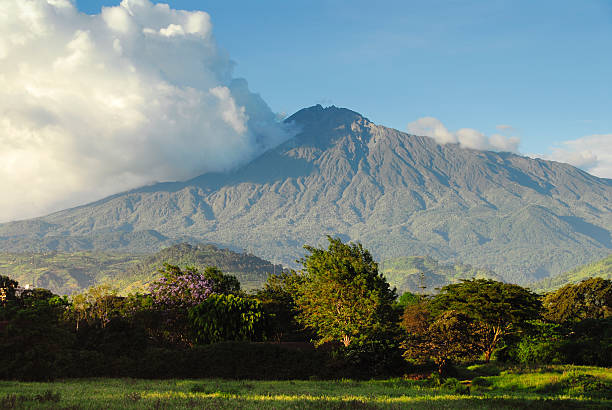
Mount Meru is an active volcano with a height of 4566 m. It is located in Arusha National Park in Tanzania.

Mount Meru is an active volcano with a height of 4566 m. It is located in Arusha National Park in Tanzania.

Higher up, the landscape transitions into heath and alpine zones, with sweeping views toward Mount Kilimanjaro on clear days. Meru itself is a major trekking destination, often used as acclimatization for Kilimanjaro climbers—but it stands fully on its own as a serious and rewarding ascent.

Ngurdoto Crater

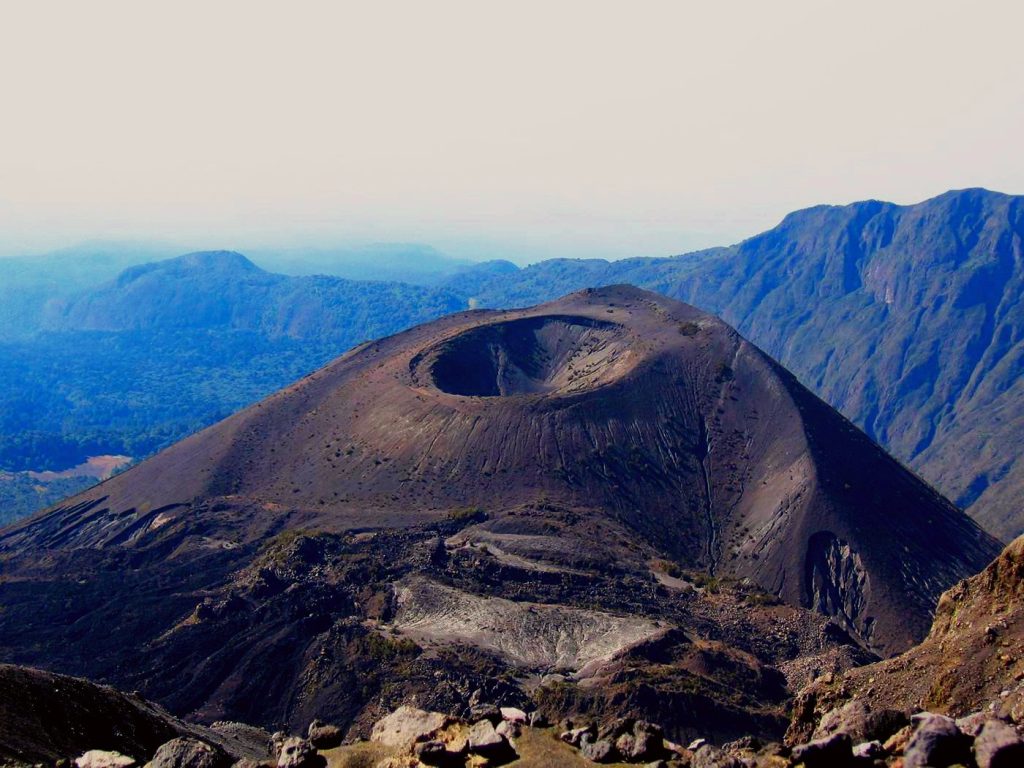
Often described as a “mini Ngorongoro,” the Ngurdoto Crater is a lush volcanic bowl with steep forested walls and a swampy floor. While visitors cannot descend into the crater, viewpoints reveal a pristine ecosystem where buffalo, warthogs, and antelope move through dense vegetation.

Ngurdoto Crater in Arusha National Park

Ngurdoto Crater

Various animals and plants, including buffalo, elephants, warthogs, antelopes, monkeys, baboons, leopards, spotted hyenas, shy red duikers, Kirk dik-diks, and numerous bird species, including herons, spur-winged geese, hornbills, bee-eaters, and turacos, inhabit the floor of the crater, which is shaped like a basin and surrounded by dense rain forests. A Tanzania wildlife safari would be incomplete without visiting Ngurdoto Crater, which is similar to Ngorongoro but has a much softer floor, making driving impossible. Instead, visitors go on walking safaris to explore the crater, which is accessed by a 4×4 safari vehicle that winds its way up to the caldera’s edge, surrounded by thick rainforest. As they make their way through the crater, they have the chance to see various animals and birds

The Momella Lakes

The northeastern section of the park holds the Momella Lakes, a series of shallow alkaline lakes formed by volcanic activity. Each lake has a slightly different mineral composition, giving them shifting colors of emerald, turquoise, and silver depending on light and season. These lakes attract thousands of flamingos at certain times of year, as well as pelicans, herons, and migratory waterbirds. Giraffes and zebras often graze along the shorelines, creating scenes that feel almost surreal in their stillness.
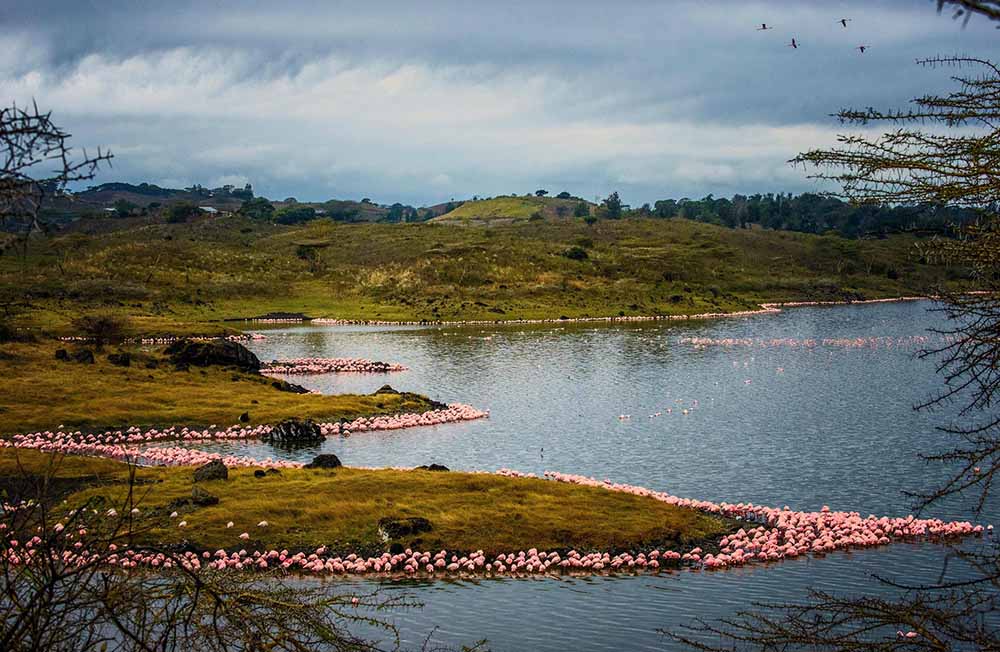
Momella Lakes

Little Momella Lake

The Momela lakes Big Momela, Little Momela, El Kekhotoito, Kusare, Rishateni, Lekandiro, and Tulusia are fantastic locations for birding safaris in Tanzania since they are home to a wide variety of birds, including the migratory greater pink flamingos. The lakes of Momela get their water from underground springs, and the hues of the water vary from verdant to turquoise. Each lake has its own unique mineral makeup, which gives them their distinct colors. The algae that live in these lakes also contribute to their unique appearance.

Birds of several kinds congregate around the lakes of Momela, including shoebills, pink flamingos, Egyptian geese, guinea fowls, African fish eagles, and African jacanas.

Wildlife: Intimate Encounters, Not Crowds

Arusha National Park is not a Big Five destination in the conventional sense; it primarily features other African animals instead of the five most sought-after animals in safari tourism: lions, leopards, elephants, buffalo, and rhinoceroses. Lions are absent, and sightings of leopards are rare. That is not a weakness; it is the park’s defining strength.

This park is a place for close-range wildlife encounters and species often overlooked elsewhere.

You can expect to see:

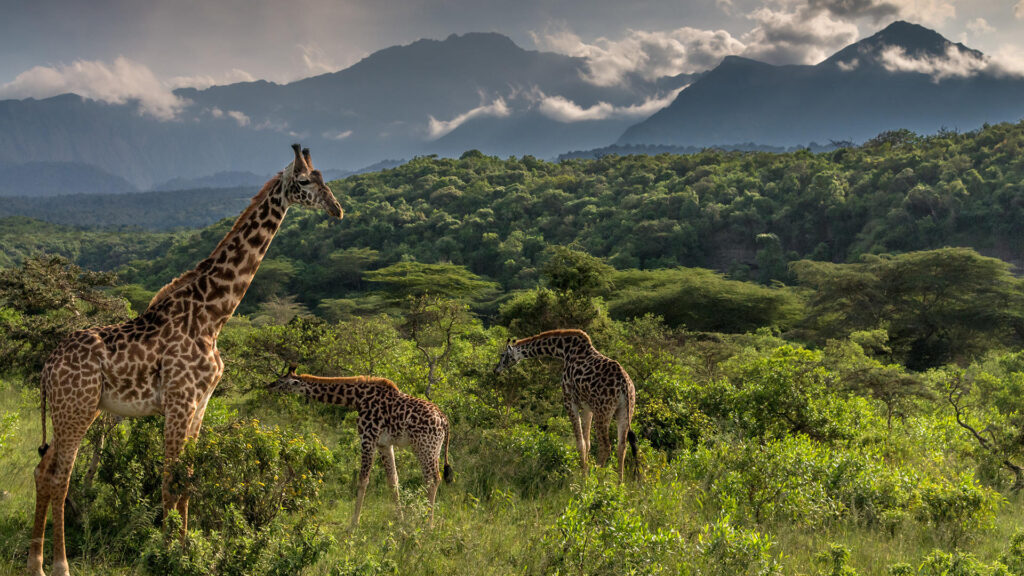
  • Giraffes moving calmly through open woodland

  • Cape buffalo in forest clearings

  • Zebras, warthogs, bushbucks, and waterbucks

  • Olive baboons in large, expressive troops

  • Black-and-white colobus monkeys leaping through the canopy

Because predator pressure is low and tourism density is modest, animals here are generally relaxed. Walking safaris, rare in many East African parks, are a signature experience, allowing visitors to explore on foot with an armed ranger.

The Mini Serengeti

One of the grasslands in Arusha National Park is the small Serengeti, also called “Serengeti Ndogo” (the Swahili name for small Serengeti). It lies adjacent to the road leading to Momella Gate, approximately 500 meters north of Ngongongare Gate. Several different herbivores congregate there to graze. Buffalo, zebras, warthogs, elephants, and waterbucks are herbivores. You can see a beautiful herd of herbivores grazing together if you bike here first thing in the morning. It is rather unusual to encounter these animals around midday.
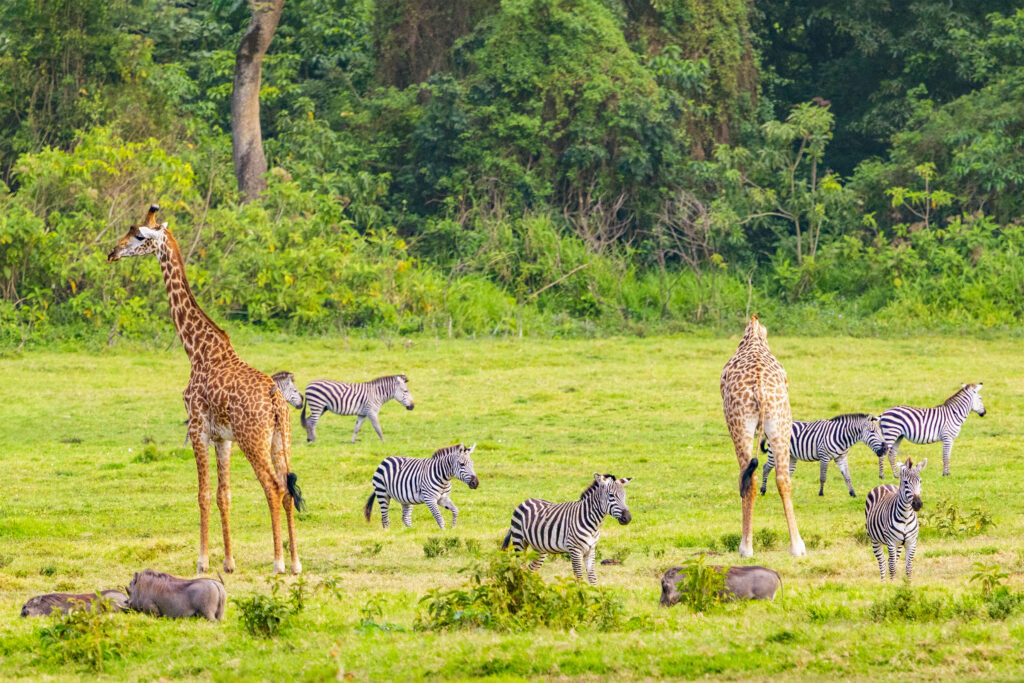
Mini Serengeti in Arusha National Park

Mini Serengeti

Mini Serengeti is a wonderful place for walking safaris, seeing animals up close, and taking pictures with them in the background. It will transport you to the majestic Serengeti

Ujambo Wa Mbogo

Ujambo Wa Mbogo, which translates to “the buffalo’s glade” in English, is a breathtaking tourist attraction in Tanzania’s Arusha National Park. Its location at the foot of Mount Meru and close proximity to the Momela entrance put it in the northeastern section of the park. Ujambo Wa Mbogo, a vast natural glade in Tanzania’s parks, is ideal for walking safaris due to its marsh, trees, and streams. Many animals use this area as a feeding ground, such as buffalo, warthogs, and giraffes.

Here we see buffalo chopping down long grasses, and here we see warthogs kneeling in the pasture fields, two of the most distinctive animals you’re likely to see in this area. It is possible to incorporate Ujambo Wa Mbogo into a Tanzanian hiking safari to the Tululusia waterfalls

The Fig Tree Arch

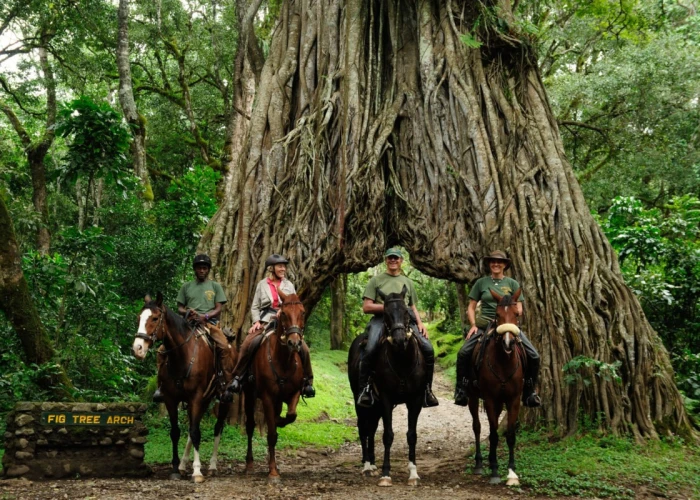
One of the most photogenic spots in Arusha National Park is the Fig Tree Arch, an arch-shaped tree with a gap big enough to squeeze an elephant through. Visitors can get breathtaking shots from various vantage points, including standing under the tree or even positioning themselves beneath it while in a safari vehicle.

The Fig Tree Arch, Arusha National Park.

The Fig Tree Arch.

A hiking safari to the Tululusia waterfalls in Tanzania includes a stop at a fig tree, which grew from a parasite tree that foraging birds dropped

Ngurudoto Museum

The Ngurudoto Museum showcases various creatures found in Arusha National Park and the Ngurudoto Crater in particular. The museum will display skeletons, fossils, taxidermy, and provide background information about these creatures. Many different kinds of plants are on display at the museum, and they have all the information you could need

Tululusia hill

Arusha National Park is home to the scenic Tululusia hill. Tululusia Hill gets its signature green color from the lush vegetation that covers it. The hill is well-known for housing elephants, buffalo, colobus, and even a few tree-dwelling pythons. This hill is home to the Tululusia waterfalls. This massive waterfall, which drops from about 28 meters, is ideal for a refreshing swim.

People often compare the Tululusia waterfalls to pebbles cascading down a hill. From a distance, you will be able to see the Tululusia waterfalls.